



Year-end budget leaks widen to coast guard
Jan 23, 2026, 07:57 am


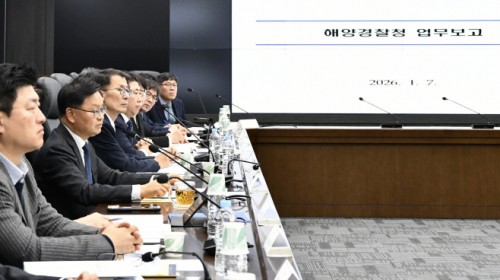 |
| Kim Seong-beom, acting minister of Oceans and Fisheries, chairs a 2026 policy briefing for the Korea Coast Guard at the ministry’s main conference room on Jan. 7. / Yonhap |
As controversy over unpaid defense spending continues, it has emerged that the Korea Coast Guard also rolled over hundreds of billions of won in funds that were not executed by year’s end.
According to materials submitted to the National Assembly, the coast guard carried over a total of 22.7 billion won as of Dec. 31, 2025, instead of executing the funds by the deadline. The unspent amount includes large-scale projects such as maintenance depot operations, shipbuilding and the construction of vessel traffic service (VTS) centers.
Data obtained by Rep. Kim Tae-ho of the ruling People Power Party show that the 22.7 billion won was originally classified as funds that should have been executed by Dec. 31 last year. Given the multi-year project structures and interim payment terms, some of the money should already have been disbursed, raising questions over whether there were problems in the allocation process by the Ministry of Economy and Finance.
A breakdown titled “status of unpaid coast guard funds” lists 22.73431 billion won across major projects, including depot operations, shipbuilding and VTS construction. Of 56 projects, more than 45 were categorized as “contract period not yet reached.” While the coast guard said payments could not be made because projects were unfinished, experts noted that under multi-year and interim payment structures, portions of the funds could have been executed by year’s end. Other reasons cited—such as project delays, documentation issues or unsubmitted claims—accounted for only a small share.
The coast guard insisted the situation does not constitute unpaid bills. “The contracts are still ongoing, so payments were not made; this does not mean we delayed or defaulted on payments owed to contractors,” it said, stressing that the case differs from instances at the Ministry of National Defense, where payments were reportedly withheld even after completion and invoicing.
However, the agency’s explanations appeared inconsistent. A coast guard spokesperson initially told this newspaper that projects proceed on a multi-year basis, with advance and interim payments made and final payments issued upon completion, and that budgets are executed according to progress. A day later, the explanation shifted to emphasize a “typical structure of 80% advance payment and 20% balance,” adding that some contracts are paid in full only after completion—effectively dropping the earlier reference to interim, progress-based payments.
When asked to clarify the nature of the 22.7 billion won—whether it represented interim payments or final balances—the coast guard said it would need to recheck individual projects and did not provide a clear answer in follow-up calls.
A political source said, “Even official materials submitted to the National Assembly offer shifting explanations of execution structures,” adding that “a parliamentary review of the Ministry of Economy and Finance’s overall allocation and execution management is unavoidable.”
#Korea Coast Guard #unpaid budget #year-end budget #Ministry of National Defense #Ministry of Economy and Finance
Copyright by Asiatoday
Most Read
-
1
Trump shares map on social media labeling Strait o..

-
2
Kia Sportage outperforms Mazda CX-5 in German auto..

-
3
Houthis launch successive attacks on Saudi airport..

-
4
U.S. deploys carrier, 10,000 more troops to Middle..

-
5
Trump rejects Iran's offer to open Strait of Hormu..

-
6
N. Korea conducts first swarm attack drill with dr..

-
7
U.S.-China summit falls short on substance as Trum..

PEOPLE






HEADLINE NEWS
- Seoul dismisses Ukraine's claim of 'S. Korean support for Russia' as "inaccurate and inappropriate"
- S. Korea, Japan race to develop nuclear-powered submarines
- Henri Kagan, Kenso Soai win Nobel Prize in Chemistry for uncovering how mol..
- Vance says Alaska LNG cooperation will move forward with Seoul's current or..

-
Address : In-Young Bldg., 34, Uisadang-daero 1-gil, Yeongdeungpo-gu, Seoul
Copyright by ASIATODAY CO., LTD. All rights resereved