



Korea Zinc plans $11bn US smelter investment
Dec 16, 2025, 09:32 am


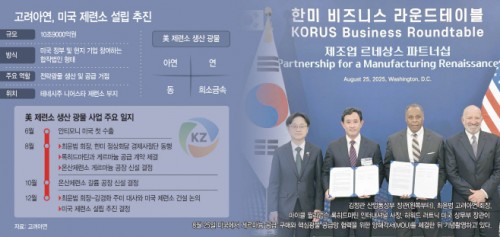 |
Korea Zinc plans to build a smelter in Clarksville, Tennessee, with a total investment of about 11 trillion won ($7.43 billion), marking a major step toward strengthening a Korea–U.S. supply-chain alliance aimed at countering China’s weaponization of critical minerals.
The project will be carried out through a joint venture involving the U.S. government and local investors. To raise funds, Korea Zinc plans to conduct a third-party share issuance targeting U.S. partners, securing approximately 2.85 trillion won. Analysts say the move could give U.S. government stakeholders, expected to hold about a 10.3% stake, the role of friendly shareholders to Chairman Choi Yoon-bum, potentially strengthening his position amid an ongoing management control dispute with Young Poong and MBK Partners.
On December 15, Korea Zinc disclosed that it would bolster future growth engines by constructing an integrated non-ferrous metal smelter in the United States.
The company plans to acquire and redevelop the site of the existing Nyrstar smelter in Tennessee, rebuilding core infrastructure. The project is expected to allow the retention of several hundred skilled workers familiar with zinc-processing operations.
Construction is scheduled to begin after site preparation in 2026, with phased operations and commercial production starting in 2029. The facility will process about 1.1 million tons of raw materials annually and produce roughly 540,000 tons of finished products.
Total projected investment amounts to $7.432 billion. An initial $2.15 billion will be provided by the U.S. Department of Defense and investors, while the U.S. Department of Commerce plans to support the project with $210 million under the CHIPS Act for equipment procurement and related purposes.
U.S. Commerce Secretary Howard Lutnick described the Tennessee project as a “game-changing deal” that will reshape the landscape of critical minerals in the United States.
Through a joint venture, Crucible JV LLC, established with the U.S. government and local defense contractors, Korea Zinc will raise $1.94 billion. The company plans to conduct a third-party share issuance to this joint venture.
The decision reflects the materialization of Chairman Choi’s long-standing strategy to expand mineral cooperation with the United States. Earlier this year, Korea Zinc completed its first export of antimony to the U.S., signaling its entry into the American market. Antimony, produced exclusively by Korea Zinc in South Korea, is a key material for the U.S. defense industry, with more than 70% of U.S. imports dependent on China.
In August, Choi joined an economic delegation to the U.S. during a Korea–U.S. summit, further advancing strategic mineral cooperation. Korea Zinc also signed a germanium supply agreement with Lockheed Martin, emerging as a key player in the global critical minerals supply chain.
On December 11, the U.S. State Department announced the launch of “Pax Silica,” an economic cooperation bloc involving eight countries including South Korea and Japan. Korea Zinc has since emerged as a central company in the discussions, which ultimately led to the U.S. smelter project. Choi recently met with South Korean Ambassador to the U.S. Kang Kyung-wha to discuss the project.
With the investment, Korea Zinc will move beyond mineral exports to secure a local production base in the United States, positioning itself as a core pillar of the Korea–U.S. resource alliance.
“Through the construction of an integrated smelter in the United States, Korea Zinc will solidify its position as a strategic partner supplying critical minerals essential to the aerospace and defense industries,” Choi said. “We aim to make this a model case that further strengthens Korea–U.S. economic security cooperation.”
#Korea Zinc #US smelter investment #critical minerals #Korea–US supply chain alliance #Tennessee project
Copyright by Asiatoday
Most Read
-
1
Kia Sportage outperforms Mazda CX-5 in German auto..

-
2
Houthis launch successive attacks on Saudi airport..

-
3
Saudi Arabia, Iran hold first diplomatic talks to..

-
4
U.S. deploys carrier, 10,000 more troops to Middle..

-
5
Saudi airport in Riyadh struck again, leaving at l..

-
6
Putin's ally visits China on the 8th ahead of APEC..

-
7
Chinese military support and training center opens..

PEOPLE






HEADLINE NEWS

-
Address : In-Young Bldg., 34, Uisadang-daero 1-gil, Yeongdeungpo-gu, Seoul
Copyright by ASIATODAY CO., LTD. All rights resereved