



Parties clash over reform bills, talks stall
Dec 12, 2025, 09:04 am


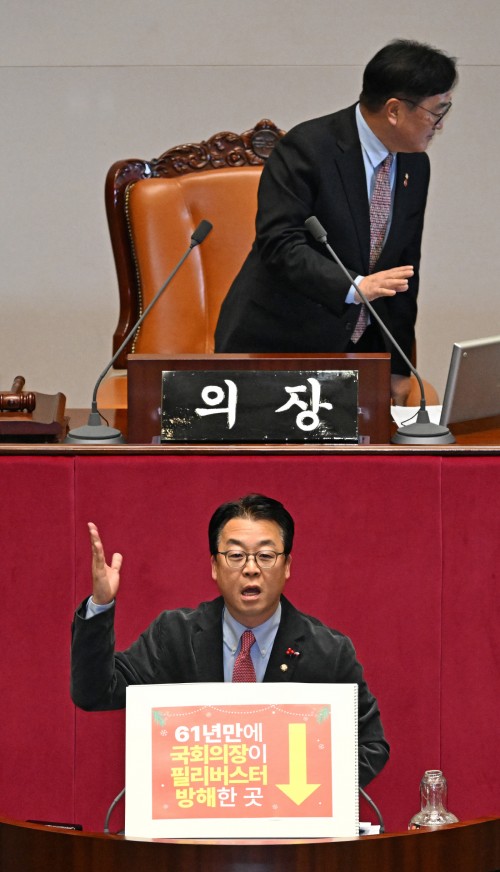 |
| Kwak Kyu-taek, a lawmaker from the People Power Party, delivers an unlimited debate (filibuster) on a proposed amendment to the Criminal Procedure Act during the first plenary session of the December extraordinary session at the National Assembly on December 11. / Source: Song Eui-joo |
Ruling and opposition parties remain deadlocked over contentious reform bills, with filibusters continuing even at the first plenary session of the December extraordinary session of the National Assembly. Although four items were placed on the agenda by bipartisan agreement, their passage is expected to be delayed as they, too, are caught up in unlimited debate.
According to political sources on December 11, the two sides agreed to put four items on the plenary agenda: an extension of the activity period for the special committee on pension reform, amendments to the Criminal Procedure Act, the Banking Act, and the Police Officers’ Execution of Duties Act. Including a revision to the Franchise Transactions Act, a total of five bills were scheduled for deliberation.
The session opened with votes on the Franchise Transactions Act amendment—whose previous filibuster ended on December 9—and the extension of the pension reform committee’s mandate. Both passed with a simple majority. However, the People Power Party launched a filibuster on the next item, the Criminal Procedure Act amendment, effectively halting further legislative progress.
The opposition party’s decision to press ahead with a filibuster from the first day reflects the lack of agreement on key bills. Around 10 measures remain in dispute, including Democratic Party-led judicial reform proposals such as a bill to establish a special tribunal for insurrection cases, the so-called crime of judicial distortion, and proposals to tighten the requirements for launching filibusters.
Floor leaders from both sides held talks for more than two hours on December 10 in an effort to narrow differences, but the meeting ended without a breakthrough. While they reached agreement on extending the pension reform committee’s mandate and forming special committees on political reform and the confirmation hearing for the chair of the Board of Audit and Inspection, they failed to agree on ending the filibuster.
Yoo Sang-bum, senior floor strategy chief of the People Power Party, said after the meeting that his party had no choice but to continue the filibuster as long as issues surrounding what it calls the “five judicial destruction bills” and the “three gag laws” remain unresolved. The party has also begun relay sit-in protests in tents outside the National Assembly to block what it labels the “eight major bad laws.”
People Power Party floor leader Song Eon-seok said the “totalitarian ‘eight major bad laws’ fundamentally threaten the constitutional order,” vowing to fight every bill brought to the plenary floor with filibusters until they are withdrawn.
The Democratic Party, for its part, reiterated its determination to press ahead with judicial reform. Party leader Jung Chung-rae told a lawmakers’ meeting that the reform agenda must continue without interruption and that there are no differences among the party, government and presidential office. “Let’s push a bit harder until these judicial reform bills pass,” he said.
With both sides maintaining hardline positions, political observers warn that a backlog of livelihood-related bills could ultimately be scrapped, given the low prospects for bipartisan compromise on the most contentious measures.
#National Assembly #filibuster #Criminal Procedure Act #judicial reform
Copyright by Asiatoday
Most Read
-
1
Trump shares map on social media labeling Strait o..

-
2
Kia Sportage outperforms Mazda CX-5 in German auto..

-
3
Houthis launch successive attacks on Saudi airport..

-
4
U.S. deploys carrier, 10,000 more troops to Middle..

-
5
Trump rejects Iran's offer to open Strait of Hormu..

-
6
N. Korea conducts first swarm attack drill with dr..

-
7
U.S.-China summit falls short on substance as Trum..

PEOPLE






HEADLINE NEWS
- Seoul dismisses Ukraine's claim of 'S. Korean support for Russia' as "inaccurate and inappropriate"
- S. Korea, Japan race to develop nuclear-powered submarines
- Henri Kagan, Kenso Soai win Nobel Prize in Chemistry for uncovering how mol..
- Vance says Alaska LNG cooperation will move forward with Seoul's current or..

-
Address : In-Young Bldg., 34, Uisadang-daero 1-gil, Yeongdeungpo-gu, Seoul
Copyright by ASIATODAY CO., LTD. All rights resereved