



Ruling party reassesses strategy after Jeon resigns
Dec 12, 2025, 08:46 am


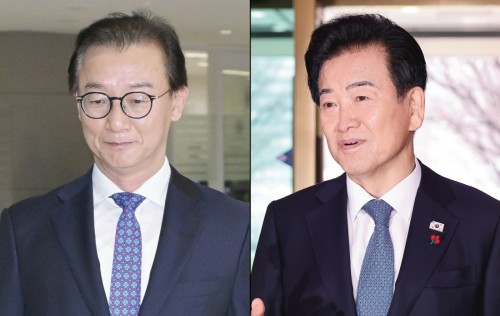 |
| Jeon Jae-soo, minister of oceans and fisheries, returns to South Korea through Terminal 2 of Incheon International Airport on December 11 after completing efforts to host the UN Ocean Conference (left). Unification Minister Chung Dong-young, who faces similar allegations, responds to reporters’ questions as he arrives at the Government Complex Seoul the same day. / Source: Lee Byung-hwa, Park Sung-il |
Allegations that senior figures of the Democratic Party received money from a former senior official of the Unification Church are spreading, prompting political ripples ahead of next year’s local elections. Oceans and Fisheries Minister Jeon Jae-soo, whose name was publicly cited, announced his resignation, while Unification Minister Chung Dong-young flatly denied the claims.
Jeon said on December 11, upon returning via Incheon International Airport, that “there was absolutely no illegal receipt of money,” but added that he would step down to clear the allegations, which he described as based on false claims. “I will resign from my post and fully clarify the truth,” he said.
Chung also released a statement denying all allegations. He said he met the individual in question only once while he was a private citizen, adding that he was neither a lawmaker nor a public official at the time and had no further contact afterward.
The developments have pushed the Democratic Party into a defensive position. Within the party, concerns are growing that the controversy could become a major variable in the June 3 local elections next year. While the party is publicly focused on containing the spread of the allegations, it is also quietly revising its internal defensive strategy.
Attention is particularly focused on how Jeon’s resignation could affect public sentiment in Busan. Rep. Kim Young-jin said on an SBS radio program that Jeon had been “a trusted and heavyweight minister who showed his commitment to revitalizing Busan’s economy,” calling the situation “regrettable.” Kim is considered a key strategist within the party and is known for offering candid advice to the president.
Commenting on the future Busan mayoral race, Kim said the party would need to prepare while watching how circumstances unfold, signaling that Jeon may shift from being a constant to a variable in the election equation. Jeon, a three-term lawmaker from Busan’s Buk District, has been widely viewed as the ruling bloc’s strongest potential candidate to reclaim the Busan mayoralty. Party officials worry that his fall could deal a blow not only to Busan but also to the broader southeastern region.
For now, the Democratic Party maintains that it is premature to launch disciplinary or internal audit procedures. Senior spokesperson Park Soo-hyun said in a radio interview that the reports lack specific evidence and remain at the level of allegations, adding that the party is “watching the situation very carefully.”
Speculation has also emerged that Cho Kuk, leader of the Rebuilding Korea Party, could run for Busan mayor in cooperation with the Democratic Party if Jeon exits the race. Political commentator Kim Jun-il said in a YTN interview that the lack of clear competitors could open the door to strategic alliances, though he noted that the Rebuilding Korea Party does not favor a merger.
Meanwhile, some within the party are calling for a head-on response in line with President Lee Jae-myung’s directive for “thorough investigations without sacred cows.” Rep. Jeon Yong-gi said in a YTN interview that if the party must face backlash over church–state entanglement, it should do so directly and “cleanly resolve the issue.”
#Jeon Jae-soo #Democratic Party #Unification Church allegations #resignation
Copyright by Asiatoday
Most Read
-
1
Trump shares map on social media labeling Strait o..

-
2
Kia Sportage outperforms Mazda CX-5 in German auto..

-
3
Houthis launch successive attacks on Saudi airport..

-
4
U.S. deploys carrier, 10,000 more troops to Middle..

-
5
Trump rejects Iran's offer to open Strait of Hormu..

-
6
N. Korea conducts first swarm attack drill with dr..

-
7
U.S.-China summit falls short on substance as Trum..

PEOPLE





HEADLINE NEWS
- Seoul dismisses Ukraine's claim of 'S. Korean support for Russia' as "inaccurate and inappropriate"
- S. Korea, Japan race to develop nuclear-powered submarines
- Henri Kagan, Kenso Soai win Nobel Prize in Chemistry for uncovering how mol..
- Vance says Alaska LNG cooperation will move forward with Seoul's current or..

-
Address : In-Young Bldg., 34, Uisadang-daero 1-gil, Yeongdeungpo-gu, Seoul
Copyright by ASIATODAY CO., LTD. All rights resereved