



Government moves to curb blanket wage system abuse
Dec 12, 2025, 08:35 am


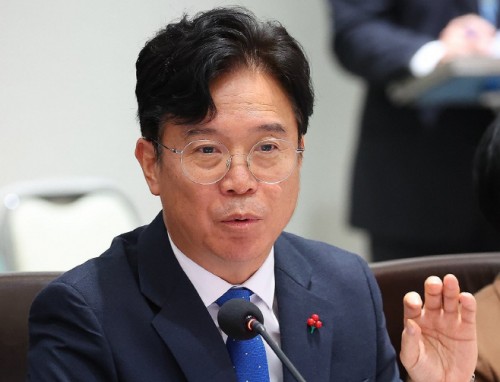 |
| Kim Young-hoon, Minister of Employment and Labor, responds to a question from President Lee Jae-myung during a Cabinet meeting at the presidential office in Yongsan, Seoul, on December 9. / Source: Yonhap News |
Minister of Employment and Labor Kim Young-hoon said the government will move to eradicate the long-standing practice of unpaid overtime and crack down on abuses of the blanket wage system, as it pushes a comprehensive plan to cut actual working hours to the OECD average.
The government plans to roll out a broad package aimed at reducing Korea’s actual working hours to around 1,700 hours per year, in line with the OECD average. The Ministry of Employment and Labor said it will strengthen workers’ “right to rest” by banning misuse of the blanket wage system, guaranteeing the “right to disconnect,” and promoting the use of paid leave.
Speaking at the presidential policy briefing for 2026 at the Sejong Convention Center on December 11, Kim said, “We will narrow gaps in the labor market and build a country where everyone can work happily,” adding, “We will put an end to unpaid overtime.”
The ministry plans to finalize a roadmap for reducing actual working hours by the end of this year and enact a “Working Hours Reduction Support Act” by March next year. The law will establish legal grounds for central and local governments to support productivity improvements at companies that adopt shorter working hours, including a 4.5-day workweek. Legislation will also move in parallel to prohibit abuse of the blanket wage system, ban discriminatory treatment over paid leave, and guarantee the right to disconnect.
Kim noted that for many small and medium-sized businesses, “the five-day workweek is still out of reach, with unpaid overtime firmly entrenched,” stressing the need to strengthen working-time management through mandatory recording of attendance.
President Lee Jae-myung criticized the blanket wage system, saying it has become “a tool for exploiting young workers,” and called for a thorough review. Kim said that “the best option is to ban the blanket wage system,” while agreeing on the need for substantive reforms such as tighter eligibility requirements. Lee instructed the ministry to establish detailed criteria to curb abuse, even through administrative guidelines if legislative amendments prove difficult.
Late-night work was also a key agenda item in the policy briefing. Kim said that while an outright ban on night work is unrealistic, regulations similar to those in Europe are needed to ensure mandatory rest periods between night shifts and limits on consecutive workdays. The ministry will conduct surveys on late-night work, including early-morning delivery jobs, and gather expert input to finalize measures to protect night workers’ health by September next year.
The government will also push to enact a “Basic Act on the Rights of Working People” covering the self-employed and platform workers. A worker presumption system, which shifts the burden of proof to employers in cases of ambiguous worker status, is set to be introduced by May next year. Expanding the application of the Labor Standards Act to workplaces with fewer than five employees will be pursued gradually based on social dialogue and consensus.
Additional measures will be bundled into a broader roadmap, including legislation on the principle of equal pay for work of equal value, enhanced disclosure of wage information, and the promotion of sector-wide collective bargaining.
Strengthening industrial accident prevention and penalties was presented as another core task. From September next year, companies with three or more workplace deaths in a year will face economic sanctions, including fines of up to 5% of operating profit, with a minimum of 3 billion won, and possible business suspension. The fines will be funneled into the industrial accident fund and reinvested in prevention programs.
Dedicated teams and inspectors for serious industrial accidents will be expanded by June next year, with authorities planning to actively use compulsory investigative measures such as search and seizure and detention. For small workplaces, oversight will be expanded from 24,000 to 50,000 sites using technologies such as drones. Measures to strengthen workers’ rights to know, participate, and refuse unsafe work—such as disclosure of accident investigation reports, mandatory appointment of honorary safety inspectors, expanded safety disclosures, and broader stop-work authority—will be rolled out in stages.
In the employment sector, the government will strengthen systems to identify and support roughly 700,000 young people who are neither working nor seeking jobs, while building tailored support programs for middle-aged workers, working parents, and people with disabilities. In June next year, it plans to announce a “Basic Plan for Employment Stability in Industrial Transition,” covering job transitions and employment security amid structural changes. Policies on foreign workers, tighter management of wage arrears with a target of keeping them below 1 trillion won, and measures to promote fund-type retirement pensions are also included.
“If the crises ahead are multilayered, the solutions must be multilayered as well,” Kim said, reiterating the importance of social dialogue. The ministry plans to operate tripartite consultative bodies focused on key issues such as working hours reduction and retirement pensions, while continuing talks with the two major labor confederations to build trust and consensus.
#Kim Young-hoon #Ministry of Employment and Labor #unpaid overtime #blanket wage system
Copyright by Asiatoday
Most Read
-
1
Celltrion’s Omlyclo gains ground in major European..

-
2
Trump demands rates fall below 1% as Fed hikes for..

-
3
Hyundai Motor Group breaks ground on integrated st..

-
4
U.S. strikes 3 Iranian oil tankers, Iran vows reta..

-
5
Trump makes $1 trillion bet ahead of midterm elect..

-
6
Iran resumes ballistic missile production, assembl..

-
7
Samsung Electronics, Mistral AI to jointly develop..

PEOPLE






-
Address : In-Young Bldg., 34, Uisadang-daero 1-gil, Yeongdeungpo-gu, Seoul
Copyright by ASIATODAY CO., LTD. All rights resereved