



Lee signals imminent easing of financial–industrial rules
Dec 11, 2025, 09:39 am


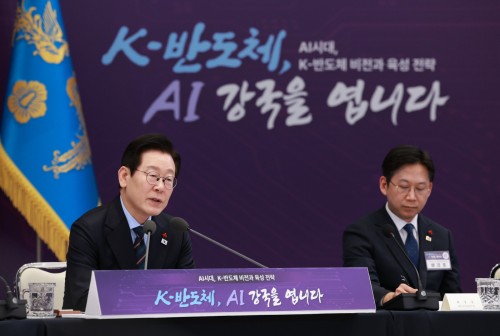 |
| President Lee Jae-myung speaks during a briefing on Korea’s semiconductor vision and strategy in the AI era at the presidential office in Yongsan, Seoul, on December 10. / Source: Yonhap News |
President Lee Jae-myung suggested on December 10 that the government is close to finalizing measures that would ease Korea’s strict financial–industrial separation rules, but only within limits that would not “damage the principle itself.” The move is aimed at enabling large-scale investment by domestic semiconductor companies.
His remarks come roughly two months after his Oct. 1 meeting with OpenAI CEO Sam Altman, where Lee said the government would consider regulatory adjustments—including easing financial–industrial separation—to support Samsung and SK’s participation in the U.S. “Stargate Project.”
Presiding over a briefing titled “K-Semiconductor Vision and Strategy for the AI Era” at the presidential office, Lee reaffirmed the administration’s commitment to bolstering Korea’s chip industry.
SK hynix CEO Kwak Noh-jung, attending the session, noted that despite perceptions that the company is well-funded, the timing of investment is critical: “It takes three years to install and set up equipment before we can generate profit. By then, we may miss the market window.” Lee replied, “That makes sense,” signaling a receptive stance to the industry’s concerns.
Lee emphasized that Korea’s semiconductor strategy must be anchored in building a strong domestic corporate ecosystem and promoting balanced regional development.
“It is important to grow the overall pie, but we must also ensure that the pie is shared among more people,” he said, urging Samsung Electronics and SK hynix to strengthen cooperation with materials, parts and equipment suppliers, and to expand regional investments to support balanced development.
Lee encouraged chipmakers to look toward southern regions rich in renewable energy, saying they could serve as bases for new industrial ecosystems. “The government will introduce bold new policies to support this,” he said.
He also stressed the need to reduce dependence on foreign suppliers in the materials, parts and equipment sectors—areas long considered structural weaknesses of Korea’s semiconductor industry.
#financial–industrial separation #semiconductor policy #Lee Jae-myung #SK hynix #Stargate Project
Copyright by Asiatoday
Most Read
-
1
Trump shares map on social media labeling Strait o..

-
2
Kia Sportage outperforms Mazda CX-5 in German auto..

-
3
Houthis launch successive attacks on Saudi airport..

-
4
U.S. deploys carrier, 10,000 more troops to Middle..

-
5
Trump rejects Iran's offer to open Strait of Hormu..

-
6
N. Korea conducts first swarm attack drill with dr..

-
7
U.S.-China summit falls short on substance as Trum..

PEOPLE






HEADLINE NEWS
- Seoul dismisses Ukraine's claim of 'S. Korean support for Russia' as "inaccurate and inappropriate"
- S. Korea, Japan race to develop nuclear-powered submarines
- Henri Kagan, Kenso Soai win Nobel Prize in Chemistry for uncovering how mol..
- Vance says Alaska LNG cooperation will move forward with Seoul's current or..

-
Address : In-Young Bldg., 34, Uisadang-daero 1-gil, Yeongdeungpo-gu, Seoul
Copyright by ASIATODAY CO., LTD. All rights resereved