



Ha Jung-woo pursues literary precision in new comedy
Dec 08, 2025, 10:10 am


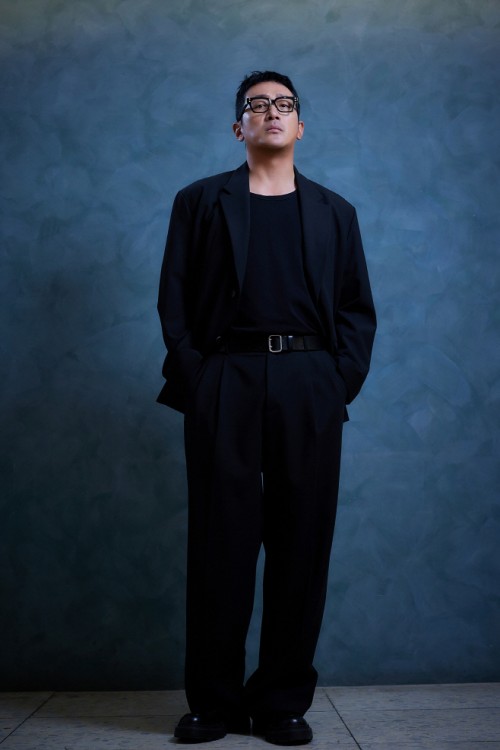 |
| Actor-director Ha Jung-woo poses for a promotional image for The Upstairs Neighbors, his fourth directorial feature. / By4M Studio |
“I wanted every single line to matter,” Ha Jung-woo says of The Upstairs Neighbors, his fourth film as director. “My goal was for every piece of dialogue to stand as if it were part of a literary work, so I collected and refined expressions one by one.”
Ha describes the film’s starting point as an attempt to reexamine the tone and rhythm of humor — identifying exactly “where empathy broke off and where the laughter slipped.”
Recently released in theaters, The Upstairs Neighbors begins with the nightly thumps of a peculiar kind of noise complaint, bringing an upstairs couple and a downstairs couple together in a confrontation that spirals into unexpected territory. Adapted from the Spanish film Sentimental, Ha rewrote the story from a woman’s perspective, adding R-rated elements and relationship-driven drama to craft a comedic voice all his own. He recalls being deeply moved when he first saw the original and immediately thinking, “This is a role Gong Hyo-jin must play.”
Although Ha previously directed Fasten Your Seatbelt, Chronicle of a Blood Merchant, and Lobby, the commercial and critical responses had fallen short of expectations, with viewers often saying the humor felt “too much.” This time, table reads and structural revisions became a way to confront those weaknesses head-on.
He began by tackling the script. With a dedicated actor handling read-throughs, Ha conducted table reads five days a week at 8 a.m., revising constantly. After working with four actors, he repeated the entire process with the film’s main cast. He also incorporated feedback from comedians like Kwak Beom and Lee Chang-ho, gathering hundreds of expressions actually used by teenagers to refine the dialogue’s texture.
One unexpected comic element that emerged was the word “Pikachu.” Its random appearance sparked small but powerful bursts of laughter, even showing up briefly in the end-credit director slot. Gong Hyo-jin and Lee Ha-nee initially told him it felt “childish,” but blind test screenings proved otherwise. “The editors told me to cut it all,” Ha says, laughing. “But I pushed to keep it in. At the Busan International Film Festival, I tested it just once — and sure enough, it landed.”
As a director, Ha also made deliberate choices to break away from his usual style. Although he typically favors abrupt, fastball-style humor, he avoided that here. To support the film’s late-game emotional arc, he adopted a quicker comedic rhythm early on, while doubling down on research for the more delicate or controversial parts. The upstairs couple’s “proposal” scene was inspired by undercover community research, and the marriage counseling sequences were crafted with repeated input from a psychiatrist.
Technical adjustments also drew from past criticism. “People always said the dialogue wasn’t clear,” Ha admits. This time he used subtitles more aggressively and pushed the boundaries on adult content.
Ha also spoke candidly about the tension between directing and acting at the same time. “Even when I try to treat actor Ha Jung-woo more coldly as a director, I can’t seem to find the right approach. And as an actor, I struggle to know whether my choices are truly the best for the film. Maybe with time I’ll understand it better, but right now, director Ha still doesn’t fully know how to handle actor Ha.”
#Ha Jung-woo interview #Upstairs Neighbors #film
Copyright by Asiatoday
Most Read
-
1
Kia Sportage outperforms Mazda CX-5 in German auto..

-
2
Houthis launch successive attacks on Saudi airport..

-
3
Saudi Arabia, Iran hold first diplomatic talks to..

-
4
U.S. deploys carrier, 10,000 more troops to Middle..

-
5
Saudi airport in Riyadh struck again, leaving at l..

-
6
Japan tracks Ukraine fiber-optic drones, bolsters..

-
7
Putin's ally visits China on the 8th ahead of APEC..

PEOPLE






HEADLINE NEWS
- Trump slams Nobel Peace Prize snub, claiming he is 'preventing war' between the two Koreas
- China makes tactical retreat following fierce pushback from EU
- Japan openly opposes U.S. sanctions on ICC, fueling tensions with Washingto..
- Military service exemptions for artists and athletes under scrutiny at parl..

-
Address : In-Young Bldg., 34, Uisadang-daero 1-gil, Yeongdeungpo-gu, Seoul
Copyright by ASIATODAY CO., LTD. All rights resereved