



Korean firms regain strength a year after political turmoil
Dec 03, 2025, 09:09 am


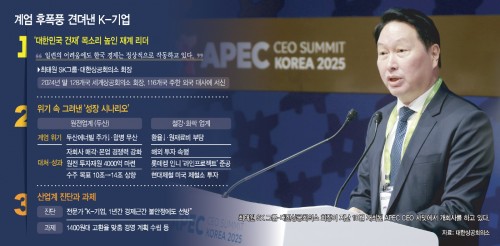 |
| Progress in key industries such as semiconductors, automobiles, shipbuilding, and defense helped Korean conglomerates regain momentum a year after the December 3 martial-law crisis. / Yonhap |
A year after the December 3 martial-law declaration sent domestic financial markets and major corporations into turmoil through sharp swings in stock prices and exchange rates, Korean businesses have regained momentum, forming stronger economic alliances with global leaders. The KOSPI now moves in the 4,000-range, exports have hit all-time highs, and core industries—from semiconductors and automobiles to shipbuilding and defense—are commanding global markets. Many attribute this turnaround to the efforts of business leaders who worked to restore international confidence amid political turbulence.
According to industry sources on Monday, the corporate sector shifted into a “24-hour crisis-management mode” during the martial-law period, as disruptions to investor sentiment threatened to upend foreign investment, financing, and supply-chain plans. Business leaders worked urgently to reassure global companies and governments. One of the most active figures was Chey Tae-won, chairman of the Korea Chamber of Commerce and Industry (KCCI).
On December 22 last year, Chey sent an official letter to chamber leaders in 128 countries and to ambassadors from 116 nations stationed in Seoul, assuring them that “the Korean economic system remains fully functional and preparations for APEC are proceeding without disruption.” Working closely with the new administration, he also met political and economic leaders across the world during overseas trips earlier this year to address concerns over Korea’s policy uncertainty.
With anticipated changes to U.S. tariffs and subsidy rules affecting Korean companies, KCCI played a coordinating role in developing on-the-ground response strategies for SK, Samsung, Hyundai Motor, and other major firms. “There were trade issues that individual companies could not resolve alone,” one industry official said, adding that “a triangular coordination line among KCCI, the Federation of Korean Industries, and the government was activated at high speed.”
Other corporate leaders also rolled up their sleeves. Cho Hyun-sang, vice chairman of HS Hyosung, and Lee Kyu-ho, vice chairman of Kolon Group, demonstrated unwavering support for the APEC summit through their work as co-chairs of the APEC Business Advisory Council.
Domestic industries also faced immediate shocks as stock and currency volatility rippled across markets. Doosan Group, for example, confronted a crisis when a major restructuring plan it had pursued for six months was jeopardized by a plunging share price, which made executing shareholder buyback commitments financially burdensome.
Doosan Enerbility sought to secure funds for nuclear-power investment by selling its stake in Doosan Bobcat, but was forced to revise its approach. Earlier this year, it listed its Czech subsidiary Doosan Škoda Power, raising 150 billion won, and in August sold its Vietnam subsidiary Doosan Vina for 290 billion won. All proceeds will be directed toward future-growth sectors such as small modular reactors (SMRs).
Chemical and steel companies, despite soaring raw-material costs from a surging won-dollar rate, continued their overseas investments to secure long-term growth engines. Lotte Chemical successfully completed its LINE project in Indonesia, expected to generate roughly 2.4 trillion won in annual revenue. Hyundai Steel announced a plan in March to invest USD 5.8 billion (about 8.5 trillion won) to build the first electric-arc furnace integrated steel mill in Louisiana, aiming to bypass U.S. tariff barriers, which currently impose a 50 percent duty on imported steel.
Hwang Yong-sik, professor of business administration at Sejong University, said, “The challenge now for companies is to recalibrate their business plans to match the new reality of a won-dollar rate firmly anchored in the 1,400 range.”
Most Read
-
1
Kia Sportage outperforms Mazda CX-5 in German auto..

-
2
Houthis launch successive attacks on Saudi airport..

-
3
Saudi Arabia, Iran hold first diplomatic talks to..

-
4
U.S. deploys carrier, 10,000 more troops to Middle..

-
5
Saudi airport in Riyadh struck again, leaving at l..

-
6
Putin's ally visits China on the 8th ahead of APEC..

-
7
Five ASEAN countries welcome Myanmar coup leader

PEOPLE





HEADLINE NEWS

-
Address : In-Young Bldg., 34, Uisadang-daero 1-gil, Yeongdeungpo-gu, Seoul
Copyright by ASIATODAY CO., LTD. All rights resereved