



Assembly approves 2026 budget before legal deadline
Dec 03, 2025, 09:01 am


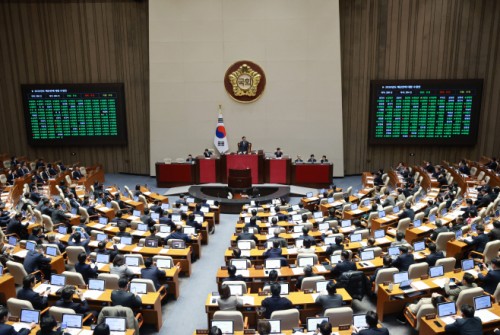 |
| Lawmakers vote on the revised 2026 national budget bill during a plenary session of the National Assembly on December 2, where the proposal passed with 248 votes in favor, eight against, and six abstentions. / Yonhap |
The Lee Jae-myung administration’s first budget bill passed the National Assembly on Monday, marking the first time in five years that a budget has cleared the legislature within the legally mandated deadline.
According to the Ministry of Economy and Finance, the Assembly finalized the 2026 national budget and fund management plans during a plenary session by adjusting total expenditures to 727.9 trillion won—1 trillion won lower than the government’s original proposal.
During parliamentary review, lawmakers cut 4.3 trillion won from items such as policy funds and artificial intelligence support programs, while increasing 4.2 trillion won for future growth engines, household welfare, disaster prevention, and regional economic revitalization. Total revenue was revised upward by 1 trillion won to 675.2 trillion won, driven largely by higher Bank of Korea surplus earnings. As a result, the managed fiscal balance deficit is expected to improve slightly to 3.9 percent of GDP from the government's proposed 4.0 percent, with the national debt ratio remaining unchanged at 51.6 percent.
The National Assembly added funding for renewable energy and AI-related sectors to reflect the need for investment in next-generation industries and demographic challenges. Key projects include 97.5 billion won for solar-income village ESS installations, 61.8 billion won for AI mobility testbed cities, 15.8 billion won for eco-friendly food support for pregnant women, and strengthened incentives for youth savings programs.
Support for vulnerable groups was also expanded. Measures include higher benefits for people with severe disabilities, broader community-based care programs, lower interest rates for special “Haepssalon” loans, increased subsidies for public transit flat-fare passes, and new city gas supply projects. Additional budget allocations were made for drought and wildfire prevention as well as industrial and infrastructure initiatives to strengthen regional growth hubs.
The budget also sets aside 400 billion won for national data center recovery and disaster-resilience systems following the government resource management agency fire. Based on the results of Korea-U.S. tariff negotiations, the 1.9 trillion won previously allocated for a U.S. trade program was reduced, while 1.1 trillion won in funding was newly added for the launch of the Korea-U.S. Strategic Investment Corporation next year.
Most Read
-
1
Celltrion’s Omlyclo gains ground in major European..

-
2
Trump demands rates fall below 1% as Fed hikes for..

-
3
Trump makes $1 trillion bet ahead of midterm elect..

-
4
Iran resumes ballistic missile production, assembl..

-
5
Trump warns countries not helping U.S. must pay re..

-
6
Apple launches first foldable, 1 million won prici..

-
7
Turkish Airlines named main club partner of Liverp..

PEOPLE







-
Address : In-Young Bldg., 34, Uisadang-daero 1-gil, Yeongdeungpo-gu, Seoul
Copyright by ASIATODAY CO., LTD. All rights resereved