



Koo vows tougher food-price controls for household stability
Dec 02, 2025, 09:33 am


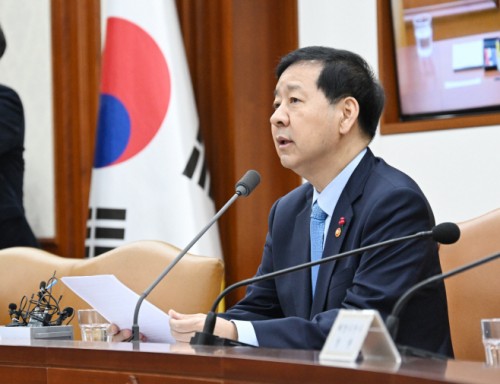 |
| Deputy Prime Minister and Finance Minister Koo Yun-cheol delivers opening remarks at an economic and price-related ministers’ meeting at the Government Complex Seoul on December 2. / Courtesy of the Ministry of Economy and Finance |
Deputy Prime Minister and Finance Minister Koo Yun-cheol said Tuesday that managing inflation, especially food prices, is central to stabilizing people’s livelihoods, vowing an “all-out effort” to contain cost pressures.
At an economic and price-related ministers’ meeting held at the Government Complex Seoul, Koo said the government would “mobilize every available tool, including tariff quotas, to stabilize key consumer items and respond strictly to unfair market practices that distort pricing.”
The comments came as the National Data Office reported that consumer prices rose 2.4% in November from a year earlier, marking the third consecutive month inflation has remained in the 2% range after climbing to 2.1% in September.
Koo attributed recent price pressures to a base effect from last year’s low inflation, as well as elevated processed-food prices following concentrated hikes earlier this year. He noted that frequent rainfall, adverse weather, a stronger U.S. dollar, and rising import costs had widened price increases in agricultural, livestock, fishery products, and petroleum items.
To ease pressures, the government will extend tariff-quota support for food and feedstock materials.
Koo announced that tariff quotas for ten food ingredients — including sugar and coffee — will be extended through the end of next year, while quotas for 12 items such as processed egg products will be extended through June. For sugar, the quota volume will be expanded 20% from 100,000 tons this year to 120,000 tons next year to spur greater competition.
Tariff quotas for nine types of feed grains, including barley, will also be extended through next year to reduce farm costs and stabilize livestock prices.
The government will additionally release about 20,000 tons of key agricultural products — such as cabbage, radish, and tangerines — through January and offer discounts of up to 40% on Korean beef and pork to ease consumer burdens.
The meeting also reviewed measures aimed at curbing “shrinkflation,” including mandatory disclosure of pre-cooking weights in the fried-chicken restaurant sector. Officials also discussed designating four new National Marine Ecological Parks this year: Garorim Bay (South Chungcheong), the Shinan–Muan area (South Jeolla), Yeojaman in Suncheon–Boseong (South Jeolla), and the Homiban-do area (North Gyeongsang).
#Inflation control #Food-price stabilization #Tariff quotas #Koo Yun-cheol
Copyright by Asiatoday
Most Read
-
1
Celltrion’s Omlyclo gains ground in major European..

-
2
Trump demands rates fall below 1% as Fed hikes for..

-
3
Trump makes $1 trillion bet ahead of midterm elect..

-
4
Iran resumes ballistic missile production, assembl..

-
5
Trump warns countries not helping U.S. must pay re..

-
6
Apple launches first foldable, 1 million won prici..

-
7
Turkish Airlines named main club partner of Liverp..

PEOPLE







-
Address : In-Young Bldg., 34, Uisadang-daero 1-gil, Yeongdeungpo-gu, Seoul
Copyright by ASIATODAY CO., LTD. All rights resereved