



S. Korea unveils first tobacco harm reduction plan
Oct 30, 2026, 11:06 am


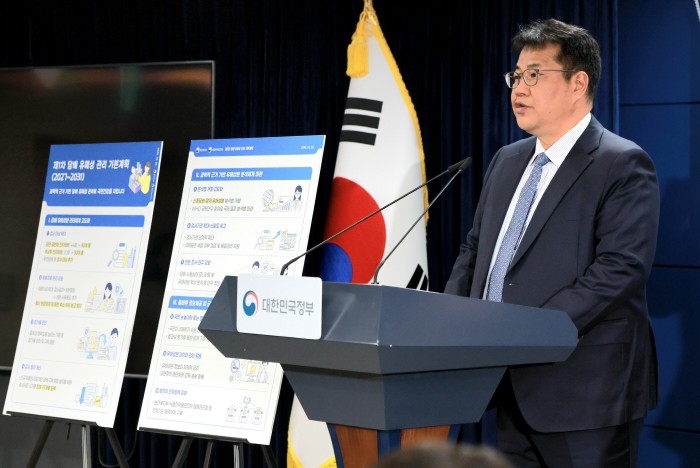 |
| Son Young-rae, head of the Office of Regional, Essential and Public Healthcare at the Ministry of Health and Welfare, announces the First Basic Plan for Tobacco Harmfulness Management and measures to disclose information on harmful tobacco constituents at a briefing room in the Government Complex Seoul in Jongno District, Seoul, on the afternoon of Oct. 29. / Yonhap News Agency |
The Korean government plans to expand testing for harmful tobacco constituents and strengthen the management of additives as part of efforts to establish a science-based tobacco harmfulness management system. Based on this framework, the government aims to develop policies that improve public health, including reducing the current use of tobacco products.
On Oct. 29, the Ministry of Health and Welfare (MOHW) and the Ministry of Food and Drug Safety (MFDS) unveiled the First Basic Plan for Tobacco Harmfulness Management and disclosed the results of harmful constituent testing for individual tobacco products for the first time.
The basic plan is a five-year, medium- to long-term initiative that sets out the fundamental objectives and policy directions for tobacco harmfulness management under Article 5 of the Act on the Management of Harmfulness of Tobacco.
The first plan, announced that day, presents a vision of "protecting public health through science-based tobacco harmfulness management."
The MOHW and MFDS determined that greater public awareness of tobacco-related health risks and a science-based management system were necessary, given the rising incidence of tobacco-related diseases, mortality risks and socioeconomic burdens.
The number of smoking-attributable deaths increased from 58,036 in 2019 to 68,536 in 2023, while the socioeconomic costs associated with smoking rose from 12.2 trillion won to 15 trillion won over the same period.
According to the MFDS's harmful constituent testing results for 465 domestically manufactured and imported tobacco products, also released that day, nicotine and tar were detected in all conventional cigarettes and heated tobacco products tested. Nicotine, propylene glycol and glycerin were found in all liquid-type e-cigarette products.
The government established "protecting public health through science-based tobacco harmfulness management" as the plan's overarching goal and presented three strategic directions and 10 priority tasks.
The three directions are advancing the management system for harmful tobacco constituents, establishing a science-based analytical framework for harmful constituents and related substances, and strengthening the provision of accurate information and cooperation with smoking cessation policies. Each direction includes its own priority tasks.
As part of efforts to improve the management system for harmful tobacco constituents, the government will expand the number of substances subject to testing.
For conventional cigarettes and heated tobacco products, the number of substances tested will increase from 44 as of last year to around 50 by 2030. For liquid-type e-cigarettes, the number will rise from 20 to around 30.
The government will also begin strengthening oversight of additives used in tobacco manufacturing. It plans to raise awareness of their potential health risks and review measures that could gradually prohibit the use of certain substances.
"Examples of additives include menthol, vitamins and minerals," said Kim Han-sook, director-general of the Health Policy Bureau at the MOHW.
"Regulations on tobacco additives are being strengthened worldwide, and we will review the issue and gradually expand our measures," Kim said.
To strengthen the scientific basis for analyzing harmful constituents, the government will continue developing analytical methods while supporting international cooperation through participation in joint research conducted by the World Health Organization (WHO) Tobacco Laboratory Network.
It also plans to gradually expand the number of testing institutions to respond to the growing variety of new tobacco products.
To strengthen coordination with smoking cessation policies, the government will improve its data management system and gradually expand the types of tobacco products subject to oversight.
The scope of management, currently limited to conventional cigarettes, heated tobacco products and liquid-type e-cigarettes, will be expanded by 2029 to include other tobacco products, such as smokeless tobacco and cigars.
"The significance of this basic plan lies in raising public awareness of tobacco-related harm through systematic verification and disclosure of harmful constituents, while establishing a science-based tobacco harmfulness management system," said Son Young-rae, head of the Office of Regional, Essential and Public Healthcare at the MOHW.
Through the plan, the government aims to lay the groundwork for establishing a stable tobacco harmfulness management system and reducing tobacco product use.
The MOHW said it aims to reduce the current tobacco product use rate among adults to 29.0% for men and 6.0% for women by 2030.
According to the Korea National Health and Nutrition Examination Survey conducted by the Korea Disease Control and Prevention Agency (KDCA), the rates stood at 36.3% for adult men and 8.6% for adult women last year.
"We will go beyond simply disclosing information on the harmfulness of tobacco products and conduct in-depth research into public perceptions, using the findings to develop new policies involving education and regulation," Son said.
"Combining these efforts will further enhance the significance of disclosing information on harmful tobacco constituents," he added.
"We are also considering smoking cessation policies from various perspectives," Son continued.
"To reduce tobacco product use, we will strengthen policies through in-depth research and discussions with experts on what additional regulations could be introduced in people's everyday environments," he said.
Seo Byeong-ju
Most Read
-
1
Putin proposes trilateral U.S.-China-Russia summit..

-
2
Attention centers on APEC for possible Trump-Xi-Pu..

-
3
U.S., Israel plan to resume strikes on Iran after..

-
4
China tightens grip on boosting domestic demand an..

-
5
China's fifth plenum to conclude amid expectations..

-
6
Amid health rumors, Chinese President Xi Jinping i..

-
7
ASEAN to discuss Myanmar's return next month

PEOPLE







-
Address : In-Young Bldg., 34, Uisadang-daero 1-gil, Yeongdeungpo-gu, Seoul
Copyright by ASIATODAY CO., LTD. All rights resereved