



NIS confirms Kim Jong Un's daughter named Ju-ae
Oct 30, 2026, 10:24 am


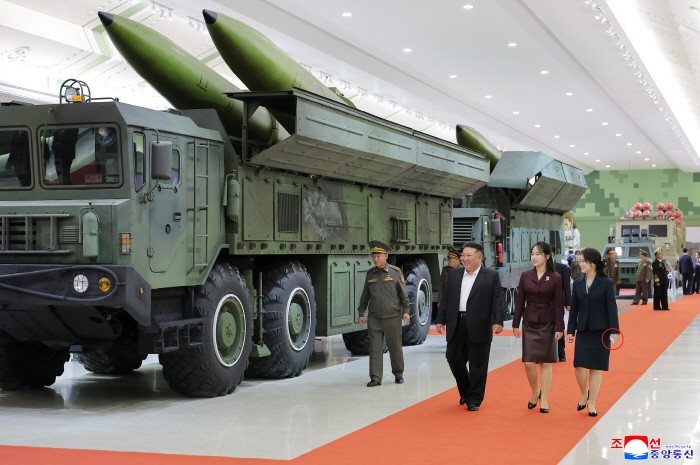 |
| North Korean leader Kim Jong-un walks in front of a missile-carrying launch vehicle with his daughter Ju-ae and his wife Ri Sol-ju, who is holding what appear to be a cigarette pack and a matchbox, at the Defense Revolution Museum of the Second Economic Committee, which opened on Oct. 11. / Yonhap News Agency |
South Korea's National Intelligence Service (NIS) has officially confirmed that the name of North Korean leader Kim Jong-un's daughter is Kim Ju-ae. The agency also assessed that she is further consolidating her position as a designated successor. It also addressed the prospects for U.S.-North Korea dialogue, restrictions on intelligence sharing between Seoul and Washington, and delays in U.S. visa issuance.
During a parliamentary audit by the National Assembly Intelligence Committee on Oct. 29, NIS Director Lee Jong-seok was asked by Democratic Party of Korea lawmaker Youn Kun-young whether the North Korean leader's daughter's name was Kim Ju-ae.
"Kim Ju-ae is correct," Lee replied.
Although Kim's daughter has long been known as Kim Ju-ae, North Korean state media have never publicly disclosed her name, and questions had been raised about whether her real name might be Kim Ju-hae. Lee's response marked the first time the NIS had officially confirmed her name as Kim Ju-ae.
Regarding her position in North Korea's succession plans, the NIS reported, "We assess that she is further consolidating her position at the stage of being designated as successor."
Based on its analysis of Kim Ju-ae's public activities since her first appearance in 2022, the agency concluded that North Korea has been pursuing a strategy of gradually establishing her status as a successor while increasing public acceptance of her potential succession.
In particular, the agency found that military-related activities accounted for 60% of her public appearances. It assessed that she has been cultivating an image as a military leader by posing for commemorative photographs at military events and that North Korea has staged appearances suggesting she is involved in practical work related to nuclear weapons and missiles.
Regarding U.S.-North Korea relations, the NIS assessed that Pyongyang remains open to the possibility of dialogue around the time of the Asia-Pacific Economic Cooperation (APEC) Summit. However, the United States and North Korea have yet to narrow their differences over the conditions for talks.
The agency assessed that Kim Jong-un's recent visit to Dandong, China, may have been intended to convey North Korea's intentions regarding dialogue with the United States to the Chinese leadership.
It cited the composition of the North Korean delegation, which was made up primarily of diplomatic officials, including Foreign Minister Choe Son-hui, rather than military or economic officials. China likewise received Kim through its diplomatic officials, including Foreign Minister Wang Yi.
However, the NIS assessed that while China might convey North Korea's position to the United States, it was unlikely to take an active mediation role.
On intelligence sharing between South Korea and the United States, the agency acknowledged that some restrictions remain in place.
The NIS reported that the United States has restricted the provision of intelligence on North Korea following remarks by Unification Minister Chung Dong-young concerning North Korea's uranium enrichment facilities.
However, the agency said the restrictions were confined to a very limited range of intelligence and that it could make up for any gaps using its own reconnaissance assets. It emphasized that intelligence cooperation between Seoul and Washington was proceeding smoothly in other areas.
The audit also addressed delays in U.S. visa issuance for South Korean officials.
Visa issuance had previously been delayed for NIS personnel scheduled to be posted to the South Korean Embassy in Washington. Democratic Party of Korea lawmaker Jung Chungrae also had to change the destination of a parliamentary audit visit because his U.S. visa application had not been processed.
The NIS rejected suggestions that these cases stemmed from tensions between South Korea and the United States.
It explained that the United States had recently tightened entry screening procedures across the board, making the visa issuance process more stringent, and that the measures were not being applied exclusively to South Korea.
The agency did not provide a separate report on whether visas had been issued to specific individuals or the precise reasons for delays, saying such matters fell outside its jurisdiction.
It also maintained that it would be difficult to directly link the visa issues to restrictions on intelligence sharing between South Korea and the United States.
The NIS also denied reports that a planned visit to the United States by Director Lee had fallen through.
It explained that Lee had been invited to an event hosted by the U.S. side but had decided not to attend after seeking the organizers' understanding, taking into account international circumstances following the outbreak of the war in Iran.
Kim Tae-hoon
Most Read
-
1
Putin proposes trilateral U.S.-China-Russia summit..

-
2
Attention centers on APEC for possible Trump-Xi-Pu..

-
3
U.S., Israel plan to resume strikes on Iran after..

-
4
China tightens grip on boosting domestic demand an..

-
5
China's fifth plenum to conclude amid expectations..

-
6
Amid health rumors, Chinese President Xi Jinping i..

-
7
ASEAN to discuss Myanmar's return next month

PEOPLE







-
Address : In-Young Bldg., 34, Uisadang-daero 1-gil, Yeongdeungpo-gu, Seoul
Copyright by ASIATODAY CO., LTD. All rights resereved