



Household delinquency rates stay stubbornly high
Oct 30, 2026, 10:48 am


 |
A growing number of household borrowers are struggling with mounting interest burdens and failing to repay loan principal and interest on time. Delinquency rates on household loans at major commercial banks have risen every quarter, while the ratio of non-performing loans (NPLs), including loans with repayments overdue by three months or more, remains elevated, pointing to worsening household loan quality.
The burden on household borrowers is expected to increase further as the Bank of Korea's (BOK) policy rate hikes coincide with rising market interest rates. The average interest rate on household loans is approaching 5% annually, while mortgage rates have climbed to their highest level in more than 14 years. With higher rates affecting not only new borrowers but also existing borrowers whose loans are approaching interest rate resets, concerns are growing that more financially vulnerable borrowers could fall behind on repayments through next year.
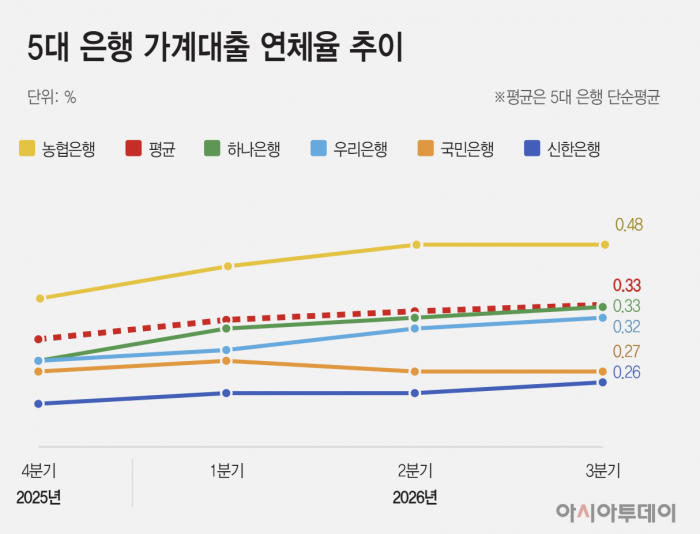
According to the banking industry on Oct. 29, the simple average household loan delinquency rate at South Korea's five major commercial banks — KB Kookmin Bank, Shinhan Bank, Hana Bank, Woori Bank and NH NongHyup Bank — stood at 0.33% at the end of September, based on principal or interest payments overdue by at least one month.
The rate was up approximately 0.03 percentage points from 0.30% at the end of last year and about 0.01 percentage points from the previous quarter, continuing its deterioration throughout this year.
By bank, NH NongHyup Bank recorded the highest delinquency rate at 0.48%, followed by Hana Bank at 0.33%, Woori Bank at 0.32%, KB Kookmin Bank at 0.27% and Shinhan Bank at 0.26%.
The rates at KB Kookmin Bank and NH NongHyup Bank remained unchanged from the previous quarter, while those at Hana Bank, Woori Bank and Shinhan Bank rose slightly.
Signs of deteriorating asset quality are also evident in NPL ratios, which measure troubled loans whose recovery has become uncertain, including those with principal or interest payments overdue by three months or more.
The simple average household NPL ratio at the five banks has steadily increased from 0.21% at the end of 2024 to 0.23% at the end of last year and 0.25% at the end of the first half of this year. It remained at 0.25% at the end of the third quarter, unchanged from the previous quarter, indicating that the elevated level of troubled loans has shown little sign of easing.
Prolonged high interest rates and weak domestic demand are cited as major factors behind the deterioration in household financial health.
A delayed recovery in domestic demand and rising prices have weakened the repayment capacity of small-scale self-employed business owners and financially vulnerable borrowers. At the same time, interest burdens have increased sharply as loans taken out during the earlier low-interest-rate period reach their scheduled rate reset dates.
"Loans issued at low interest rates of around 2% to 3% during the COVID-19 pandemic are gradually reaching their interest rate reset dates," an official at a commercial bank said.
"The increase appears to reflect a growing number of borrowers who are unable to cope with substantially higher interest rates," the official added.
The recent policy rate hikes have further worsened borrowing conditions.
According to the BOK's Weighted Average Interest Rates of Financial Institutions statistics released that day, the average interest rate on newly extended household loans by deposit-taking banks reached 4.96% annually in September, up 0.20 percentage points from the previous month and approaching 5%.
Over the same period, the mortgage rate rose 0.22 percentage points to 4.88% annually, its highest level in 14 years and five months since April 2012.
Another concern is that the number of borrowers choosing variable-rate loans, which are particularly vulnerable to rising interest rates, has increased significantly.
Variable-rate mortgages accounted for more than 60% of newly extended mortgage loans at deposit-taking banks throughout the third quarter.
Borrowers have gravitated toward variable-rate mortgages because their interest rate of 4.76% is currently 0.35 percentage points lower than the rate on fixed-rate mortgages.
However, variable mortgage rates have also been rising sharply, increasing 0.23 percentage points in just one month. This means borrowers could face substantially higher interest payments when their loan rates are reset.
Experts expect household loan delinquency rates to continue rising for some time as the effects of policy rate hikes gradually increase repayment burdens.
"The effects of interest rate hikes are already being felt, but their negative impact will become even greater over time," said Son Jae-seong, a professor in the Department of Accounting at Soongsil University.
"Delinquency rates are likely to rise further in the fourth quarter of this year. If upward pressure on interest rates persists, the increase could continue through the first half of next year," he added.
Han Sang-wook
#Delinquency rates #Bank #Inflation
Copyright by Asiatoday
Most Read
-
1
Putin proposes trilateral U.S.-China-Russia summit..

-
2
Attention centers on APEC for possible Trump-Xi-Pu..

-
3
U.S., Israel plan to resume strikes on Iran after..

-
4
China tightens grip on boosting domestic demand an..

-
5
China's fifth plenum to conclude amid expectations..

-
6
Amid health rumors, Chinese President Xi Jinping i..

-
7
ASEAN to discuss Myanmar's return next month

PEOPLE







-
Address : In-Young Bldg., 34, Uisadang-daero 1-gil, Yeongdeungpo-gu, Seoul
Copyright by ASIATODAY CO., LTD. All rights resereved