



Indonesian students take to streets over inflation and wildfires
Oct 30, 2026, 10:43 am


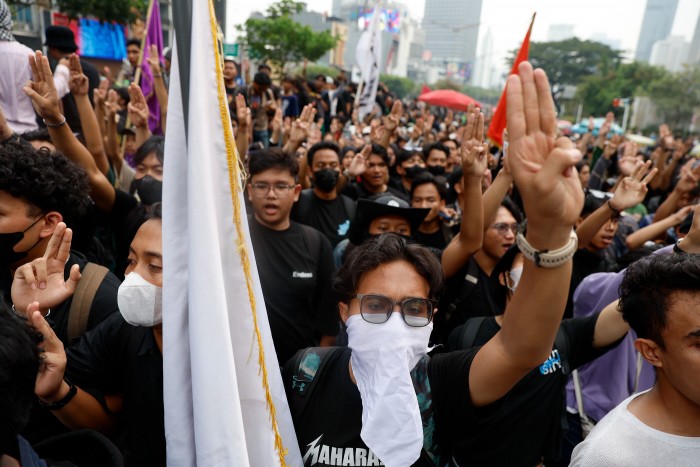 |
| Indonesian university students raise the three-finger salute, a symbol of resistance, and chant slogans during an anti-government protest in central Jakarta on Oct. 28. / EPA-Yonhap |
Hundreds of Indonesian university students took to the streets to protest soaring prices, cuts to energy subsidies and the government's inadequate response to forest fires.
According to Singapore-based Channel News Asia (CNA) on Oct. 28 (local time), students from various universities and members of nonprofit organizations gathered around Thamrin Street and Sudirman Street in central Jakarta to protest President Prabowo Subianto's policies. The two streets are among Jakarta's main commercial thoroughfares, home to the headquarters of major domestic and international companies.
The demonstrations carried added symbolic significance as they coincided with Youth Pledge Day, which commemorates the 1928 declaration of national unity by Indonesian youths that helped establish the country's national identity.
Protesters urged the government to immediately declare the massive forest fires that have continued for months across Sumatra and Kalimantan, the Indonesian part of Borneo, a "national disaster."
They also demanded a complete halt to spending on populist programs, including Prabowo's flagship free school meals initiative. Critics argue that soaring government spending on large-scale populist programs has come at the expense of essential funding for disaster response and infrastructure development.
Indeed, the budgets for free meals and disaster response stand in stark contrast.
On July 21, senior officials overseeing the free meals program said this year's budget had been reduced from the initially allocated 268 trillion rupiah (approximately 19.7 trillion won) to 229 trillion rupiah (approximately 16.9 trillion won), with further cuts possible. Even after the reduction, the amount remained vastly larger than the budget allocated to disaster authorities.
In February, Suharyanto, then head of the National Disaster Management Agency (BNPB), complained that the agency's budget for this year had been cut by nearly 75% from the previous year to just 491 billion rupiah (approximately 36 billion won).
It was only last month, after a series of disasters had struck, that BNPB Secretary-General Rustian explained that the agency's regular budget for this year had been increased to 1.08 trillion rupiah (approximately 79 billion won), with a separate 4.62 trillion rupiah (approximately 340 billion won) in emergency funds available for immediate use.
The government's decision to sharply reduce energy subsidies also sparked anger among protesters.
Late last month, the Indonesian government decided to cut energy subsidies by more than 30%, from 376.8 trillion rupiah (approximately 27.7 trillion won) this year to 261 trillion rupiah (approximately 19.2 trillion won) next year.
"The subsidy cut came as ordinary people were already struggling with soaring gasoline prices and shortages of subsidized fuel because of rising tensions in the Middle East," said Diana, a 20-year-old University of Indonesia student who participated in the protest.
"It also came just as the government decided to pour more money into wasteful programs such as free meals and village cooperatives," she criticized.
Students had planned to gather at the Hotel Indonesia Roundabout, a frequent rallying point for protesters, before marching approximately 3 kilometers to the Presidential Palace. However, police blocked their route.
With heavy police security preventing some protesters from even reaching the gathering point, demonstrators dispersed across the city center and continued holding scattered protests.
Several scuffles broke out between protesters attempting to break through police barricades and security personnel, but the attempts were blocked.
"The authorities have no right to prevent us from exercising our freedom of expression where we need to be," said Tigor, a 23-year-old student at Pancasila University.
The anti-government demonstrations have spread beyond Jakarta to parts of Borneo and Sumatra directly affected by haze from the forest fires. A protest demanding government action was also held in Central Kalimantan last week.
Street protests against the Prabowo administration are nothing new.
Last year, nationwide protests continued for weeks following the death of a motorcycle taxi driver at the hands of police, resulting in several additional deaths.
Hundreds of protesters were detained during large-scale demonstrations in August this year, while university students also staged street protests last week.
As public dissatisfaction intensifies, President Prabowo's approval rating has plummeted as he marks his second anniversary in office.
According to a survey by local polling organization Saiful Mujani Research and Consulting (SMRC), Prabowo's approval rating, which stood at 81.2% in November last year, began declining toward the end of the year and fell to 44.5% this month.
Jeong Ri-na
Most Read
-
1
Putin proposes trilateral U.S.-China-Russia summit..

-
2
Attention centers on APEC for possible Trump-Xi-Pu..

-
3
U.S., Israel plan to resume strikes on Iran after..

-
4
China tightens grip on boosting domestic demand an..

-
5
China's fifth plenum to conclude amid expectations..

-
6
Amid health rumors, Chinese President Xi Jinping i..

-
7
ASEAN to discuss Myanmar's return next month

PEOPLE







-
Address : In-Young Bldg., 34, Uisadang-daero 1-gil, Yeongdeungpo-gu, Seoul
Copyright by ASIATODAY CO., LTD. All rights resereved