



[Market Power] LG Energy Solution shares plunge 8.6% on LG Chem stake sale plan
Oct 30, 2026, 10:07 am


 |
 |
LG Energy Solution shares plunged on Oct. 29 after its parent company, LG Chem, moved to sell 2.5 trillion won worth of shares in the battery maker. LG Chem said the move was intended to improve its financial structure and secure funds for future investments, but it dealt a blow to LG Energy Solution shareholders.
The concern is that LG Chem is expected to continue selling more than 5 trillion won worth of shares in its subsidiary through 2030. LG Chem plans to reduce its stake in LG Energy Solution and use the proceeds for shareholder returns and financial stabilization. Since LG Chem pushed ahead with the separate listing of LG Energy Solution, the subsidiary has effectively been in a position where it serves as a source of financing for its parent company for years.
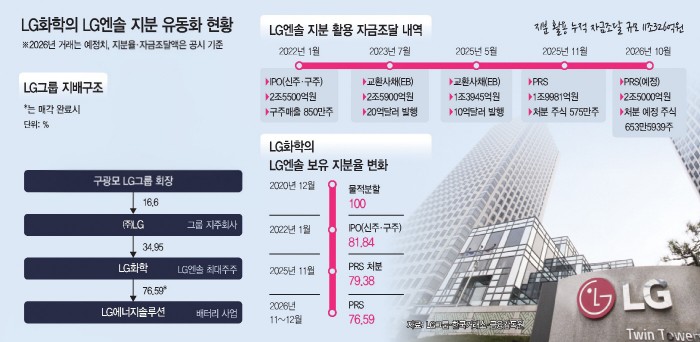
Despite raising funds through sales of its subsidiary's shares, LG Chem has yet to achieve meaningful growth. From the 2.55 trillion won raised through the sale of existing shares following LG Energy Solution's initial public offering (IPO) in 2022 to its recent price return swap (PRS) agreement backed by LG Energy Solution shares, LG Chem has secured more than 11 trillion won. Nevertheless, its market capitalization has fallen by nearly 30 trillion won over the past four years. Critics argue that the separate listing following the earlier spin-off has undermined the valuations of both the parent company and its subsidiary.
According to the Financial Supervisory Service (FSS), LG Chem announced that it would enter into a PRS agreement involving 6,535,939 common shares of LG Energy Solution as the underlying asset. The transaction is valued at 2.5 trillion won, based on a price of 382,500 won per share. Under a PRS agreement, a company raises funds through a contract with a financial institution using shares it owns as the underlying asset. The parties subsequently settle the difference based on changes in the share price during the contract period.
LG Chem said it would use the proceeds to improve its financial structure and enhance shareholder value, but shares of both companies declined. LG Chem fell 0.85% from the previous session, while LG Energy Solution plunged 8.60% to close at 356,000 won. The parent company's large-scale stake sale drove down LG Energy Solution's share price, while LG Chem, which had sought to boost its own corporate value, also saw its shares fall.
This marks LG Chem's second PRS agreement involving LG Energy Solution shares. In November last year, the company raised 1.9981 trillion won through a PRS agreement involving 5.75 million shares of LG Energy Solution.
Before that, LG Chem had raised funds by issuing exchangeable bonds (EBs) backed by its LG Energy Solution shares. It issued EBs twice in July 2023, when LG Energy Solution shares were trading at around 650,000 won. The exchange prices were set at approximately 125% to 130% of the share price, at 687,500 won and 715,000 won per share, respectively. The two issuances totaled 2.59 trillion won.
However, as LG Energy Solution's share price subsequently declined, increasing the likelihood that investors would exercise their put options, or early redemption rights, LG Chem decided in May 2025 to issue another $1 billion worth of EBs. The exchangeable shares for this issuance represented 1.76% of LG Energy Solution, with an exchange price of 337,700 won per share. LG Chem raised 1.3 trillion won through the issuance, all of which was used to repay debt.
Most of the approximately 11.0326 trillion won that LG Chem raised using its LG Energy Solution stake was invested in medium- to long-term businesses or used to strengthen its financial position. In January 2022, the 2.55 trillion won raised through the sale of existing shares during LG Energy Solution's listing was invested in expanding its cathode materials business and developing its advanced materials and biotechnology businesses.
The problem is that the trillions of won raised through sales of LG Energy Solution shares have done little to strengthen LG Chem's competitiveness. At the time of the physical spin-off in December 2020, LG Chem's market capitalization stood at approximately 58 trillion won. By January 2022, when LG Energy Solution was listed, it had fallen by 15 trillion won to 43 trillion won. As of Oct. 29, it stood at 16.5 trillion won.
On a standalone basis, LG Chem's net profit declined from 3 trillion won at the end of 2022 to 1.368 trillion won at the end of last year. Its operating profit margin also fell from 4.65% at the end of 2022 to minus 1.16% at the end of last year.
This is why LG Energy Solution's separate listing continues to draw scrutiny in the market. When spinning off LG Energy Solution, LG Chem chose a physical spin-off rather than a spin-off that distributes shares to existing shareholders.
There are two main types of corporate spin-offs. In a spin-off that distributes shares to existing shareholders, shareholders receive shares in the newly established company in proportion to their holdings in the parent company. In a physical spin-off, the parent company retains 100% ownership of the subsidiary.
When a subsidiary is subsequently listed following a physical spin-off, the value attributed to that subsidiary within the parent company's valuation can decline, increasing losses for existing shareholders. This has been cited as a factor behind LG Chem's prolonged share price decline since LG Energy Solution's listing.
A key advantage of a physical spin-off is that the parent company, and ultimately its controlling shareholder, can maintain control. Regardless of LG Energy Solution's share price performance, LG Chem initially held more than 80% of the subsidiary. This means that even after large-scale stake sales, the controlling shareholder can retain control, although share prices may decline.
"From shareholders' perspective, there are certainly issues surrounding physical spin-offs and separate listings. But from an industry perspective, companies have recently faced difficulties pursuing IPOs and rights offerings, leaving them with little choice but to rely on these financing methods and separate listings," an industry official said.
"However, it is also true that when Korean companies make such decisions, they tend to focus more on corporate growth than on the interests of existing shareholders," the official added.
Yoon Seo-young
#LG Energy Solution #LG Chem
Copyright by Asiatoday
Most Read
-
1
Putin proposes trilateral U.S.-China-Russia summit..

-
2
Attention centers on APEC for possible Trump-Xi-Pu..

-
3
U.S., Israel plan to resume strikes on Iran after..

-
4
China tightens grip on boosting domestic demand an..

-
5
China's fifth plenum to conclude amid expectations..

-
6
Amid health rumors, Chinese President Xi Jinping i..

-
7
ASEAN to discuss Myanmar's return next month

PEOPLE







-
Address : In-Young Bldg., 34, Uisadang-daero 1-gil, Yeongdeungpo-gu, Seoul
Copyright by ASIATODAY CO., LTD. All rights resereved