



China nears $1 trillion current-account surplus but grapples with wealth gap
Oct 12, 2026, 03:13 pm


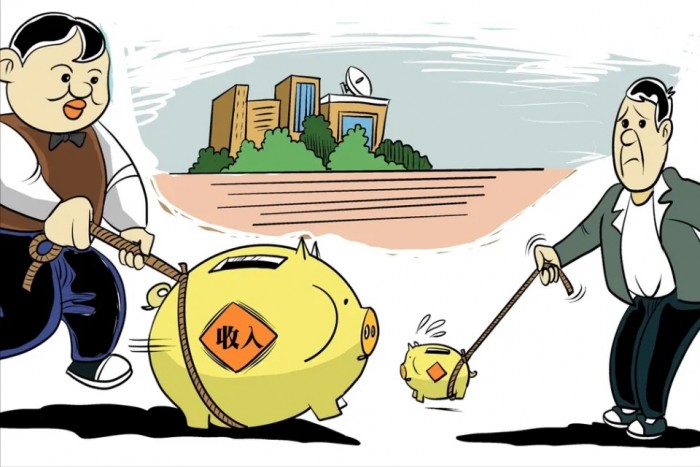 |
| China's current account surplus is projected to reach 1 trillion dollars annually. Yet amid this, the wealth gap continues to widen. An editorial cartoon from one media outlet vividly illustrates this reality. / The Beijing News |
While it is virtually certain that China's current account surplus this year will near 1 trillion dollars—a clear reality rather than a pipe dream—the wealth gap is also showing signs of steadily widening, deepening the authorities' concerns. Without workable countermeasures in the near term, a national disaster could loom on the horizon.
Synthesizing recent reports from media outlets including The Beijing News, China's current account balance in the first half of this year is estimated to have reached 378 billion dollars (504.63 trillion won). That equates to posting roughly 200 billion dollars in the first quarter alone. Considering that the current account surplus typically expands further in the second half of the year, the likelihood of nearing 1 trillion dollars this year is quite high. It would not be an exaggeration to say that expressions of marvel at this unprecedented feat arise naturally.
Under such conditions, it would hardly be surprising if nearly all Chinese citizens were cheering. If they expect that an immense current account surplus—no matter how limited the trickle-down effect—will have some positive bearing on their livelihoods, that would seem entirely natural. Yet reality appears to be heading in the exact opposite direction. The prevailing situation can well be characterized by widespread discontent, with the vast majority complaining that their felt economic conditions are worsening.
Indeed, examining economic conditions as of mid-October, this verdict is by no means an overstatement. China's economic authorities set an economic growth target of 4.5 to 5% during the fourth session of the 14th National People's Congress (NPC, China's parliament) in March this year. With roughly two and a half months remaining in the year, projections suggest this target is achievable to a certain degree. From the authorities' perspective, carrying themselves with confidence and standing tall might seem warranted.
However, once one recalls that the industrial sectors driving this economic growth are limited to a select few—such as artificial intelligence (AI), humanoid robots, semiconductors, and lithium batteries—the story shifts entirely. That is because it leads naturally to the conclusion that many other sectors employing the majority of the population are languishing. In reality, industries including real estate, catering, shipbuilding, and steel are reportedly suffering under historically severe slumps.
Moreover, economic disparities between large metropolitan areas, smaller cities, and rural provinces in China are exceptionally severe. Hoping that AI and other advanced industries in major metropolitan areas will produce positive spillover effects for smaller cities or rural regions is essentially wishful thinking. In addition, as demonstrated by the case of Taiwan, the positive trickle-down effects of AI and high-tech sectors on the broader economy remain quite limited. One can assert without hesitation that this falls far short of easing the polarization characterizing the overall industrial landscape.
Naturally, such realities adversely affect the "rich get richer, poor get poorer" landscape confronting 1.4 billion Chinese citizens, carrying a strong likelihood of further widening the wealth gap. According to recent analyses by media outlets and economic commentators, the divide appears to be deteriorating at a rapid pace. Some argue that the Gini coefficient—an index of wealth inequality where 1 denotes maximum inequality—is quickly racing toward 0.5, a perilous benchmark signifying uncontrollable danger. Standing currently at 0.47, crossing that threshold is largely a matter of time.
If the wealth gap widens further, social cohesion could face significant strain. Considering that China is a socialist country, this is an outcome that is truly unacceptable. Handled poorly, there is no guarantee that not just China, but the entire world, will avoid an unprecedented catastrophe. It is no exaggeration to say that the concerns of China's economic authorities are deepening substantially.
Hong Soon-do
Most Read
-
1
Trump shares map on social media labeling Strait o..

-
2
Kia Sportage outperforms Mazda CX-5 in German auto..

-
3
Houthis launch successive attacks on Saudi airport..

-
4
U.S. deploys carrier, 10,000 more troops to Middle..

-
5
Saudi airport in Riyadh struck again, leaving at l..

-
6
Japan tracks Ukraine fiber-optic drones, bolsters..

-
7
Putin's ally visits China on the 8th ahead of APEC..

PEOPLE






HEADLINE NEWS
- Trump slams Nobel Peace Prize snub, claiming he is 'preventing war' between the two Koreas
- China makes tactical retreat following fierce pushback from EU
- Japan openly opposes U.S. sanctions on ICC, fueling tensions with Washingto..
- Military service exemptions for artists and athletes under scrutiny at parl..

-
Address : In-Young Bldg., 34, Uisadang-daero 1-gil, Yeongdeungpo-gu, Seoul
Copyright by ASIATODAY CO., LTD. All rights resereved