



S. Korea eyes return to Poland’s nuclear market via Westinghouse after earlier exit
Oct 12, 2026, 10:28 am


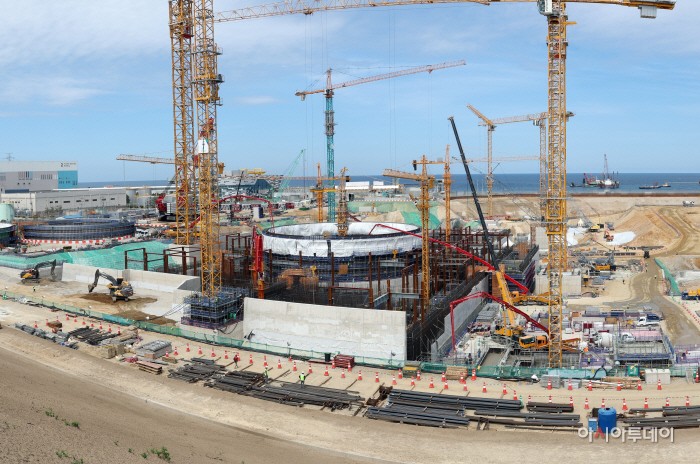 |
| Construction site of Shin-Hanul Units 3 and 4 at the Hanul Nuclear Power Headquarters. / Korea Hydro & Nuclear Power (KHNP) |
Possibilities are resurfacing for South Korean nuclear energy firms to enter Poland's nuclear power projects, even after South Korea withdrew from direct bidding. Following recent nuclear cooperation agreements between South Korea and the U.S. that established frameworks expanding Korean corporate involvement in AP1000 equipment supply and construction, opportunities could open up for domestic players such as Doosan Enerbility and Hyundai E&C if Poland selects the American reactor model.
According to nuclear industry sources on the 11th, Poland's second nuclear power plant project is currently undergoing partner selection procedures covering technology and business proposals, vetting bids from the U.S., France, and Canada. The Polish government plans to select its strategic partner and technology in 2027, with groundbreaking projected around 2032. The evaluation framework reviews bundled proposals combining technology and financing, jointly assessing electricity pricing, local industry participation, and investor equity contributions.
Korea Hydro & Nuclear Power (KHNP) stepped back from Polish nuclear projects after resolving intellectual property disputes with Westinghouse ahead of its Czech nuclear power deal. Under that agreement, KHNP's participation in new European nuclear ventures was constrained, sidelining it from direct bidding on Poland's second plant.
Doosan Enerbility previously supplied major equipment—including reactor pressure vessels and steam generators—for AP1000 reactors at the Vogtle plant in the U.S. Last month, Reuters highlighted Doosan alongside Canada's BWXT as key qualified suppliers available to support the global scale-up of the AP1000 design. Should Westinghouse be selected as partner for Poland's second plant, Doosan could enter the competitive fray to supply major components.
Hyundai E&C participated in constructing Units 1 through 4 of the Barakah Nuclear Power Plant in the United Arab Emirates and is pursuing collaboration with Westinghouse on Bulgaria's new nuclear power build. If the American reactor model is chosen in Poland, prospects for cooperation in engineering, procurement, and construction (EPC) could gain traction.
South Korea–U.S. nuclear cooperation frameworks include provisions for Korean firms to participate in construction and equipment supply for domestic U.S. AP1000 projects. Cameco, a major co-owner of Westinghouse, noted that new AP1000 orders in the U.S. could catalyze broader adoption of the reactor design across global markets.
At the 1st Nuclear Export Leaders Forum held on the 7th, Lee Sang-eun, head of the Nuclear Export Promotion Division at the Ministry of Trade, Industry and Energy, noted, "Accumulating equipment supply and construction track records through U.S. AP1000 projects will enable South Korean companies to leverage those credentials in third-country markets. We will broaden participation in global AP1000 projects by facilitating vendor registrations and certifications with Westinghouse."
However, bilateral nuclear cooperation between Seoul and Washington does not automatically guarantee contract awards in Poland. Even if the U.S. is selected as the strategic partner for the second plant, supply contracts for primary components, ancillary equipment, and construction must go through individual procurement and contracting rounds. Westinghouse is currently pursuing supplier partnerships with six British companies across valves, pumps, pressure vessels, heat exchangers, and piping, while also consulting with Canada's BWXT regarding the fabrication of steam generators and reactor vessels.
Supply chain competition has also intensified around Poland's first nuclear plant. Polskie Elektrownie Jądrowe (PEJ) entrusted procurement procedures for long-lead items for the initial AP1000 unit to Westinghouse on the 8th. Marking the stage where supplier selection and raw material orders begin for critical components like containment vessels and structural modules, Westinghouse signaled plans to integrate Polish suppliers across its European AP1000 pipeline.
Poland aims to elevate domestic industry participation from around 40% for the first unit up to 70% for subsequent units. Westinghouse is conducting final qualification assessments on six Polish enterprises to evaluate nuclear-grade quality requirements and manufacturing capabilities. South Korean companies cannot rely solely on historical supply and construction credentials; they must compete directly against local and international suppliers on price, delivery schedules, quality certifications, and local procurement quotas.
Jeong Soon-young
Most Read
-
1
Trump shares map on social media labeling Strait o..

-
2
Kia Sportage outperforms Mazda CX-5 in German auto..

-
3
Houthis launch successive attacks on Saudi airport..

-
4
U.S. deploys carrier, 10,000 more troops to Middle..

-
5
Japan tracks Ukraine fiber-optic drones, bolsters..

-
6
Putin's ally visits China on the 8th ahead of APEC..

-
7
Chinese military support and training center opens..

PEOPLE





HEADLINE NEWS
- Trump slams Nobel Peace Prize snub, claiming he is 'preventing war' between the two Koreas
- China makes tactical retreat following fierce pushback from EU
- Japan openly opposes U.S. sanctions on ICC, fueling tensions with Washingto..
- Military service exemptions for artists and athletes under scrutiny at parl..

-
Address : In-Young Bldg., 34, Uisadang-daero 1-gil, Yeongdeungpo-gu, Seoul
Copyright by ASIATODAY CO., LTD. All rights resereved