



15 nations including S. Korea, the U.S., and Japan launch joint response to China's industrial overcapacity
Oct 12, 2026, 10:05 am


A coalition of 15 nations, including South Korea, the United States, Japan, and European Union (EU) member states, has moved to devise joint countermeasures against the swift diversion of Chinese goods into European and emerging markets after being blocked by U.S. trade barriers. The initiative appears driven by the shared assessment that Chinese firms, leveraging massive industrial capacity and ultralow pricing—the so-called high price-to-performance ratio—are eating into global market share and posing a direct threat to domestic industries worldwide.
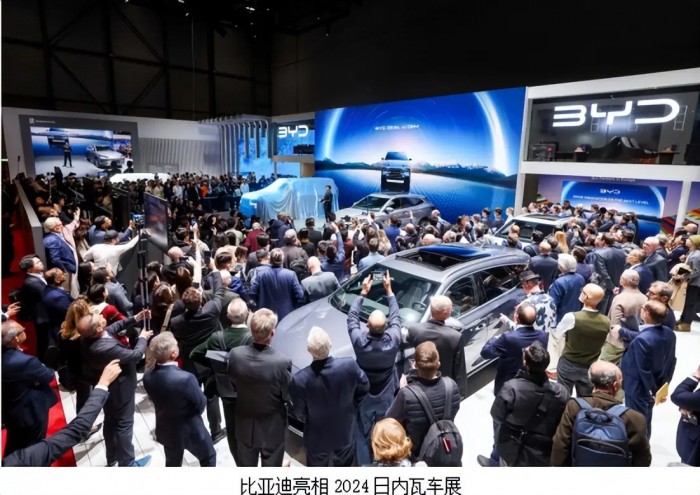 |
| A scene from a 2024 motor show presentation in Geneva, Switzerland, by BYD, China's leading electric vehicle maker. The display appears to illustrate the potent momentum of Chinese EVs sweeping across Europe. / The Beijing News (Xinjingbao) |
According to Beijing sources well-versed in global economic affairs on the 9th, a group of 15 nations, including South Korea, issued a "Joint Ministerial Statement on Addressing Structural Overcapacity" on the 7th (local time) at the headquarters of the Organisation for Economic Co-operation and Development (OECD) in Paris, France. The joint statement brought together 15 participants, including South Korea, the United States, Japan, the European Union, the United Kingdom, Canada, Australia, and India.
The participating countries first defined structural global overcapacity as a grave threat to the global economy. They stressed the critical necessity of confronting non-market policies and practices, such as subsidies that distort market mechanisms and perpetuate chronic overproduction. The targeted areas for joint response span five core sectors: automobiles and electric vehicles, batteries, chemicals, legacy semiconductors, and solar panels. Moving forward, the participating nations plan to establish sector-specific working groups to assess industrial surplus capacities and analyze their ripple effects across global markets while formulating countermeasures.
The statement stopped short of explicitly naming the originator of the overcapacity. Nevertheless, observers see the initiative as unmistakably aimed at China. Given that no other nation possesses the staggering manufacturing scale and cost advantages rapidly capturing market share across key sectors like EVs and batteries, the target is evident.
This reality is plainly reflected in new energy vehicle (NEV) production metrics. According to recent reports from Chinese media outlets, including The Beijing News (Xinjingbao), China produced an estimated 16.626 million NEVs—encompassing battery electric and plug-in hybrid models—last year alone, marking a sharp 29% jump from the previous year. With output reaching 12.6 million units through September this year, annual production is expected to close near 17 million units, modestly outpacing last year's figures.
Export volumes abroad proved equally substantial. Roughly 2.615 million units—representing about 15.7% of total production—were shipped outside China. Exports of pure battery electric vehicles alone totaled roughly 1.65 million units, closely trailing total EV sales in the EU last year (about 1.88 million units) and far surpassing total U.S. sales (about 1.27 million units). By any measure, the sector has maintained formidable momentum.
Washington, however, has moved aggressively to halt this expansion. Entry into the U.S. market is poised to become increasingly difficult going forward. Reflecting the adage that "where there is a policy from above, there is a countermeasure from below," Chinese manufacturers have responded vigorously by swiftly shifting export channels toward European and emerging markets. Against this backdrop, the coordinated action by the 15-nation coalition appears well grounded.
Conditions remain broadly analogous across other industrial sectors, where high-volume shipments and rock-bottom prices serve as the default playbook. Given that China's structural overcapacity is projected to endure for an extended period, these competitive dynamics will almost certainly intensify. The policy dilemma confronting the 15-nation coalition is set to deepen over time.
Hong Soon-do
Most Read
-
1
Trump shares map on social media labeling Strait o..

-
2
Kia Sportage outperforms Mazda CX-5 in German auto..

-
3
Houthis launch successive attacks on Saudi airport..

-
4
U.S. deploys carrier, 10,000 more troops to Middle..

-
5
Japan tracks Ukraine fiber-optic drones, bolsters..

-
6
Putin's ally visits China on the 8th ahead of APEC..

-
7
Chinese military support and training center opens..

PEOPLE






HEADLINE NEWS
- Trump slams Nobel Peace Prize snub, claiming he is 'preventing war' between the two Koreas
- China makes tactical retreat following fierce pushback from EU
- Japan openly opposes U.S. sanctions on ICC, fueling tensions with Washingto..
- Military service exemptions for artists and athletes under scrutiny at parl..

-
Address : In-Young Bldg., 34, Uisadang-daero 1-gil, Yeongdeungpo-gu, Seoul
Copyright by ASIATODAY CO., LTD. All rights resereved