



S. Korea launches 'K-GX' initiative to foster decarbonized industries and green technologies
Oct 08, 2026, 10:41 am


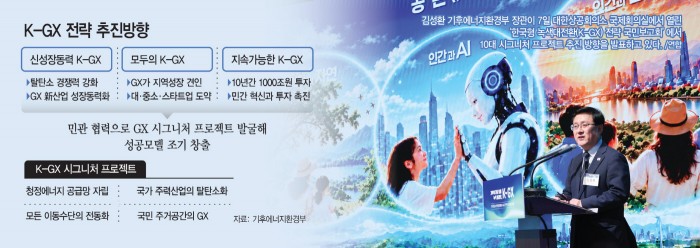 |
The South Korean government has decided to deploy 1,000 trillion won in funding—combining fiscal expenditure and climate finance—by 2035 to overhaul production methods in high-carbon industries such as steel and petrochemicals, while cultivating green industries into new growth engines. The private sector will also launch investment projects valued at 220 trillion won to develop next-generation technologies and expand production facilities.
On the 7th, the government held a public briefing attended by the President at the Korea Chamber of Commerce and Industry in Jung-gu, Seoul, where it unveiled the "Korean Green Transformation (K-GX) Strategy." The plan is anchored on three key pillars: strengthening industrial competitiveness, fostering shared growth between regions and businesses, and establishing a sustainable investment foundation. Public-private partnership "Signature Projects" will be pursued across four areas: clean energy supply chain independence, decarbonization of flagship industries, electrification of transportation, and the green transformation of residential spaces.
The funding backing the strategy spans from 2026 to 2035, comprising 200 trillion won from state finances and over 790 trillion won in climate finance. Government budgets will support technology development and facility investments, while loans and guarantees from policy financing institutions will alleviate the burden of transition investments for corporations. More than 50% of the climate financing supply will be allocated to regional areas, and over 70% to small and medium-sized enterprises (SMEs) and mid-market firms.
By sector, the government aims to demonstrate a 300,000-ton-class hydrogen-reduction steelmaking facility by 2030, with commercialization targeted for 2037. In petrochemicals, core technologies for electrically heated naphtha cracking facilities will be secured by 2028, and next-generation tandem solar cells are slated for commercialization that same year. Domestic production tax credits for solar, wind, and battery manufacturing are also set to be introduced. Detailed sector-by-sector transition roadmaps for high-emission industries will be released toward the end of the year.
Alongside financial support, regulatory reforms will be pursued in parallel to improve corporate investment conditions. Lee Hyung-il, Deputy Prime Minister and Minister of Economy and Finance, stated, "We will support expedited licensing for companies holding core GX technologies and expand the regulatory sandbox to foster an environment where enterprises can concentrate on investment and innovation." He added, "Now that the climate crisis is intensifying, sustainable growth and quality job creation can only be realized when AI transformation (AX) is paired with GX." AX stands for AI transformation, while GX refers to green transformation.
This green transition applies not only to industrial sites but also to household heating and cooling systems. Kim Sung-whan, Minister of Climate, Energy, and Environment, remarked, "Following the rollout of heat pumps to general housing this year, we plan to demonstrate gas-pipe-free apartments next year." He continued, "Energy-independent eco-friendly homes combining heat pumps, solar panels, and energy storage systems (ESS)—driven by Samsung Electronics and LG Electronics—will fundamentally reshape the future residential landscape."
However, performance management for the climate finance supporting the transition remains centered around the volume of capital supplied. While the government included plans to establish an information-sharing platform and a performance monitoring framework in this strategy, it did not provide specific methodology or an operational timeline for tallying total emissions reductions across all financial assistance to evaluate contributions toward the Nationally Determined Contribution (NDC) targets.
Transition finance includes mechanisms to monitor emissions and verify whether funded firms are fulfilling their transition plans. The strategy also intends to strengthen impact and reduction assessments for state-budget projects relative to the NDC. Nonetheless, how individual corporate inspections and budget evaluation results will be aggregated into the overarching reduction performance of climate finance as a whole remains to be detailed separately.
Civil society advocates have noted that support measures must be coupled with stronger emissions reduction incentives for corporations. They emphasize the need to expand the auctioning of emissions permits and disclose carbon intensities by sector, enterprise, and product to link them directly to assistance benchmarks and compliance audits.
Jeong Soon-young
Most Read
-
1
Trump shares map on social media labeling Strait o..

-
2
Kia Sportage outperforms Mazda CX-5 in German auto..

-
3
U.S. deploys carrier, 10,000 more troops to Middle..

-
4
Trump rejects Iran's offer to open Strait of Hormu..

-
5
N. Korea conducts first swarm attack drill with dr..

-
6
U.S.-China summit falls short on substance as Trum..

-
7
Japan tracks Ukraine fiber-optic drones, bolsters..

PEOPLE






HEADLINE NEWS
- Seoul dismisses Ukraine's claim of 'S. Korean support for Russia' as "inaccurate and inappropriate"
- S. Korea, Japan race to develop nuclear-powered submarines
- Henri Kagan, Kenso Soai win Nobel Prize in Chemistry for uncovering how mol..
- Vance says Alaska LNG cooperation will move forward with Seoul's current or..

-
Address : In-Young Bldg., 34, Uisadang-daero 1-gil, Yeongdeungpo-gu, Seoul
Copyright by ASIATODAY CO., LTD. All rights resereved