



Seizures of Chinese fishing boats decline for second straight year
Oct 08, 2026, 09:49 am


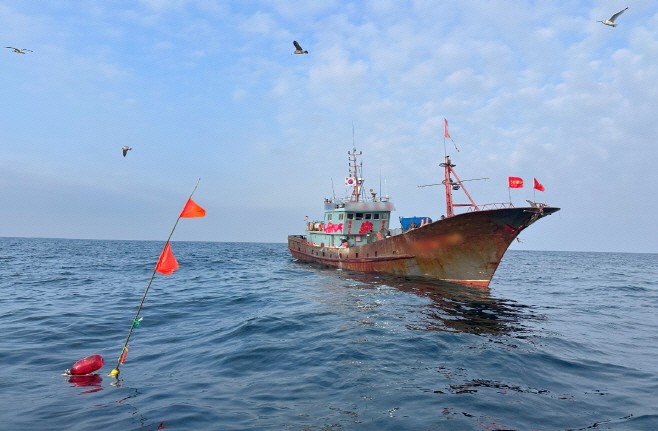 |
| A Chinese fishing vessel seized for violating restrictions under the Act on the Exercise of Sovereign Rights over Foreigners' Fishing Activities within the Exclusive Economic Zone. / Mokpo Coast Guard |
Seizures of Chinese fishing vessels in the exclusive economic zone (EEZ) by the National Fishery Products Quality Management Service's Fishery Management Service—responsible for protecting fisheries resources and cracking down on illegal fishing in South Korean waters—have been on the decline. While the Ministry of Oceans and Fisheries maintains that seizure numbers alone do not indicate weakened enforcement, personnel in the field point out that responding effectively has become increasingly difficult due to staffing shortages and the increasingly sophisticated evasion tactics used by Chinese vessels.
According to the Ministry of Oceans and Fisheries and related authorities on the 7th, the number of Chinese fishing vessels seized by the Fishery Management Service within the EEZ declined for two consecutive years, dropping from 59 vessels in 2023 to 49 in 2024 and 39 in 2025. This contrasts with the Korea Coast Guard, whose seizures of Chinese fishing vessels rose to 52 vessels last year.
Regarding this trend, a ministry official explained that "if violations decrease, the number of seizures can also drop."
Separate from the decline in seizures, observers point to structural limitations in on-site enforcement capacity. In particular, detection and proof itself have grown harder as Chinese vessels adopt increasingly clever tactics to evade crackdowns. Some note that crews on Chinese vessels are well-versed in how to respond once apprehended.
Verifying and proving illegal fishing activities has also become more demanding. While blatant violations have decreased, vessels continue to skirt the law through methods such as keeping duplicate fishing logs or reversing statements in court by claiming they were merely in transit and not fishing.
Physical constraints also pose an obstacle, as boarding inspection teams of only four to five personnel struggle to thoroughly search concealed fish holds and other hidden compartments on large Chinese vessels amid shortages of on-site personnel.
As of last month, personnel rosters across government fisheries inspection vessels under the West Sea Fishery Management Service showed that several of the 13 vessels in its jurisdiction were operating below authorized strength. The Mugunghwa 5, 10, and 14 each had an authorized complement of 19 but an actual roster of 17, while the Mugunghwa 24 had an authorized complement of 22 and an actual roster of 19.
Additionally, the concentration of crackdown duties among a small group of experienced personnel and a staffing system that does not adequately reflect the nature of field operations are cited as compounding problems. Recruiting staff as general civil servants without separate physical fitness tests is seen as a limiting factor in maintaining a stable pool of personnel suited for high-risk boarding inspections of Chinese vessels.
An industry source noted that "while eight or nine out of ten Chinese vessels follow instructions safely, teams must always factor in the remaining dangerous scenarios." Because of the constrained talent pool, enforcement capacity has been curtailed, leading inspection vessels to deploy only one fast interceptor boat where they previously operated two.
Systemic limitations also hamper responses to increasingly sophisticated evasion methods. Unlike the Coast Guard, the Fishery Management Service lacks dedicated investigative units, leaving navigation personnel to handle investigations alongside their core duties.
Lee Jeong-yeon
Most Read
-
1
Trump shares map on social media labeling Strait o..

-
2
Kia Sportage outperforms Mazda CX-5 in German auto..

-
3
U.S. deploys carrier, 10,000 more troops to Middle..

-
4
Trump rejects Iran's offer to open Strait of Hormu..

-
5
N. Korea conducts first swarm attack drill with dr..

-
6
U.S.-China summit falls short on substance as Trum..

-
7
Japan tracks Ukraine fiber-optic drones, bolsters..

PEOPLE






HEADLINE NEWS
- Seoul dismisses Ukraine's claim of 'S. Korean support for Russia' as "inaccurate and inappropriate"
- S. Korea, Japan race to develop nuclear-powered submarines
- Henri Kagan, Kenso Soai win Nobel Prize in Chemistry for uncovering how mol..
- Vance says Alaska LNG cooperation will move forward with Seoul's current or..

-
Address : In-Young Bldg., 34, Uisadang-daero 1-gil, Yeongdeungpo-gu, Seoul
Copyright by ASIATODAY CO., LTD. All rights resereved