



Argentines’ dollar purchases surge after FX controls lifted, nearing size of foreign reserves
Sep 30, 2026, 10:26 am


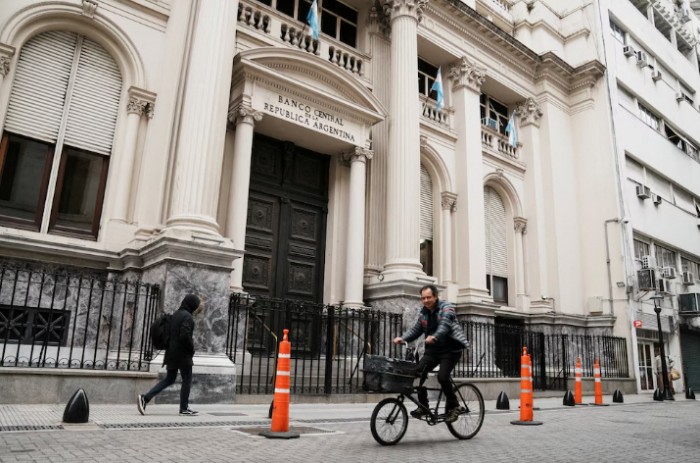 |
| Pedestrians walk past the central bank in Buenos Aires, Argentina. / Reuters, Yonhap |
The amount of U.S. dollars purchased by Argentine citizens since currency exchange controls were lifted in April 2024 has been found to rival the country's foreign exchange reserves.
According to Infobae, the Central Bank of Argentina stated in its foreign exchange balance report on the 28th (local time) that U.S. dollar cash purchased by the non-financial private sector, including individuals and corporations, through official channels such as commercial banks totaled $47.29 billion from April 2025 to August 2026.
Adding U.S. dollars purchased by the private sector via wire transfers brings the total to $51.644 billion. Over the same period, U.S. dollars sold by the non-financial private sector stood at $6.947 billion.
As of the 23rd, Argentina's foreign exchange reserves tallied by the central bank stood at $48.928 billion. Had it not been for the massive private demand for foreign exchange, Argentina's foreign exchange reserves could have reached $100 billion.
Argentina, which had imposed various restrictions—such as capping official peso-dollar currency exchanges at $200 per person per month due to a dollar shortage—lifted its foreign exchange controls in April 2024.
With the easing of exchange restrictions, private demand that once flocked to the black market shifted toward official channels such as banks. According to the central bank, individuals, corporations, and other private buyers purchasing U.S. dollars in the foreign exchange market last April totaled a cumulative 1 million people, with purchases reaching $2.077 billion.
The removal of exchange restrictions also restored order to the foreign exchange market. The gap between the black-market dollar rate and the official exchange rate, which once widened to 180% in 2023, narrowed to around 2% this month, bringing stability to a market previously destabilized by five to six competing peso-dollar exchange rates.
For Argentine citizens, whose currency lost value amid past hyperinflation making peso savings impossible, physical U.S. dollar cash was virtually the only viable means of saving.
Even when fixed-deposit interest rates surged well past 100% in 2022–2023, many still favored dollar exchange over bank deposits due to this longstanding backdrop.
The appeal of dollar investment in Argentina has recently been waning. This shift stems from the peso-dollar exchange rate rising at a slower pace compared to inflation.
The peso-dollar exchange rate rose only about 3.3% (50 pesos), moving from 1,495 pesos in January to 1,545 pesos as of September. According to the National Institute of Statistics and Censuses (INDEC), consumer prices rose 21.3% from January to August. In effect, the purchasing power of the dollar has declined accordingly.
Local media reported analyses indicating that while the appeal of dollar investments is no longer what it used to be when comparing exchange rate trends against inflation, the persistent demand for currency exchange shows that the myth of dollar invincibility remains firmly intact in Argentina.
Son Young-sik
Most Read
-
1
Trump shares map on social media labeling Strait o..

-
2
Kia Sportage outperforms Mazda CX-5 in German auto..

-
3
Houthis launch successive attacks on Saudi airport..

-
4
U.S. deploys carrier, 10,000 more troops to Middle..

-
5
Trump rejects Iran's offer to open Strait of Hormu..

-
6
N. Korea conducts first swarm attack drill with dr..

-
7
U.S.-China summit falls short on substance as Trum..

PEOPLE






HEADLINE NEWS
- Seoul dismisses Ukraine's claim of 'S. Korean support for Russia' as "inaccurate and inappropriate"
- S. Korea, Japan race to develop nuclear-powered submarines
- Henri Kagan, Kenso Soai win Nobel Prize in Chemistry for uncovering how mol..
- Vance says Alaska LNG cooperation will move forward with Seoul's current or..

-
Address : In-Young Bldg., 34, Uisadang-daero 1-gil, Yeongdeungpo-gu, Seoul
Copyright by ASIATODAY CO., LTD. All rights resereved