



Indonesia pushes E50 ethanol blend, aims to end gasoline imports
Sep 23, 2026, 09:53 am


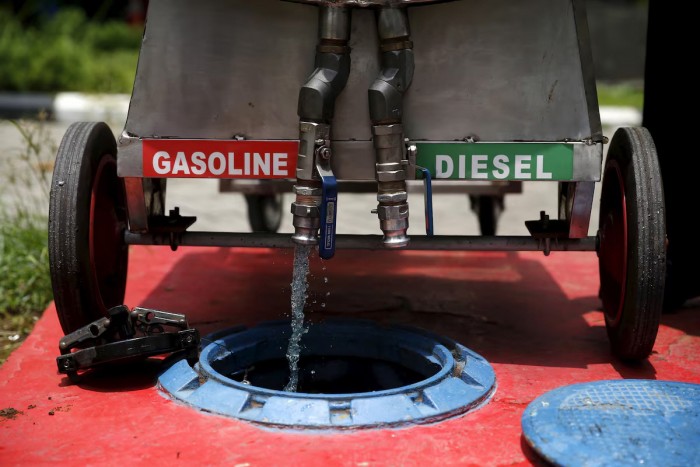 |
| A worker pumps gasoline into an underground storage tank at a gas station in Jakarta, Indonesia. / Reuters, Yonhap News |
The Indonesian government has begun establishing a roadmap to introduce E50, a fuel blend containing 50% ethanol. The initiative aims to completely eliminate dependence on imported finished gasoline and achieve energy self-sufficiency.
According to Indonesian state news agency Antara on the 22nd (local time), Minister of Energy and Mineral Resources Bahlil Lahadalia met with reporters the previous day following a ministry event in Jakarta and stated, "If we can achieve the E50 standard, we will meet our target of completely halting finished gasoline imports." Minister Bahlil noted that President Prabowo Subianto instructed the National Energy Council to immediately draw up an E50 implementation roadmap.
The rollout will proceed in phases. Plans call for introducing E10 (a 10% ethanol blend) first in 2027, raising the blend ratio to E20 in 2028, and ultimately scaling up to E50.
The initiative follows the successful rollout of the mandatory B50 biodiesel program, which blends 50% palm-based fatty acid methyl ester (FAME). Indonesia's annual gasoline consumption stands at 39 million to 40 million kiloliters. The government intends to replace these imports using abundant domestic agricultural resources, shielding the country from energy security risks posed by global geopolitical volatility.
To that end, the government designated sugarcane, cassava, and corn as the three primary feedstocks for ethanol production, drawing inspiration from Brazil's adoption of 100% ethanol fuel.
Meeting all feedstock requirements purely through domestic supply was set as a strict prerequisite. Minister Bahlil reaffirmed the domestic production principle, stating, "We do not want to pursue E10, E20, or E50 if ethanol is imported from abroad; that would amount to no difference from importing gasoline."
The key challenge lies in local processing capacity. While Indonesia began introducing E5 (a 5% blend) across key hubs such as Jakarta and Java last July, annual production stood at only around 160,000 kiloliters as of 2024, according to the bioethanol producers association. Because implementing just E10 requires roughly 1.4 million kiloliters per year—nearly nine times current output—the speed of expanding processing infrastructure to meet target timelines will be critical.
Alongside biofuel expansion, President Prabowo is pursuing a comprehensive energy security strategy that includes accelerating domestic oil field and basin exploration while boosting recovery efficiency at mature wells to expand national crude production.
Jeong Ri-na
Most Read
-
1
Celltrion’s Omlyclo gains ground in major European..

-
2
Trump demands rates fall below 1% as Fed hikes for..

-
3
Trump makes $1 trillion bet ahead of midterm elect..

-
4
Iran resumes ballistic missile production, assembl..

-
5
Trump warns countries not helping U.S. must pay re..

-
6
Apple launches first foldable, 1 million won prici..

-
7
Turkish Airlines named main club partner of Liverp..

PEOPLE







-
Address : In-Young Bldg., 34, Uisadang-daero 1-gil, Yeongdeungpo-gu, Seoul
Copyright by ASIATODAY CO., LTD. All rights resereved