



Consumer sentiment rebounds after one month as stock volatility eases, income outlook improves
Sep 23, 2026, 09:38 am


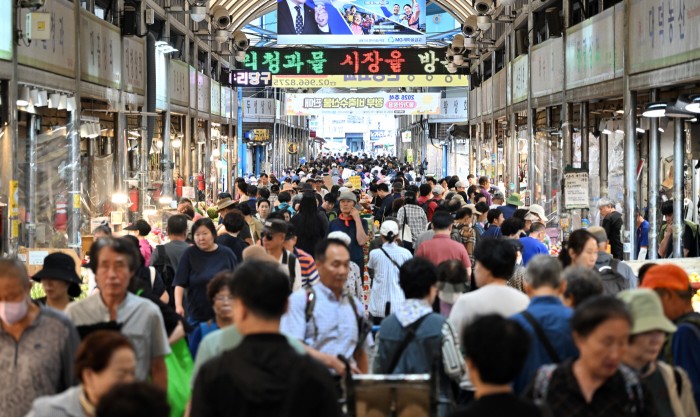 |
| Citizens shop for groceries at a traditional market in downtown Seoul. / Reporter Song Ui-ju |
South Korea's consumer sentiment rebounded after a one-month dip, driven by easing domestic stock market volatility and solid real economic indicators such as exports and private consumption. In particular, growing expectations for income improvements amid expanding economic growth boosted household income outlooks and notably enhanced current economic perceptions.
While housing prices in the Seoul metropolitan area continued to rise, the effects of government real estate measures and benchmark interest rate hikes offset the upward momentum, keeping the housing price outlook steady at last month's level.
According to the "September Consumer Survey Results" released by the Bank of Korea on the 23rd, the Composite Consumer Sentiment Index (CCSI) for this month stood at 106.6, up 2.1 points from the previous month (104.5). After retreating from 106.8 in July to 104.5 in August, the index turned upward again after a one-month decline.
The CCSI is calculated based on six major sub-indices: current living standards, prospective living standards, prospective household income, prospective consumer spending, current economic judgment, and prospective economic conditions. A reading above the long-term baseline of 100 indicates that consumer sentiment is more optimistic than historical averages.
Expectations for improved income conditions played a major role. The CSI for prospective household income rose 2 points month-on-month to 102. Prospective consumer spending CSI also increased by 1 point to 110, while prospective living standards CSI climbed 1 point to 98.
Perceptions of general economic conditions also improved. The current economic judgment CSI gained 4 points from the previous month to reach 83, and the prospective economic conditions CSI moved up 1 point to 90. The Bank of Korea attributed these gains to sustained momentum in real economic sectors including exports and consumption, along with reduced volatility in the domestic equities market.
The housing price prospective CSI remained unchanged from the previous month at 125. After rising steeply from 96 in March to 104 in April, 112 in May, 120 in June, and 127 in July, the index dipped to 125 in August and remained flat this month. The central bank assessed that strong gains in Seoul metropolitan apartment prices exerted upward pressure, while government real estate policy measures and the benchmark interest rate hike on the 27th of last month acted as downward counterweights.
Park Yong-min, head of the economic sentiment survey team, remarked, "It continues to maintain a high level compared to the long-term average of 107. Given that the upward pace of housing prices in the greater Seoul area remains high, expectations of housing price increases also appear to remain elevated."
The interest rate prospective CSI, which forecasts interest rate levels six months ahead, rose 3 points month-on-month to 128, marking its highest reading in roughly three years since October 2023 (128).
Expected inflation for the coming year stood unchanged from the previous month at 2.7%. When asked which items would exert the greatest upward pressure on prices over the next year, respondents most frequently cited petroleum products at 52.7%.
Park noted, "Robust semiconductor exports translated into facility investments and consumer spending recovery, which in turn spurred improvements in income conditions. Looking ahead, given various unforeseen variables such as stock market fluctuations and conflicts in the Middle East, it remains premature to definitively say that this upward trend will persist continuously."
Han Sang-wook
Most Read
-
1
Celltrion’s Omlyclo gains ground in major European..

-
2
Trump demands rates fall below 1% as Fed hikes for..

-
3
Trump makes $1 trillion bet ahead of midterm elect..

-
4
Iran resumes ballistic missile production, assembl..

-
5
Trump warns countries not helping U.S. must pay re..

-
6
Apple launches first foldable, 1 million won prici..

-
7
Turkish Airlines named main club partner of Liverp..

PEOPLE







-
Address : In-Young Bldg., 34, Uisadang-daero 1-gil, Yeongdeungpo-gu, Seoul
Copyright by ASIATODAY CO., LTD. All rights resereved