



1.18 million senior jobs planned, raising future tax burden
Sep 22, 2026, 09:20 am


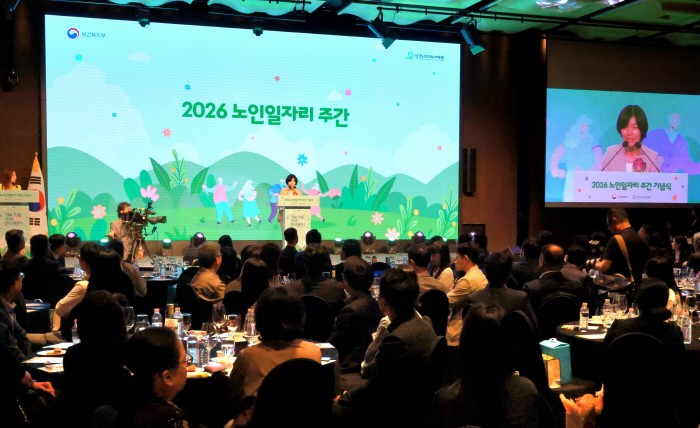 |
| Hyun Soo-yup, first vice minister of health and welfare, speaks at a ceremony marking Senior Jobs Week at The Plaza Seoul in Jung-gu, Seoul, on Sept. 21. / Yonhap |
The number of jobs for older adults will increase from 1.15 million to 1.18 million next year. While intended to boost seniors' vitality and reduce the support burden on the younger generation through work-driven self-reliance, the initiative remains focused on simple manual labor, such as caregiving and cleaning, while continuing to expand purely in quantitative terms, increasingly burdening future generations.
According to the Ministry of Health and Welfare on the 21st, next year's elderly job positions will reach 1.18 million, an increase of 30,000 from this year. South Korea's re-employment policy largely centers on senior job programs, heavily concentrated in welfare services provided by government agencies and social enterprises. The aging of workplaces and the deterioration of job quality are also accelerating. While youth employment in sectors like manufacturing and information and communications technology continues to decline, job growth remains predominantly driven by senior employment in areas such as social welfare.
According to a report titled "Outlook for Welfare Project Restructuring and Fiscal Requirements in an Aging Society," conducted last year through a National Assembly Budget Office research commission, the ministry's budget for senior jobs and social activity support surged 1.68 times in five years, climbing from 1.2995 trillion won in 2020 to 2.1846 trillion won in 2025. Senior job programs account for the largest share of senior welfare spending after the basic pension and long-term care insurance. The quantitative expansion centered on public-sector jobs without qualitative growth is directly translating into national fiscal expenditures.
As much as 85.5% of the demand base for senior jobs already receives the basic pension, which is financed entirely by tax revenue. The basic pension, which accounts for the largest proportion of senior welfare expenditures, has been on a steep upward trajectory, rising from 13.1759 trillion won in 2020 to 21.8146 trillion won last year. Fiscal requirements have been exacerbated further as next year's basic pension was altered for the worse to grant an extra 30,000 won per month to the bottom 30%. This structure constitutes dual support, handing simple manual jobs funded by tax dollars to basic pension recipients.
The problem is that the working-age population paying taxes is shrinking amid South Korea's entry into a super-aged society, whereas the senior population requiring support is swelling rapidly, meaning the burden on future generations will grow increasingly heavy. According to 2023 National Data Service projections, the proportion of seniors aged 65 and older in the total population is estimated to jump from 20.3% (10.51 million) in 2025 to 44.2% (18.68 million) by 2060. The ministry's overall budget for the senior sector is also expanding rapidly. The total senior sector budget of the Ministry of Health and Welfare grew by more than 10 trillion won in five years, increasing from an executed 16.6156 trillion won in 2020 to 27.4794 trillion won in the 2025 budget.
Experts point out that unless the structure of current senior welfare projects—fixated solely on quantitative expansion—is overhauled, a fiscal crisis beyond what future generations can endure will emerge. In particular, experts suggest raising the qualifying age for senior job programs, currently set at 60 to 65, to pace the tax burden imposed on the youth demographic. Indeed, an analysis showed that raising the eligibility age for senior jobs and social activity support from the current 65 to 70 would have saved 867.3 billion won in government expenditures as of 2024.
Studies from institutions including the Korea Development Institute (KDI) have also suggested the need to steadily raise the senior threshold age by about one year every decade, taking into account the pace of improvements in seniors' health conditions. This is because if the senior age remains fixed at 65, South Korea's burden of supporting the senior population after 2054 is projected to reach the highest level among member countries of the Organization for Economic Cooperation and Development (OECD).
At a symposium held that day during "Senior Job Week," calls were also made for expanding private-sector employment free from fiscal dependence and facilitating region-tailored matching. In a presentation titled "Demographic Shifts and the Future of the Welfare State," Professor Moon Jin-young of Sogang University emphasized that "we need career-leveraging re-employment and private-sector job matching tailored to each region's aging pace and industrial structure, moving away from a uniform, one-size-fits-all national approach."
Lee Jeong-yeon
Most Read
-
1
Trump shares map on social media labeling Strait o..

-
2
Kia Sportage outperforms Mazda CX-5 in German auto..

-
3
Houthis launch successive attacks on Saudi airport..

-
4
U.S. deploys carrier, 10,000 more troops to Middle..

-
5
Trump rejects Iran's offer to open Strait of Hormu..

-
6
N. Korea conducts first swarm attack drill with dr..

-
7
U.S.-China summit falls short on substance as Trum..

PEOPLE






HEADLINE NEWS
- Seoul dismisses Ukraine's claim of 'S. Korean support for Russia' as "inaccurate and inappropriate"
- S. Korea, Japan race to develop nuclear-powered submarines
- Henri Kagan, Kenso Soai win Nobel Prize in Chemistry for uncovering how mol..
- Vance says Alaska LNG cooperation will move forward with Seoul's current or..

-
Address : In-Young Bldg., 34, Uisadang-daero 1-gil, Yeongdeungpo-gu, Seoul
Copyright by ASIATODAY CO., LTD. All rights resereved