



Korean cinema partners with Europe and U.S. to expand global reach
Sep 09, 2026, 10:10 am


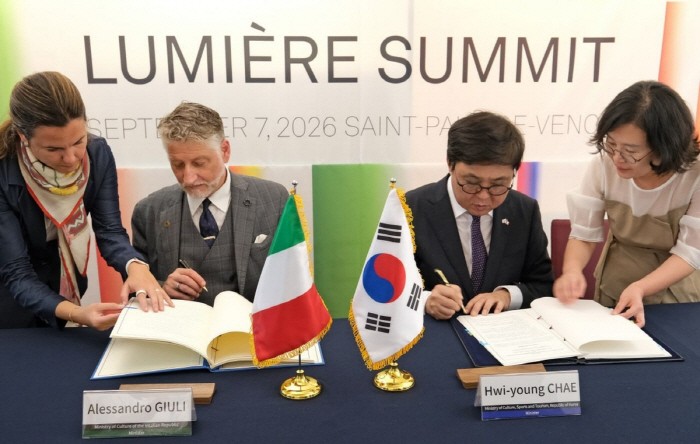 |
| Minister of Culture, Sports and Tourism Chae Hwi-young formally signs the South Korea-Italy Film Co-production Agreement with Italian Minister of Culture Alessandro Giuli during their bilateral meeting at the Lumiere Summit held in France on the 7th (local time). / Ministry of Culture, Sports and Tourism |
The South Korean film industry is set to make a concerted push into the global market by expanding its collaborative networks with leading film and audiovisual companies and institutions across Europe and the U.S. The core strategy centers on moving beyond simple content exports to build cooperative frameworks encompassing co-production, investment, and distribution, thereby diversifying international expansion channels for K-content.
The Ministry of Culture, Sports and Tourism announced on the 8th that it achieved significant momentum in expanding international partnerships for the domestic film and video industry on the occasion of the Lumiere Summit, an international audiovisual conference held at the Maeght Foundation in Saint-Paul-de-Vence, France, on the 7th (local time). Co-chaired by South Korea and France, the summit brought together some 200 participants from roughly 50 nations, including government officials, business executives, public agency representatives, and creators.
The most notable outcome is the Lumiere Partnership, under which South Korea and France agreed to each invest 500 million euros (approximately 800 billion won) in their respective film and audiovisual sectors over the next five years. Building on this policy finance injection, the two nations will support creative ecosystems across the film and video industries while expanding collaboration to co-production, financing, and global distribution. To steer these efforts, both governments will establish a joint steering committee comprising officials from their culture ministries and related agencies.
The cooperation comes as the production and distribution landscape undergoes rapid shifts driven by the proliferation of OTT streaming services and advances in AI technology. The initiative holds particular significance because it aims to evolve into an open international platform for audiovisual collaboration by encouraging participation from other countries and private enterprises beyond the bilateral Korea-France framework.
Tangible initiatives also emerged from the private sector. Domestic content studio SLL will pursue remakes and multi-genre co-productions with European media group Mediawan utilizing both companies' intellectual property (IP). The partners plan to develop co-productions targeted at the global market by adapting successful Korean content for European audiences and introducing European IP to the Korean domestic market.
Naver will collaborate with France's National Audiovisual Institute (INA) to preserve and restore audiovisual cultural heritage and develop digital content using AI technology. The Korean Film Council (KOFIC) also agreed to widen its scope of cooperation with the Motion Picture Association (MPA) across talent discovery, professional training, industry personnel exchanges, market information sharing, and joint screening events.
The institutional foundation for co-productions between South Korea and Europe has also broadened significantly. Culture, Sports and Tourism Minister Chae Hwi-young signed the South Korea-Italy Film Co-production Agreement with Italian Minister of Culture Alessandro Giuli on the same day. Films certified as official co-productions under the treaty will be granted national status in both countries, qualifying them for state support funds, tax incentives, and subsidies, while also guaranteeing mobility for production crews and equipment.
The treaty holds strategic significance by enabling Korean cinema to move beyond merely screening films overseas and integrate directly into local production and investment ecosystems. Following the large-scale investment pact with France, securing an independent co-production system with Italy alongside expanded public and private partnerships with the U.S. and Europe marks a concrete step forward in South Korea's film globalization strategy.
In his closing address at the summit, Minister Chae remarked, "As a global hub for audiovisual content creation and the most trusted partner, the South Korean government will broaden creative freedom and spare no policy or institutional support."
Jeon Hye-won
Most Read
-
1
U.S. Treasury Secretary Bessent publicly warns ove..

-
2
China overhauls National Defense Mobilization Law..

-
3
U.S. strikes Iran after a month, hits IRGC rocket..

-
4
Hyundai Motor Group breaks ground on integrated st..

-
5
Russia faces warning signs over prolonged war econ..

-
6
CIA director visits Russia, warns Moscow not to at..

-
7
Anti-Western solidarity strengthens amid Trump's e..

PEOPLE






HEADLINE NEWS
- U.S. strikes Iranian tanker again, retaliating for attack on American warships
- Canada enacts retaliatory tariffs up to 50% on U.S., deepening trade confli..
- 'Super El Niño' looms over Latin America, threatening food security and put..
- S. Korea and France sign 16 agreements and MOUs on defense, advanced tech

-
Address : In-Young Bldg., 34, Uisadang-daero 1-gil, Yeongdeungpo-gu, Seoul
Copyright by ASIATODAY CO., LTD. All rights resereved