



Canada announces retaliatory tariffs on U.S. from Sept. 8, U.S. trade rep vows retaliation
Aug 23, 2026, 04:31 pm


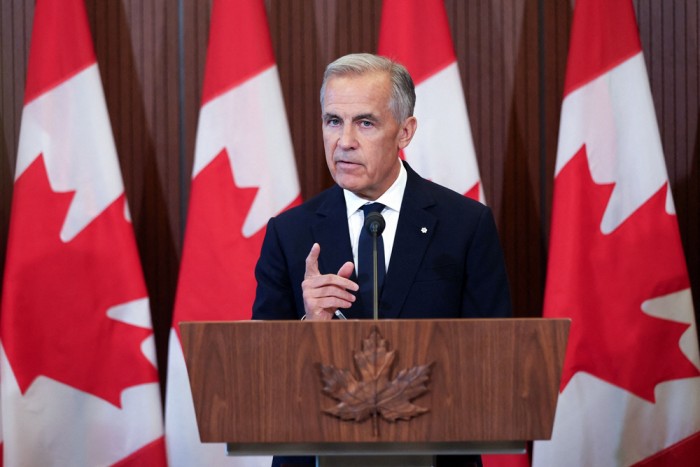 |
| Canada's Prime Minister Mark Carney speaks at a press conference in Ottawa, Ontario on the 22nd (local time). / AFP-Yonhap |
Canada announced it will impose tariffs on U.S. imports — including steel, electronics, agricultural equipment, and dairy products — starting September 8 (local time), in retaliation for U.S. 50% tariffs affecting roughly $20 billion (about 28 trillion won) worth of Canadian goods. The U.S., in turn, pushed back, saying it had offered Canada favorable terms that were rejected, and vowed to respond to the retaliation.
With Canada's ongoing friction with the Trump administration coming to a head following the breakdown in negotiations, observers suggest the two countries could be heading toward a full-scale retaliatory tariff war.
According to Reuters, Canadian Prime Minister Mark Carney held a press conference at the parliament building in Ottawa on the 22nd, calling the U.S. proposal "a bad deal" and announcing that Canada would impose tariffs matching the new U.S. tariffs on a one-to-one basis to protect Canadian workers, farmers, families, and businesses. Asked whether Canada was now in a "trade war" with the U.S., Carney responded, "If you're attacked, you're at war," adding, "We have been attacked."
He said Canada would also impose tariffs on certain items previously targeted by past U.S. tariffs on Canadian goods. Canada's government plans to announce further details on this in the coming days, and also intends to prepare support measures for industries affected by the new tariffs.
Carney attributed the breakdown in negotiations to demands the U.S. made in the final stages of talks. He explained that the U.S. introduced new conditions that were uneconomical, unfair, and undermined Canada's net benefit, raising doubts about the credibility of reaching a deal, adding that these demands included provisions limiting Canada's ability to enter into new trade agreements.
Candace Laing, president and CEO of the Canadian Chamber of Commerce, said, "We will mobilize our business network across every region and every industry to prepare for the shock of this situation and make the best of a difficult circumstance."
The U.S., for its part, said it has no plans to pursue new negotiations with Canada and vowed to respond to the retaliatory measures. U.S. Trade Representative Jamieson Greer said in a Fox News interview that same day, "We will take action in response to Canada's retaliatory measures," adding, "They have always enjoyed the best terms and could still have gotten better terms, but they didn't want them." He added, "Our focus is on protecting American workers and America's supply chains."
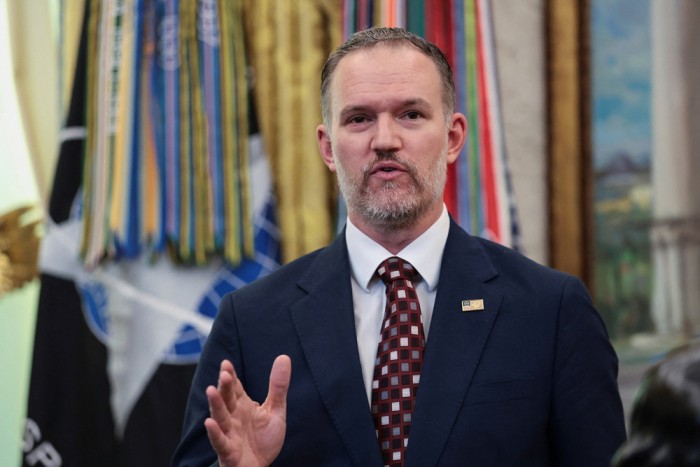 |
| U.S. Trade Representative Jamieson Greer speaks during President Donald Trump's executive order signing ceremony at the Oval Office in Washington, D.C. on the 6th (local time). / Reuters-Yonhap |
The new U.S. tariffs correspond to about 5% of Canada's exports to the United States. Trade experts warned that vulnerable industries such as softwood lumber and wine could suffer serious damage from the tariffs, potentially leading to job losses and business closures.
The U.S. and Canada had pushed back the original implementation date of the 50% tariff by three days, from the 19th, engaging in marathon negotiations that ultimately failed to produce an agreement. The U.S. demanded, among other things, an end to boycotts of American liquor underway in parts of Canada, while Canada sought the withdrawal of existing tariffs on steel, automobiles, and other goods — but the two sides were unable to bridge their differences, and the 50% tariff took effect at midnight on the 22nd.
President Trump has pressured Canada with tariffs since the very start of his second term. In February of last year, he designated Canada, alongside Mexico and China, as a tariff target over alleged involvement in fentanyl trafficking, and subsequently imposed 50% tariffs on Canada's core steel and aluminum industries and 25% tariffs on automobiles, citing Section 232 of the Trade Expansion Act.
During a visit to a Ford plant in Detroit in January, Trump dismissed the U.S.-Mexico-Canada Agreement (USMCA) — already strained by his tariff policies — as offering no real benefit and calling it meaningless. He has also repeatedly expressed a desire to make Canada the 51st U.S. state, describing it as merely a dependent territory sustained by America.
Prime Minister Carney escalated the friction with remarks at the Davos Forum that same month, targeting the U.S. by saying the rules-based international order is eroding, and that powerful nations can act as they please while weaker nations must bear the consequences, adding that middle powers need to act together.
Given the two countries' deeply interconnected relationship across trade, defense, and other domains, there are concerns that a prolonged standoff could burden both sides. According to the U.S. Energy Information Administration (EIA), about 52% of the oil the U.S. imports comes from Canada. The New York Times reported that about 75% of Canada's exported goods and services go to the U.S. The two countries, which share the world's longest land border, also conduct joint military exercises daily across various regions, including the Arctic, cooperating closely on multiple fronts.
Kim Hyun-min
Most Read
-
1
Trump shares map on social media labeling Strait o..

-
2
Kia Sportage outperforms Mazda CX-5 in German auto..

-
3
Houthis launch successive attacks on Saudi airport..

-
4
U.S. deploys carrier, 10,000 more troops to Middle..

-
5
Trump rejects Iran's offer to open Strait of Hormu..

-
6
N. Korea conducts first swarm attack drill with dr..

-
7
U.S.-China summit falls short on substance as Trum..

PEOPLE






HEADLINE NEWS
- Seoul dismisses Ukraine's claim of 'S. Korean support for Russia' as "inaccurate and inappropriate"
- S. Korea, Japan race to develop nuclear-powered submarines
- Henri Kagan, Kenso Soai win Nobel Prize in Chemistry for uncovering how mol..
- Vance says Alaska LNG cooperation will move forward with Seoul's current or..

-
Address : In-Young Bldg., 34, Uisadang-daero 1-gil, Yeongdeungpo-gu, Seoul
Copyright by ASIATODAY CO., LTD. All rights resereved