



Argentine business leaders hold rare street protest in front of presidential palace
Aug 23, 2026, 10:31 am


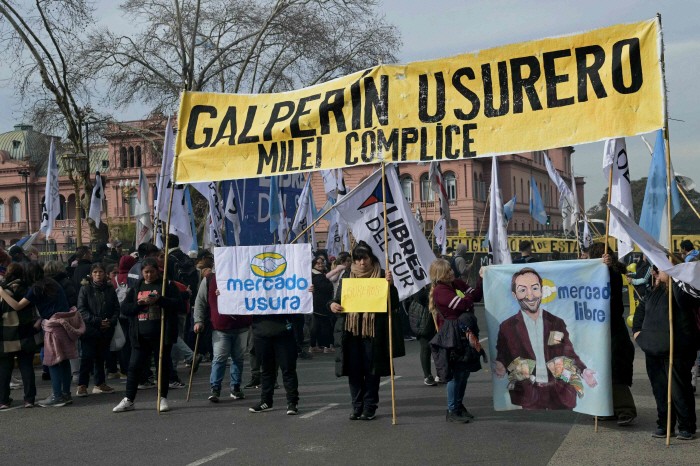 |
| Members of the political group Libres del Sur stage a protest in front of the presidential palace in the Argentine capital of Buenos Aires on the 20th (local time). They are protesting that the financial practices of large platform companies are deepening social inequality. / AFP, Yonhap |
As the recession deepens due to aggressive austerity policies in Argentina, small and medium-sized business owners have taken to the streets to urge a shift in government policy. Analysts view it as highly unusual for business owners to hold a protest to make their voices heard directly in Argentina, where labor protests are common.
According to local media outlets such as Infobae, small and medium-sized business owners held a rally on August 20 (local time) at the Plaza de Mayo in front of the presidential palace in Buenos Aires, calling for a change in the direction of economic policy.
The rally was jointly organized by 13 business organizations related to footwear, leather, apparel, and production, including the Association of Entrepreneurs for National Development (ENAC). The event was held on Business Owners' Day, and participants marched to the presidential palace carrying placards that read, "Let us not lose even one more small business."
The business owners strongly demanded a shift in economic policy, stating that prolonged recession has brought them to a breaking point.
Emanuel Fernandez, head of a sneaker manufacturing company, lamented, "The market situation is so desperate and catastrophic that not a day goes by without a shoe store shutting down," adding, "If this continues, no business in Argentina will survive." His company once employed 120 people, but prolonged recession forced him to cut staff down to 15.
Since the inauguration of the Javier Milei administration, the implementation of aggressive austerity policies aimed at curbing inflation has deepened management difficulties for small and medium-sized enterprises.
According to Argentina's Superintendence of Occupational Risks (SRT), 8,438 businesses closed down in the January-May period alone. Concerns are mounting that the collapse of businesses is accelerating, given that 9,979 companies shut down in the entire year of last year.
Over the 30-month period from December 2023, when the Milei administration took office, to May of this year, a total of 30,633 businesses closed down. The number of active companies, which stood at 512,357 in November 2023, dropped to 481,724 in May of this year. This equates to an average of 34 companies disappearing each day.
Production and employment also declined alongside company closures. According to the SME Observatory (OPyme), an economic monitoring organization, second-quarter production at small and medium-sized businesses dropped 11 percent year-on-year, while employment fell 4.5 percent.
Business associations emphasized that the rally was not a mere protest, but rather aimed at "letting the government directly confirm the severity of the crisis."
Local media pointed out that demands for easing austerity are spreading to the point where business owners are exceptionally taking to the streets, noting, "The phrase 'austerity is devouring 10,000 businesses every year' is gaining currency in business circles."
Son Young-sik
Most Read
-
1
Trump shares map on social media labeling Strait o..

-
2
Kia Sportage outperforms Mazda CX-5 in German auto..

-
3
Houthis launch successive attacks on Saudi airport..

-
4
U.S. deploys carrier, 10,000 more troops to Middle..

-
5
Trump rejects Iran's offer to open Strait of Hormu..

-
6
N. Korea conducts first swarm attack drill with dr..

-
7
U.S.-China summit falls short on substance as Trum..

PEOPLE





HEADLINE NEWS
- Seoul dismisses Ukraine's claim of 'S. Korean support for Russia' as "inaccurate and inappropriate"
- S. Korea, Japan race to develop nuclear-powered submarines
- Henri Kagan, Kenso Soai win Nobel Prize in Chemistry for uncovering how mol..
- Vance says Alaska LNG cooperation will move forward with Seoul's current or..

-
Address : In-Young Bldg., 34, Uisadang-daero 1-gil, Yeongdeungpo-gu, Seoul
Copyright by ASIATODAY CO., LTD. All rights resereved