



From end-of-life care to data use, government seeks bioethics solutions
Aug 18, 2026, 09:40 am


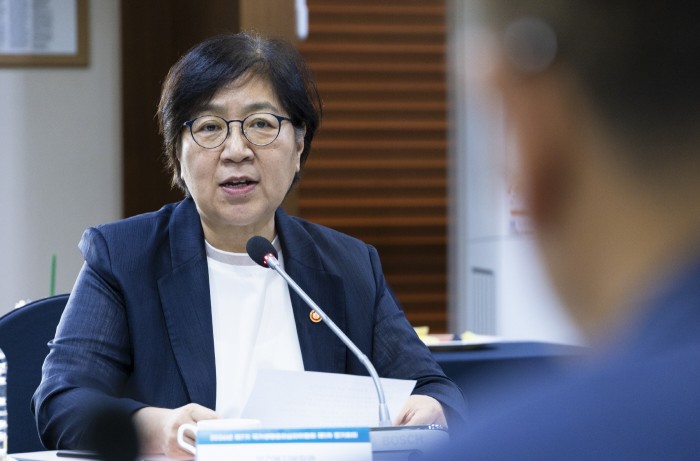 |
| Health and Welfare Minister Jeong Eun-kyeong speaks at the first regular meeting of the 7th National Bioethics Committee, held at the Korea Press Center in Jung-gu, Seoul on the 14th. / Ministry of Health and Welfare |
Discussions have begun to refine the criteria for when to withhold or discontinue life-sustaining treatment for patients. Going forward, efforts to reduce confusion in the field around end-of-life treatment decisions, along with institutional improvements spanning AI and health data use and protection of data subjects, are expected to move into full swing.
The Ministry of Health and Welfare announced on the 14th that at the first regular meeting of the 7th National Bioethics Committee, held at the Korea Press Center in Jung-gu, Seoul, it deliberated on operational plans for a "Special Committee to Improve the Life-Sustaining Treatment Decision System" and a "Special Committee on AI and Health Data Use."
A total of four agenda items were addressed at the meeting, including the election of a vice-chair. Three items — improvements to the life-sustaining treatment decision system, the operational plan for the AI and health data special committee, and related matters — were taken up for deliberation, while the composition plan for subcommittees under the National Bioethics Committee was presented as a reporting item.
In the area of life-sustaining treatment, discussions will focus on narrowing the gap between the system and actual medical practice that has emerged since the policy was implemented. The government plans to examine the difficulties patients, families, and medical staff face in the actual process of making decisions about life-sustaining treatment, and review key improvement tasks, including the timing for withholding or discontinuing such treatment.
To this end, the ministry formed a special committee of 14 experts from relevant fields, including medicine, ethics, patient advocacy groups, law, religion, and media. The committee plans to discuss improvement tasks, including the timing of withholding or discontinuing life-sustaining treatment, and prepare a set of recommendations by the end of the year.
Discussions to establish standards for AI and health data use are also moving forward in earnest. As AI technology advances and demand for health big data grows, there is a need for institutional standards that can both promote research and industrial use while protecting the rights of data subjects.
Specific areas under review include the consent procedures required when using health data, standards for using pseudonymized information, and committee review procedures. The plan is to develop recommendations for institutional improvements that expand the scope of data use while upholding individual rights and bioethical principles.
Kim Ok-joo, chair of the National Bioethics Committee, said, "The two special committees launching today are central to the 7th committee's work," adding, "We will guide discussions in a direction that resolves the real difficulties patients, families, and medical staff face under the current life-sustaining treatment decision system, while advancing data technology in a way that protects human dignity and rights."
The committee also received a report on plans to form five subject-specific subcommittees to handle ongoing bioethics issues, covering bioethics and safety policy, embryos, human-derived materials, genetics, and research subject protection, each of which will review related policy and research issues.
Health and Welfare Minister Jeong Eun-kyeong, who serves as the committee's chief secretary, said, "Improving the life-sustaining treatment decision system and health data use are tasks directly tied to people's lives, so I hope the two special committees can lead effective discussions grounded in voices from the field and the public," adding, "As the ministry serving as chief secretary, we will make every policy effort to ensure the committee's discussions translate into actual institutional improvements."
Starting with this meeting, the 7th committee plans to form and operate the two special committees and five subject-specific subcommittees, and hold policy discussion sessions to deliberate on bioethics issues.
Lee Se-mi
Most Read
-
1
Trump shares map on social media labeling Strait o..

-
2
Kia Sportage outperforms Mazda CX-5 in German auto..

-
3
Houthis launch successive attacks on Saudi airport..

-
4
U.S. deploys carrier, 10,000 more troops to Middle..

-
5
Trump rejects Iran's offer to open Strait of Hormu..

-
6
N. Korea conducts first swarm attack drill with dr..

-
7
U.S.-China summit falls short on substance as Trum..

PEOPLE






HEADLINE NEWS
- Seoul dismisses Ukraine's claim of 'S. Korean support for Russia' as "inaccurate and inappropriate"
- S. Korea, Japan race to develop nuclear-powered submarines
- Henri Kagan, Kenso Soai win Nobel Prize in Chemistry for uncovering how mol..
- Vance says Alaska LNG cooperation will move forward with Seoul's current or..

-
Address : In-Young Bldg., 34, Uisadang-daero 1-gil, Yeongdeungpo-gu, Seoul
Copyright by ASIATODAY CO., LTD. All rights resereved