



White House says China dodges tariffs via 40-plus countries, flags Korea's chip belt as transshipment route
Aug 14, 2026, 10:27 am


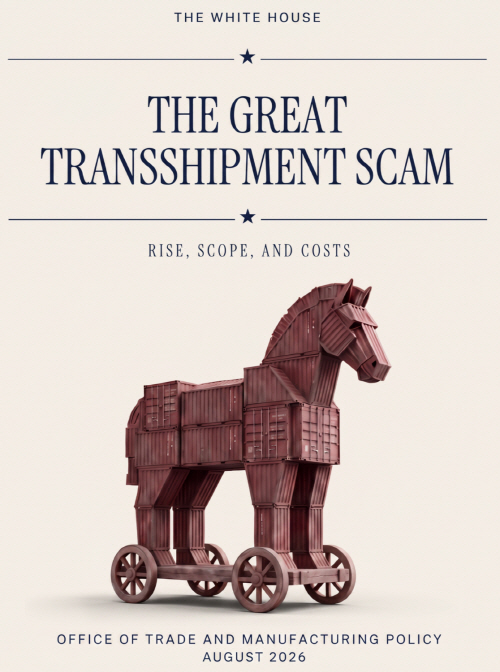 |
| Screen capture of the cover of the report "The Great Transshipment Scam," released by the White House on the 13th (local time), stating that Chinese exporters have built a "Shadow Transshipment Network" routing goods through more than 40 countries, including South Korea, to evade high tariffs. |
The White House announced on the 13th (local time) that Chinese exporters have built a "Shadow Transshipment Network," routing goods through more than 40 countries, including South Korea, to evade high tariffs.
The White House estimated potential exposure to illegal transshipment and related trade diversion at $40-303 billion (about 56.8-430 trillion won) annually, placing South Korea in Tier 1 transshipment-risk countries and identifying Gyeonggi Province's semiconductor belt as a potential distribution route for China-linked integrated circuits.
As direct China exports fall, third-country routes expand — a "shadow transshipment network" spanning 40-plus countries
In "The Great Transshipment Scam," a report released that day by the White House Office of Trade and Manufacturing Policy, Chinese exporters have expanded routing through third countries since the Section 301 trade tariffs imposed under the first Trump administration in 2018. The report explained that through limited assembly or finishing, repackaging, or altering labels and invoices, these products can be exported as if they originated elsewhere.
Currently, the average U.S. tariff burden on Chinese products stands at about 50%. If China-linked products pass through Mexico or Canada and improperly claim coverage under the U.S.-Mexico-Canada Agreement (USMCA), tariffs could drop to zero or near zero.
However, the report acknowledged that China's declining share of the U.S. import market and the rising share of the more than 40 at-risk countries doesn't necessarily indicate illegal transshipment in every case, noting that genuine shifts in production, investment, and sourcing are also part of the picture.
White House Trade and Manufacturing Policy Adviser Peter Navarro said China has been "laundering its exports" through more than 40 countries.
Potential exposure of $40-303 billion; a $75 billion benchmark implies 450,000 displaced jobs
The report compared five separate government and private-sector estimates, putting potential exposure to illegal transshipment or related trade diversion at $40-303 billion annually.
Goldman Sachs estimated $40 billion; the White House Council of Economic Advisers (CEA) put the figure at $34.2-89.6 billion, with a rounded midpoint of $60 billion; and AI supply chain firm Exiger estimated $75 billion. The Commerce Department's Office of Trade and Economic Analysis (OTEA) put the figure at $109 billion, based on a broader trade-diversion benchmark. U.S. AI supply chain analytics firm Altana, using facility-level supply chain analysis, estimated the upper bound of potential transshipment exposure at $303 billion.
The report specified that these figures should not be summed or directly compared. Applying a tariff-rate gap of 25-45%, the report estimated annual tariff revenue losses at $10-136 billion (14.194-193.0384 trillion won). Under a model using the central estimate of $75 billion (106.455 trillion won), roughly 450,000 jobs would be displaced, GDP would fall by $113-150 billion (160.3922-212.91 trillion won), and related federal tax revenue would decline by $19-26 billion (26.9686-36.9044 trillion won). The report noted that this jobs figure is a model-based estimate, not an actual observed number.
South Korea placed in Tier 1 transshipment-risk group — Gyeonggi's integrated circuit route flagged, pressure cited on 4 U.S. chip cities
The report divided the more than 40 countries into three tiers. South Korea was placed in Tier 1, "Diversified Scale Leaders," alongside Canada, the EU, India, Israel, Japan, Mexico, and Taiwan. The report explained that these countries have large volumes of China-linked trade and well-developed industrial bases and export platforms to the U.S., meaning transshipment risk could be mixed in with genuine large-scale trade.
Tier 2 included Brazil, Indonesia, Malaysia, Thailand, Turkey, and Vietnam.
The report argued in particular that Gyeonggi Province's semiconductor belt could serve as a distribution route for China-linked integrated circuits (HS 854239), which could put pressure on U.S. semiconductor production in Phoenix, Austin, Portland, and San Jose. However, the so-called "Ugly Sister Cities" comparison represents potential exposure linking high-risk products to U.S. manufacturing regions, not actual documented cases of illegal transshipment.
At a press call, Adviser Navarro also raised concerns over Chinese dumping, pointing to Korean steel dumping as well, and said, "Our only line of defense is tariffs."
CBP to use AI to trace origin and shipping routes; linked to USTR trade-deal rules of origin
The Trump administration presented AI-based "Detective Border" monitoring as its core tool for cracking down on transshipment. The system combines shipping records, transport history, product classification, ownership relationships, production capacity, anomalous transactions, and computer vision to distinguish genuine overseas investment and nearshoring from simple pass-through trade.
Executive Order 14411, signed by President Trump on June 3, strengthened importer requirements, bonding and U.S. asset requirements, disclosure of ownership and corporate relationships, penalties, and trade transparency. AP reported that, according to Adviser Navarro, importers who falsely declare a product's origin could face retroactive tariffs on imports going back about a year.
In an interview with Bloomberg TV, Navarro called the report "a warning to the world," saying, "Don't try to cheat America." U.S. Trade Representative Jamieson Greer criticized transshipment for undermining the competitiveness of American businesses and workers and threatening the trade deal achievements of President Trump.
While Navarro drew a clear line stating that this report is "entirely separate" from the ongoing Section 301 investigation, he explained it could still inform future USTR trade negotiations. The Financial Times reported that while USTR has been including anti-transshipment provisions in trade agreements, the rules of origin needed to determine a product's actual place of production have not yet been finalized in detail.
Ha Man-ju
Most Read
-
1
Trump shares map on social media labeling Strait o..

-
2
Kia Sportage outperforms Mazda CX-5 in German auto..

-
3
Houthis launch successive attacks on Saudi airport..

-
4
U.S. deploys carrier, 10,000 more troops to Middle..

-
5
Trump rejects Iran's offer to open Strait of Hormu..

-
6
N. Korea conducts first swarm attack drill with dr..

-
7
U.S.-China summit falls short on substance as Trum..

PEOPLE






HEADLINE NEWS
- Seoul dismisses Ukraine's claim of 'S. Korean support for Russia' as "inaccurate and inappropriate"
- S. Korea, Japan race to develop nuclear-powered submarines
- Henri Kagan, Kenso Soai win Nobel Prize in Chemistry for uncovering how mol..
- Vance says Alaska LNG cooperation will move forward with Seoul's current or..

-
Address : In-Young Bldg., 34, Uisadang-daero 1-gil, Yeongdeungpo-gu, Seoul
Copyright by ASIATODAY CO., LTD. All rights resereved