



Lee tries to ease public frustration with housing supply push
Aug 07, 2026, 09:12 am


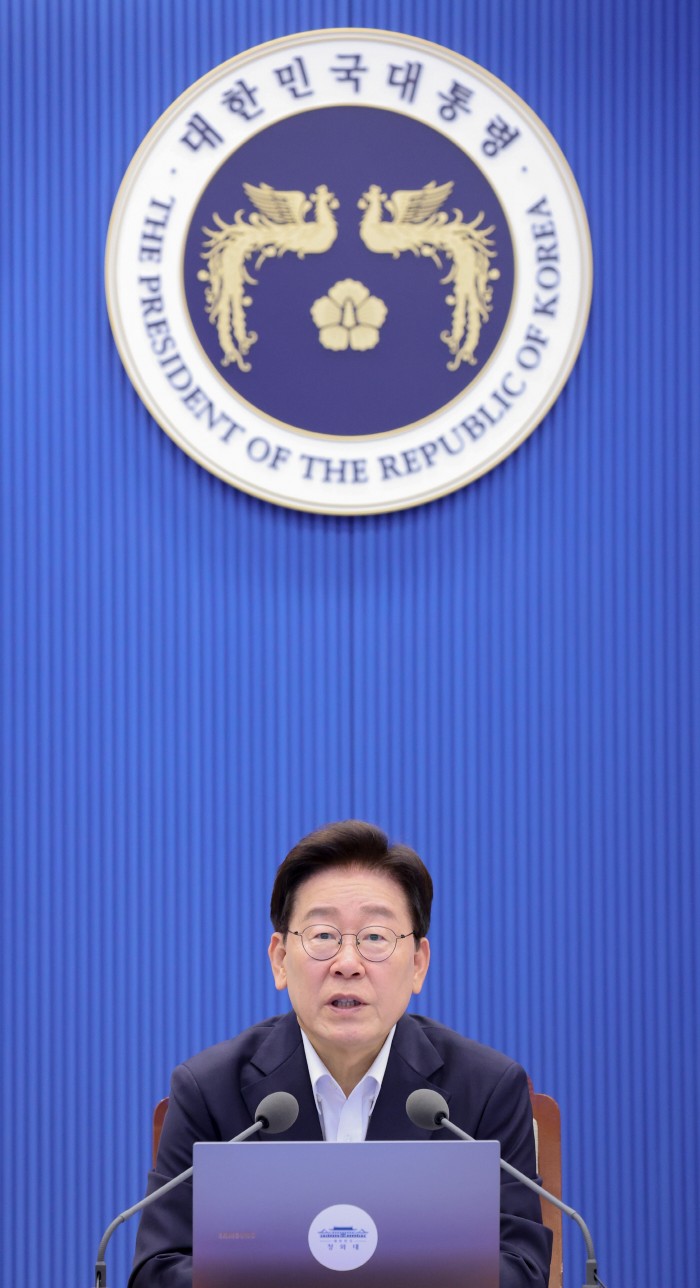 |
| President Lee Jae-myung speaks at a meeting of senior presidential secretaries at the presidential office on the 6th. / Yonhap |
President Lee Jae-myung will chair a second real estate policy review meeting on the 7th, revisiting plans to expand housing supply, rationalize housing finance, and stabilize the jeonse and monthly rent markets. As market skepticism has persisted even after the government's tax reform announcement, Lee has instructed officials to secure housing supply through "extraordinary solutions" that break from past practice, signaling a faster push on follow-up measures.
According to the presidential office on the 6th, President Lee will chair the second real estate policy review meeting on the 7th, attended by ministers from relevant agencies and senior presidential aides. This follows just four days after his July 3 review meeting on real estate and the stock market, where he called for expanded supply.
Presidential Communications Secretary Seong Ki-hong said on CBS Radio's "Park Sung-tae's News Show" that day that the government is working with an extraordinary sense of determination. Seong added that the government is currently working on multifaceted measures, including expanding housing supply and rationalizing housing finance, and plans to present policies to the public as soon as possible, including on the supply issue.
Regarding the tax reform plan unveiled on the 3rd, Seong described it as a measure aimed at tax fairness. He said, "As the president has repeatedly stated, the government has no intention of controlling housing prices through taxation," adding, "We are working on multifaceted measures to stabilize the real estate market, including expanding supply and rationalizing housing finance."
This appears intended to separate the controversy over tax reform from supply measures, signaling that the government's main focus for stabilizing the market will be expanding supply. Within and around the government, there is speculation that the upcoming measures could exceed earlier projections of "50,000 or more homes for the greater Seoul area." The presidential office and the government are reportedly broadly reviewing options including reassessing existing candidate sites, shortening permitting procedures, financial and fiscal support, and deregulation.
Measures to stabilize the jeonse and monthly rent markets are also expected to be included in the follow-up plan. Seong said the government will expand the supply of public rental housing to stabilize the rental market and continue pursuing measures to ease the housing cost burden for young people and those without homes going forward — an approach aimed at stabilizing not just the sales market but also the rental market through expanded supply.
The presidential office is also weighing ways to reverse its recent decline in approval ratings. With livelihood-related economic issues such as real estate policy and stock market volatility cited as factors behind the decline, a Media Tomato poll released that day showed President Lee's approval rating for state affairs at just 47.7%. In particular, disapproval among people in their 30s stood at 61%, the highest of any age group, while approval among people in their 20s fell 18.8 percentage points in just a week — observations suggesting a growing need for the presidential office to address livelihood concerns more directly.
Coordination with local governments over expanding supply in Seoul remains a variable. Presidential Chief Policy Officer Kim Yong-beom held a working lunch with Seoul Mayor Oh Se-hoon the previous day to discuss supply expansion measures, but Mayor Oh on the 6th rejected the possibility of building housing on the site of Yongsan Children's Garden, calling it something that could absolutely never happen. While Oh has called for easing the mandatory ratio of industrial facilities required to use quasi-industrial zones, he has drawn a clear line against greenbelt deregulation and using the Yongsan Park site.
Park Young-hoon
Most Read
-
1
Celltrion’s Omlyclo gains ground in major European..

-
2
Trump demands rates fall below 1% as Fed hikes for..

-
3
Trump makes $1 trillion bet ahead of midterm elect..

-
4
Iran resumes ballistic missile production, assembl..

-
5
Trump warns countries not helping U.S. must pay re..

-
6
Apple launches first foldable, 1 million won prici..

-
7
Turkish Airlines named main club partner of Liverp..

PEOPLE







-
Address : In-Young Bldg., 34, Uisadang-daero 1-gil, Yeongdeungpo-gu, Seoul
Copyright by ASIATODAY CO., LTD. All rights resereved