



Korea exports recycled naphtha made from waste plastic for first time
Aug 06, 2026, 10:16 am


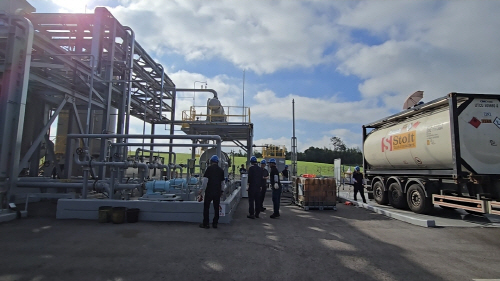 |
| Employees at City Oil Field's Wave Jeongeup plant transfer recycled feedstock from storage tanks to an ISO tank. / Courtesy of City Oil Field |
South Korea, which has relied entirely on imported crude oil, has achieved a breakthrough by converting domestic waste plastic into "naphtha-grade regenerated oil" (RGO), a petrochemical feedstock, and supplying it to overseas markets for the first time. The move is seen as a new milestone in Korea's shift from a resource-importing country to an exporter of eco-friendly circular feedstock.
City Oil Field, a company specializing in eco-friendly resource circulation, announced on the 4th that it shipped its first batch of 220 tons of RGO — produced using non-combustion, low-temperature pyrolysis technology at its Wave Jeongeup plant in Jeongeup, North Jeolla Province — through Gwangyang Port in South Jeolla Province, into the supply chain of global commodities trader Trafigura. The shipment, loaded onto 11 ISO tank containers, is expected to arrive at its final destination, Pasir Gudang Port in Malaysia, on the 17th.
This shipment carries deep significance, marking the first case of restoring waste plastic — beyond simple recycling — into a high-quality circular feedstock ready for immediate use in petrochemical processes, and supplying it directly to the global market.
Until now, Korea's petrochemical industry has repeatedly been exposed to naphtha import disruptions and price volatility whenever external variables arose, such as geopolitical risk in the Middle East or sharp swings in global oil prices. City Oil Field's technology extracts naphtha-grade feedstock from waste vinyl and plastic through a process using electric-powered low-temperature indirect heating and ceramic ball wave energy. Since the process does not involve direct combustion, it dramatically reduces carbon emissions and the generation of hazardous substances.
The Jeongeup plant, with an annual production capacity of about 4,550 tons, will supply its entire output overseas through Trafigura for the next three years. Notably, the facility has obtained "ISCC PLUS" international certification — a stringent standard for quality, sustainability, and traceability essential for entering global markets such as Europe — establishing it as a supply source aligned with global carbon-reduction goals.
City Oil Field CEO Jung Young-hoon said, "Restoring petrochemical feedstock that had previously relied on imports, using our own technology, and supplying it overseas is a historic event in the field of resource circulation," adding, "We will expand our domestic production capacity to about 70,000 tons (roughly 89 million liters) annually by next year, leading the way in building a global eco-friendly supply chain."
Oh Se-eun
Most Read
-
1
Celltrion’s Omlyclo gains ground in major European..

-
2
Trump demands rates fall below 1% as Fed hikes for..

-
3
Trump makes $1 trillion bet ahead of midterm elect..

-
4
Iran resumes ballistic missile production, assembl..

-
5
Trump warns countries not helping U.S. must pay re..

-
6
Apple launches first foldable, 1 million won prici..

-
7
Turkish Airlines named main club partner of Liverp..

PEOPLE







-
Address : In-Young Bldg., 34, Uisadang-daero 1-gil, Yeongdeungpo-gu, Seoul
Copyright by ASIATODAY CO., LTD. All rights resereved