



Retail investors break RIA accounts to exit domestic market
Aug 06, 2026, 10:20 am


 |
| This image was generated by AI. |
The "Return-to-domestic-market Investment Account" (RIA), introduced by the government to redirect overseas stock investment funds back into the domestic market, has seen an outflow of funds just four months after launch. Retail investors who had returned to the domestic market for tax benefits appear to be growing weary of extreme volatility in Korean stocks and are heading back to the U.S. market, giving up existing tax breaks and even accepting penalty taxes to do so.
Experts say that for RIA accounts to function effectively as a genuine tool for drawing overseas funds back home, the government needs to ease the liquidity constraint of the one-year mandatory holding period and redesign incentives to make them more effective given current market conditions.
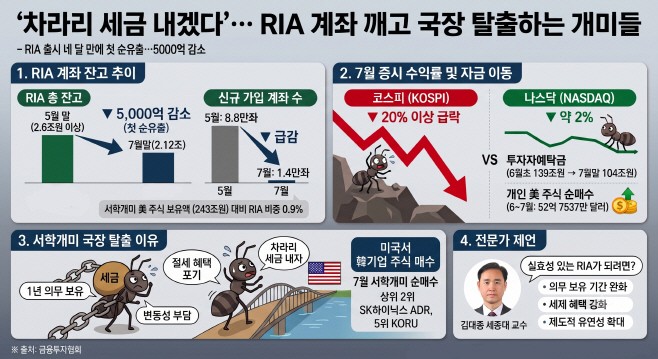
According to the Korea Financial Investment Association on the 5th, the total balance of RIA accounts stood at 2.1214 trillion won as of the 31st of last month. This is down about 500 billion won from more than 2.6 trillion won at the end of May — a drop within just two months. This marks the first time the monthly balance has turned to a decline since the RIA system launched on March 23.
Analysts attribute investors' willingness to close accounts early, even at the cost of tax penalties, to the burden of domestic market volatility combined with the one-year mandatory holding requirement. To receive a capital gains tax deduction on overseas stock sales through an RIA account, investors must reinvest the proceeds from selling foreign stocks into domestically listed shares or equity funds for at least one year.
However, the domestic market has recently undergone a sharp correction, with the Kospi falling more than 20% in July alone, deepening investor anxiety. In contrast, the U.S. Nasdaq fell only about 2% in July, posting relatively solid returns by comparison. This appears to have driven retail investors to act out of fear that, in trying to save on capital gains tax, they could end up locking their money in the domestic market for a year and lose principal as well.
This "exodus from the domestic market" trend is also showing up in the numbers. From June, when the domestic market correction began in earnest, through the end of July, individual investors' net purchases of U.S. stocks reached $5.27537 billion (about 8 trillion won). Meanwhile, investor deposits awaiting investment in the domestic market — a gauge of funds on the sidelines — plunged by 35 trillion won in just two months, from about 139 trillion won in early June to around 104 trillion won by the end of July.
There has even been a trend of investors buying Korea-related products listed on U.S. exchanges, accepting the capital gains tax, in order to avoid supply-demand instability tied to domestically listed shares. Last month, among the most-bought stocks by Korean retail investors trading overseas ("seohak ants"), SK Hynix's American Depositary Receipt (ADR) ranked second, while "KORU," a 3x leveraged ETF tracking the Korean stock market, ranked fifth.
Amid this trend, the total RIA account balance at the end of last month (2.1214 trillion won) accounted for just 0.9% of Korean investors' total holdings of U.S. stocks (about 243 trillion won). The number of newly opened accounts also plunged, from 88,000 in May to 14,400 in July, leading to assessments that the RIA policy has effectively lost momentum.
Kim Dae-jong, a professor at Sejong University, said, "Uncertainty in the domestic market, combined with the liquidity constraints of RIA accounts, has driven investors' funds to leave," adding, "For RIA to establish itself as a sustainable system, it needs greater institutional flexibility, including easing the mandatory holding period and strengthening tax incentives."
Han Hye-sung
Most Read
-
1
Celltrion’s Omlyclo gains ground in major European..

-
2
Trump demands rates fall below 1% as Fed hikes for..

-
3
Trump makes $1 trillion bet ahead of midterm elect..

-
4
Iran resumes ballistic missile production, assembl..

-
5
Trump warns countries not helping U.S. must pay re..

-
6
Apple launches first foldable, 1 million won prici..

-
7
Turkish Airlines named main club partner of Liverp..

PEOPLE







-
Address : In-Young Bldg., 34, Uisadang-daero 1-gil, Yeongdeungpo-gu, Seoul
Copyright by ASIATODAY CO., LTD. All rights resereved