



Angered by housing, stocks, Lee's approval hits post-inauguration low of 45.9%
Aug 04, 2026, 10:04 am


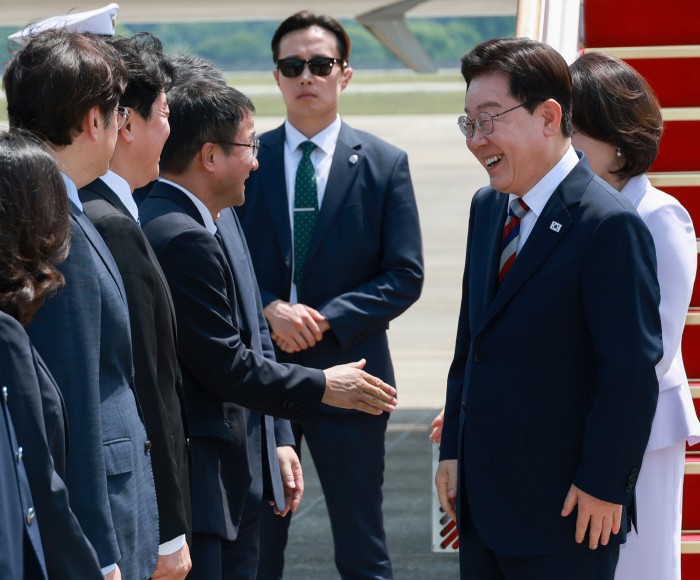 |
| President Lee Jae-myung, returning home after trips to the U.S., South America, and Germany, greets welcoming officials, including acting Democratic Party leader and floor leader Han Byung-do and Chief of Staff Kang Hoon-sik, at Seoul Airport in Seongnam on the 3rd. / Yonhap |
After returning from his trip to the U.S. and South America on the 3rd, President Lee Jae-myung faces the heavy task of reviving people's livelihoods and the economy. Calming public anxiety over real estate and stock market instability, and reversing his approval rating's fall to a post-inauguration low, are seen as key to restoring his administration's momentum for the second half of the year.
According to a Realmeter survey commissioned by the Energy Economy Newspaper, conducted from the 27th to the 31st of last month among 2,508 people aged 18 and older nationwide, President Lee's job approval rating fell 0.4 percentage points from the previous week to 45.9%. This marks a third straight weekly decline and the lowest level since he took office. Disapproval reached 50.5%, topping 50% for the first time since his inauguration.
Realmeter attributed the decline to a combination of factors, including the sharp stock market drop, controversy over single-stock leveraged ETFs, real estate tax policy, the proposed constitutional amendment on presidential reelection, and the controversy over abolishing prosecutors' supplementary investigative power.
Stabilizing the stock and real estate markets is seen as the most urgent task. During the president's trip, domestic stocks swung sharply between gains and losses, with volatility expanding significantly. Financial authorities have suspended new listings and advertising of single-stock leveraged products, and raised the minimum deposit requirement from 10 million won, including eligible securities, to 30 million won in cash, effective the 31st of last month. The government plans to monitor whether this measure cools overheated investment demand and consider additional steps if needed.
The real estate market situation also remains challenging. The government plans to restructure the long-term holding special deduction around residency status and extend relief from the multi-home owner capital gains tax surcharge through 2028, aiming to encourage owners to convert to owner-occupied housing and bring more properties to market. Many observers say it remains to be seen whether the government's ambitious tax reforms alone can cool rising home prices.
Reducing "political uncertainty" is another challenge. A standoff continues between the ruling and opposition parties over the revised Criminal Procedure Act, which would abolish prosecutors' supplementary investigative power. The revision could be put to a vote at a Cabinet meeting as early as the 4th, and controversy over follow-up legislation and potential investigative gaps is expected to continue.
Managing internal conflict within the ruling camp is also seen as a variable. The extremely close race for the Democratic Party's national convention has taken on the character of a power struggle within the pro-Lee faction, in an analysis that highlights divisions within the ruling camp. Depending on the new leadership's inclinations, the way the party and government coordinate on livelihood legislation and economic policy could shift, and how quickly the factional conflict that emerged during the race is resolved is also expected to affect state affairs going forward.
Park Young-hoon
Most Read
-
1
Trump shares map on social media labeling Strait o..

-
2
Kia Sportage outperforms Mazda CX-5 in German auto..

-
3
Houthis launch successive attacks on Saudi airport..

-
4
U.S. deploys carrier, 10,000 more troops to Middle..

-
5
Trump rejects Iran's offer to open Strait of Hormu..

-
6
N. Korea conducts first swarm attack drill with dr..

-
7
U.S.-China summit falls short on substance as Trum..

PEOPLE






HEADLINE NEWS
- Seoul dismisses Ukraine's claim of 'S. Korean support for Russia' as "inaccurate and inappropriate"
- S. Korea, Japan race to develop nuclear-powered submarines
- Henri Kagan, Kenso Soai win Nobel Prize in Chemistry for uncovering how mol..
- Vance says Alaska LNG cooperation will move forward with Seoul's current or..

-
Address : In-Young Bldg., 34, Uisadang-daero 1-gil, Yeongdeungpo-gu, Seoul
Copyright by ASIATODAY CO., LTD. All rights resereved