



39.7 billion won refund risk looms over PPP's leadership, presidential race
Jul 29, 2026, 10:07 am


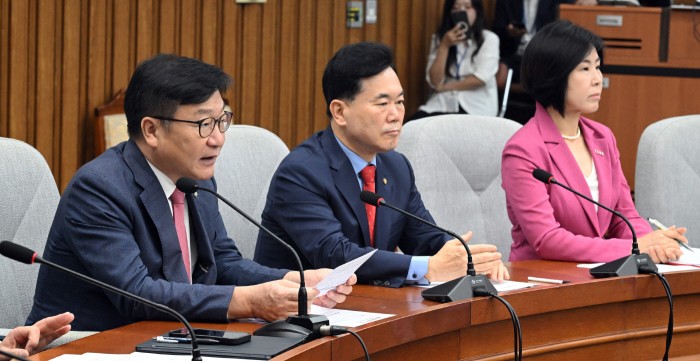 |
| People Power Party Floor Leader Jeong Jeom-sik (first from left) speaks during a floor strategy meeting held at the National Assembly on July 28. / Photo by Reporter Song Eui-ju |
The People Power Party (PPP) has entered the "time of judiciary." From returning tens of billions of won in election expenses to the political standing of next presidential hopefuls and internal factional conflicts, court rulings are emerging as the ultimate variable in every major factor, leading to assessments that the judiciary has come to decide the party's future.
The biggest risk is former President Yoon Suk Yeol's Public Official Election Act violation case. If former President Yoon receives a final ruling confirming an invalidation of election sentence with a fine of 1 million won or more, the PPP must return 39.7 billion won in election expenses reimbursed during the 2022 presidential election. This accounts for about a third of the party's assets. If the financial burden becomes reality, significant disruptions will be inevitable not only for organizational operations but also for preparations for the 2028 general elections.
A two-term lawmaker voiced concern, saying, "Parties ultimately run their organizations with money," adding, "It is a fatal trial that could severely shrink the party's financial capacity ahead of the general elections." The lawmaker also pointed out, "The issue of the Democratic Party's returning 43.4 billion won was also virtually concluded with the Supreme Court's remand," adding, "If whether a trial proceeds depends on who holds power, wouldn't that create a structure where being in power determines a party's survival?"
A prosecutor-turned-lawyer predicted, "Considering the special counsel situation and other factors, the possibility of a sentence reduction to a fine of less than 1 million won does not look high," adding, "The party could effectively be driven to the brink of dissolution." The lawyer added, however, "The court will also find it difficult to completely disregard legal stability and political fallout."
The next presidential race structure also hinges on court rulings. Inside and outside the party, close attention is being paid to Seoul Mayor Oh Se-hoon's Public Official Election Act violation case. Mayor Oh was sentenced in the first trial to a fine exceeding the threshold for invalidating an election.
Under the Public Official Election Act's so-called "6-3-3 rule," if trials proceed according to statutory deadlines, the Supreme Court could issue a ruling around January next year. If the first trial sentence is upheld, Mayor Oh's right to run for public office will be restricted, barring him from entering the next presidential race stage. In this case, with the departure of a leading moderate-conservative figure capable of expanding support in the Seoul metropolitan area, the conservative camp's presidential race and internal power dynamics could be severely shaken. A reform-minded party lawmaker said, "Mayor Oh is someone who defended the Seoul metropolitan area with his individual competitiveness in a tough local election," adding, "If a key pillar keeping the dominant faction in check disappears, the internal party balance could also be shaken."
Internal factional conflicts could also escalate into legal disputes. Although the Central Ethics Committee launched disciplinary proceedings against pro-Han lawmakers and non-mainstream faction members, internal clashes over how the committee is run have publicly surfaced, making it unlikely that the outcome will be smoothly accepted. As in previous cases involving Representative Bae Hyun-jin and former Supreme Council member Kim Jong-hyuk, the possibility of escalating into legal battles such as injunctions to suspend disciplinary measures is being raised.
A first-term lawmaker expressed concern, saying, "With fewer issues that can be resolved politically within the party, we are left with no choice but to watch court decisions," adding, "If political issues are brought excessively to the judiciary, the judicialization of politics could ultimately lead to the politicization of the judiciary."
Kim Chae-yeon
Most Read
-
1
Trump shares map on social media labeling Strait o..

-
2
Kia Sportage outperforms Mazda CX-5 in German auto..

-
3
Houthis launch successive attacks on Saudi airport..

-
4
U.S. deploys carrier, 10,000 more troops to Middle..

-
5
Trump rejects Iran's offer to open Strait of Hormu..

-
6
N. Korea conducts first swarm attack drill with dr..

-
7
U.S.-China summit falls short on substance as Trum..

PEOPLE





HEADLINE NEWS
- Seoul dismisses Ukraine's claim of 'S. Korean support for Russia' as "inaccurate and inappropriate"
- S. Korea, Japan race to develop nuclear-powered submarines
- Henri Kagan, Kenso Soai win Nobel Prize in Chemistry for uncovering how mol..
- Vance says Alaska LNG cooperation will move forward with Seoul's current or..

-
Address : In-Young Bldg., 34, Uisadang-daero 1-gil, Yeongdeungpo-gu, Seoul
Copyright by ASIATODAY CO., LTD. All rights resereved