



S. Korea is set to begin review procedures for importing Brazilian beef
Jul 29, 2026, 09:22 am


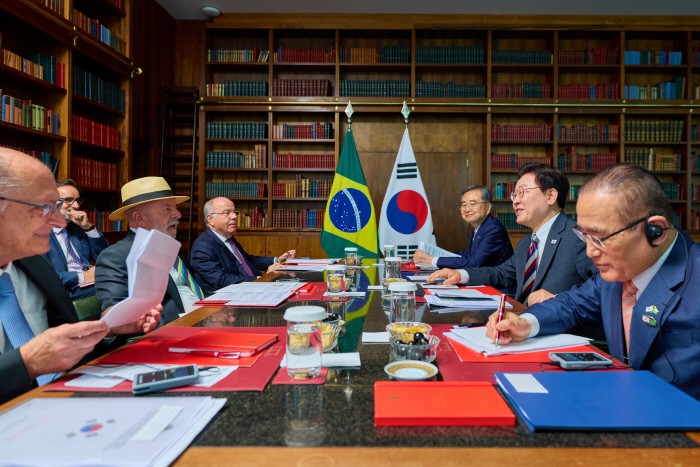 |
| President Lee Jae-myung and Brazilian President Luiz Inacio Lula da Silva hold a restricted-format meeting at the Presidential Residence in Brasilia on July 27 (local time). / Yonhap News |
South Korea and Brazil will begin official procedures to review importing Brazilian beef into the South Korean market. The two countries also agreed to swiftly advance procedures to expand the import-permitted regions for Brazilian pork, which is already being imported into South Korea.
Additionally, both nations agreed to discuss building supply chains for critical minerals, including rare earths, and developing every stage of the supply chain, including technology transfer.
The strategy aims to further strengthen economic cooperation with Brazil by opening the South Korean beef market—a key interest for Brazil—while securing crucial cooperation on critical mineral supply chains.
According to the "South Korea-Brazil Joint Presidential Statement" released by the Blue House on July 28 (local time), President Lee Jae-myung and Brazilian President Luiz Inacio Lula da Silva reaffirmed their existing commitments regarding market access for Brazilian beef and pork during their summit the previous day.
Consequently, the Animal and Plant Quarantine Agency (APQA) and the Ministry of Agriculture, Food and Rural Affairs (MAFRA) will begin risk evaluation procedures for Brazilian beef starting with an on-site technical inspection in Brazil this August. The goal is to complete the procedures without delay once all conditions are met to facilitate exports.
Discussions were also held to expand the import-permitted regions for Brazilian pork. Currently, South Korea only imports pork produced in Santa Catarina, a region recognized as free of foot-and-mouth disease.
The joint statement noted, "The two leaders agreed to continue joint efforts toward expanding South Korean market access for Brazilian pork from regions outside Santa Catarina in a timely manner, based on concrete and mutually satisfactory outcomes."
The joint statement also included measures to strengthen supply chain cooperation for critical minerals, including rare earths.
It stated, "The two leaders emphasized the importance of cooperation on minerals, such as rare earths, and the establishment of diversified, resilient, sustainable, and inclusive supply chains, while highlighting their intention to discuss advancing all stages of the supply chain, including technology transfer."
Senior Blue House Press Secretary Kang Yu-jung explained in a written briefing, "The significance of signing the joint statement on critical strategic minerals lies in building resilient and diversified supply chains for critical minerals, including rare earths, and emphasizing shared prosperity through local processing and value creation."
She added, "Both South Korea and Brazil agreed that critical and strategic minerals play a crucial role in the energy and digital transitions, technological applications, and sustainable economic development. In particular, both sides recognized the importance of preserving national sovereignty and policy autonomy in mineral sector development. This reflects an intent to cooperate mutually while respecting Brazil's resource sovereignty and industrial policy autonomy."
Hong Sun-mi
Most Read
-
1
Trump shares map on social media labeling Strait o..

-
2
Kia Sportage outperforms Mazda CX-5 in German auto..

-
3
Houthis launch successive attacks on Saudi airport..

-
4
U.S. deploys carrier, 10,000 more troops to Middle..

-
5
Trump rejects Iran's offer to open Strait of Hormu..

-
6
N. Korea conducts first swarm attack drill with dr..

-
7
U.S.-China summit falls short on substance as Trum..

PEOPLE






HEADLINE NEWS
- Seoul dismisses Ukraine's claim of 'S. Korean support for Russia' as "inaccurate and inappropriate"
- S. Korea, Japan race to develop nuclear-powered submarines
- Henri Kagan, Kenso Soai win Nobel Prize in Chemistry for uncovering how mol..
- Vance says Alaska LNG cooperation will move forward with Seoul's current or..

-
Address : In-Young Bldg., 34, Uisadang-daero 1-gil, Yeongdeungpo-gu, Seoul
Copyright by ASIATODAY CO., LTD. All rights resereved