



KT charts future network security roadmap with quantum tech
Jun 21, 2026, 09:58 am


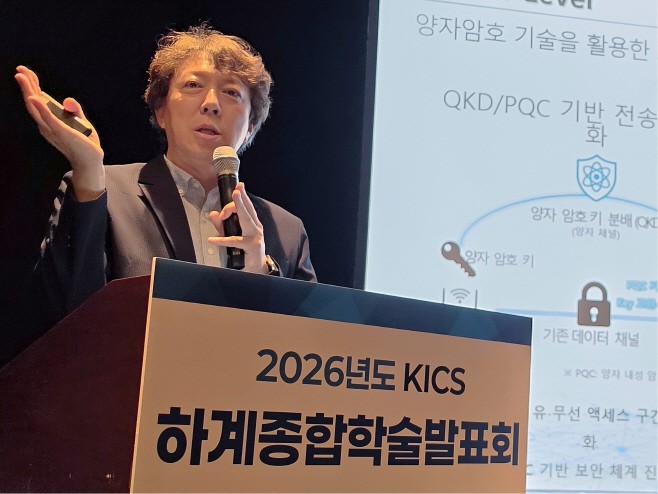 |
| Jeong Je-min, Vice President and Head of the Network AI Research Department at KT, explains the company's future network security vision during a special KT session at the Summer Conference of the Korean Institute of Communications and Information Sciences (KICS) held in Jeju Island on the 19th. / Courtesy of KT |
KT announced its future network security vision to counter changing environments in AI and quantum technology, with a plan to apply quantum technology against increasing security threats driven by advancing AI technology.
On the 21st, during a special session at the Summer Conference of the Korean Institute of Communications and Information Sciences held from the 17th to the 19th at Haevichi Hotel & Resort in Jeju, KT unveiled 'E2E Quantum Security,' its future network security vision designed to respond to changing environments in AI and quantum technology.
The event served as an academic conference where experts from industry, academia, and research institutes shared the latest ICT research achievements and innovative technologies, and Jein-min Jeon, Vice President and Head of the Network AI Research Department at KT, delivered a presentation during KT's special session on the 19th.
KT explained that AI technology is being utilized for vulnerability detection and automated attacks, and that autonomously evolving attack methods are shifting the traditional network security paradigm. The company also emphasized that the advancement of quantum computing technology could compromise the safety of existing public-key cryptography systems. In a public-key cryptography system, anyone can encrypt data, but decryption can only be performed by specific users. Previously, even if hackers intercepted encrypted data, they could not decrypt it, but there is a possibility it could be decrypted using quantum computers.
To counter these threats, KT presented the 'E2E Quantum Security' strategy, which is KT's future network security vision that applies quantum technology across major infrastructures, including network equipment, AI data centers, and clouds, as well as data transmission paths.
E2E Quantum Security consists of three core technical pillars: 'Quantum Link' which protects data transmission sections between customers and communication networks; 'Quantum Node' which detects and protects against vulnerabilities and anomalies within network equipment and operational sections; and 'Quantum Vault' which secures data throughout its entire lifecycle, from generation and storage to utilization and deletion.
Through this, KT expects to establish an integrated protection framework across all domains spanning transmission sections, network equipment, and data, further strengthening cyber attack response speeds and security safety. In addition to AI and quantum security, KT addressed security issues related to communication network operations, discussing security vulnerabilities and wireless attack techniques in 5G and LTE mobile communication environments, security issues in device, wireless protocol, and service configuration processes, zero-trust-based security frameworks, and telecom operators' security strategies for the AI era.
Lee Jong-sik, Head of KT's Future Network Lab (Senior Vice President), stated, "This special session was a meaningful opportunity to share AI-based security technologies and KT's future network security vision to counter increasingly sophisticated cyber attacks," adding, "Based on our capabilities in AI and quantum technology, KT will continuously strengthen the stability and reliability of future networks."
Lee Ji-sun
Most Read
-
1
Kia Sportage outperforms Mazda CX-5 in German auto..

-
2
Houthis launch successive attacks on Saudi airport..

-
3
Saudi Arabia, Iran hold first diplomatic talks to..

-
4
U.S. deploys carrier, 10,000 more troops to Middle..

-
5
Saudi airport in Riyadh struck again, leaving at l..

-
6
Putin's ally visits China on the 8th ahead of APEC..

-
7
Chinese military support and training center opens..

PEOPLE






HEADLINE NEWS

-
Address : In-Young Bldg., 34, Uisadang-daero 1-gil, Yeongdeungpo-gu, Seoul
Copyright by ASIATODAY CO., LTD. All rights resereved