



Trump urges Iran to halt Israel strikes and negotiate, eyes end-of-war MOU in 8–10 days
Jun 08, 2026, 09:12 am


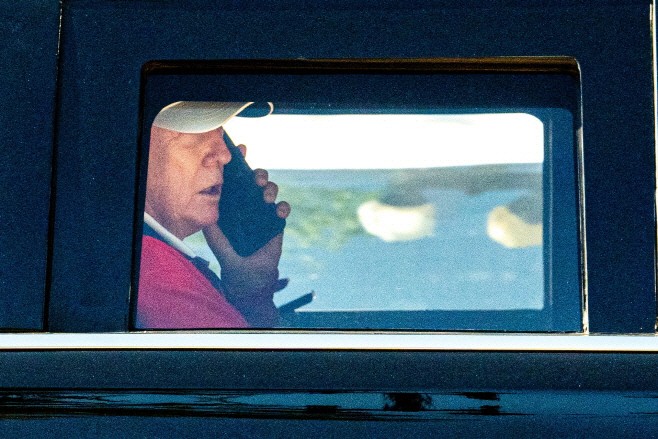 |
| U.S. President Donald Trump talks on the phone as he leaves the White House to head to the Trump National Golf Club in Sterling, Virginia, on May 31 (local time). / Photo via Reuters, Yonhap News |
With Iran firing approximately 10 ballistic missiles toward northern Israel on the 7th (local time) for the first time since the ceasefire took effect, the end-of-war negotiations between the United States and Iran have faced a new test.
In a telephone interview with Fox News on this day, U.S. President Donald Trump urged Iran, stating, "You fired the missiles, so now stop it, return to the negotiating table, and make a deal," while adding that the negotiations are moving in a direction where progress toward an agreement is possible during this week on the 8th, 9th, or 10th.
Iran launches first missile attack on Israeli mainland since ceasefire; Trump warns Israel "Do not retaliate"
Iran fired around 10 ballistic missiles toward northern Israel on this day, prompting the Israeli military to issue school closure orders for all schools in the affected region.
This attack serves as retaliation against Israel's strikes on a key stronghold of the pro-Iranian militant group Hezbollah in the southern suburbs of Beirut, Lebanon, marking Iran's first attack on the Israeli mainland since the U.S.-Iran brokered ceasefire took effect on April 8. President Trump pointed out in his Fox News interview that "this attack will in no way help the negotiations."
Furthermore, in a phone conversation with the U.S. online news outlet Axios, President Trump stated, "Nobody was hurt by Iran's attack. I hope Israel does not retaliate," adding, "If Bibi (the nickname for Israeli Prime Minister Benjamin Netanyahu) retaliates, the conflict will simply continue just as it has for the past 47 years or 3,000 years."
President Trump noted, "I will call Bibi right now and tell him not to retaliate," emphasizing, "Israel attacked, and Iran attacked. We do not need further attacks." He underscored, "We are very close to a final deal with Iran. It will be a good deal," stressing, "I do not want this to be derailed because of what is happening right now."
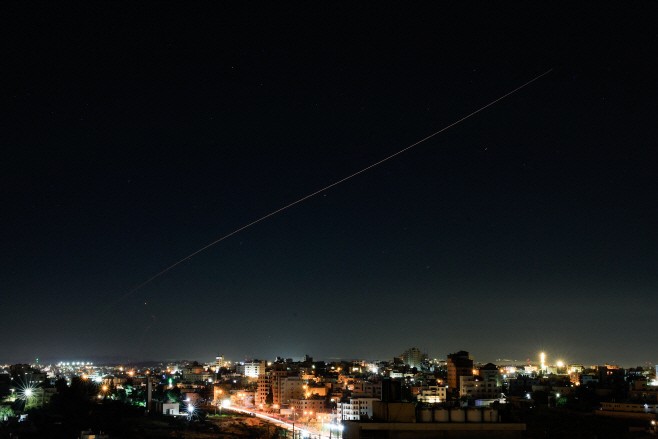 |
| Iranian missiles fly through the skies over Israel on the 7th (local time), in a photograph taken from Hebron in the Israeli-occupied West Bank. / Photo via Reuters, Yonhap News |
Trump's NBC interview: "Only 21–22% of Iranian missiles remain"; 50,000 troops in Middle East to stay "until completion"
In an interview on NBC's 'Meet the Press' broadcast on the same day, President Trump shared his assessment of Iran's military capabilities and the current status of the negotiations.
He evaluated that Iran's leadership has been "largely decapitated," its navy, air force, and air defense networks have vanished, and only about 21 to 22% of its missiles remain. However, The Washington Post reported that U.S. intelligence agencies assess a substantial portion of Iran's ballistic missile capabilities remains intact, presenting a discrepancy with President Trump's assessment of their military strength.
President Trump characterized the situation as "de facto regime change," noting that the Iranian negotiating counterpart is not the existing leadership but a "third group."
Regarding Iran's Supreme Leader Mojtaba Khamenei, Trump described him as "younger, more rational, and severely wounded," while adding that his approval constitutes a part of the negotiation process.
President Trump stated that he would not immediately withdraw the 50,000 U.S. troops deployed in the Middle East, affirming he would "keep them stationed there until completion." Concurrently, regarding Israel's strikes on Lebanon, he expressed dissatisfaction during his Fox News interview, stating, "There was no coordination with Israel. I am not happy about it."
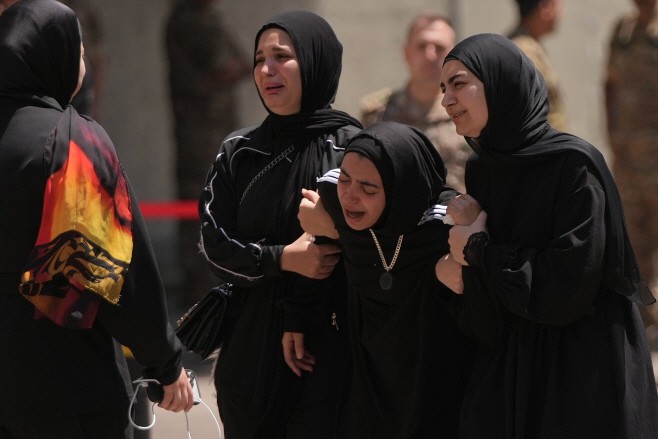 |
| Bereaved family members of Lebanese soldier Hussein Nazal weep during his funeral held in Beirut, Lebanon, on the 7th (local time). Nazal was killed the previous day in southern Lebanon by an Israeli airstrike, alongside a brigadier general and a captain. / Photo via AP, Yonhap News |
U.S., Iran clash over HEU recovery methods and timing of frozen asset release; Bloomberg notes "peace agreement faces difficulties"
In his NBC interview, President Trump spoke regarding the disposal of highly enriched uranium (HEU), a core sticking point in the end-of-war negotiations, stating, "If we agree to have a friendly relationship, we will all go together," and noted that it would be destroyed either on-site or externally utilizing U.S. equipment.
He warned that if an agreement is not reached, "We will hit them very hard militarily and then go in." He explained that at his request, provisions prohibiting Iran from not only developing nuclear weapons but also from "purchasing, acquiring, or buying" them were added to the end-of-war memorandum of understanding (MOU).
The New York Times pointed out that Iran's pledge to abandon nuclear weapons has been repeated since its accession to the Non-Proliferation Treaty (NPT), and its actual value will depend on future enrichment limitations and verification mechanisms.
Frozen assets stand as the greatest obstacle to the agreement. President Trump drew a line regarding the unfreezing of Iranian assets or sanctions relief, stating he would not accept them as preconditions and noting they "come after."
Conversely, Iran views the release of 24 billion dollars (37.43 trillion won) in frozen assets as a test of trust. In the existing proposal, a plan was discussed to release 12 billion dollars (18.72 trillion won) in the first phase, followed by the release of an additional 12 billion dollars.
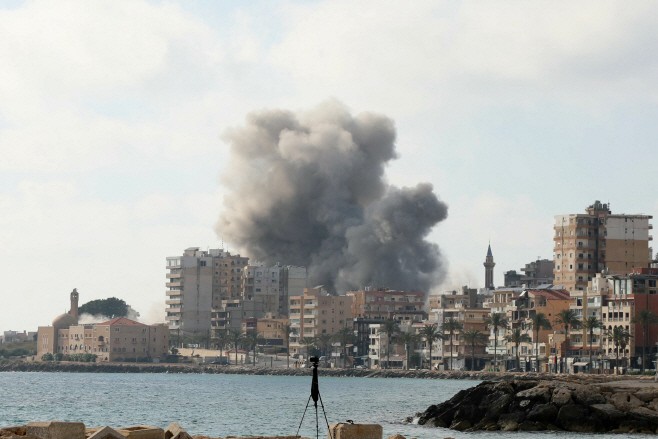 |
| Smoke rises from an area in the southern Lebanese coastal city of Tyre on the 7th (local time) following an Israeli airstrike. / Photo via AFP, Yonhap News |
Israel's Beirut airstrikes and Iran's warnings of retaliation; direct hit to Lebanon front negotiations
In retaliation for Hezbollah's attacks on Israeli territory, the Israeli military on this day launched airstrikes on Hezbollah's headquarters in Dahiyeh, a southern suburb of Beirut. The Lebanese Ministry of Health announced that at least two people were killed and 11 were injured, while the AP and Israeli media outlets reported that the number of injured reached 20.
Mohammad Bagher Ghalibaf, the speaker of the Iranian parliament who had led the negotiating delegation to the United States, warned via the social media platform X, "They neither abide by ceasefires nor believe in dialogue," adding, "Our military's options always remain open to strike the bases and assets of the U.S. and Israeli regimes within the region." Ebrahim Rezaei, the spokesperson for the National Security and Foreign Policy Committee of the Iranian parliament, also foreshadowed a "decisive and painful response." Hezbollah rejected the U.S.-brokered Israel-Lebanon ceasefire agreement, calling it a "farce," and Iran maintains its position that an agreement with the United States is difficult to reach without a ceasefire in Lebanon.
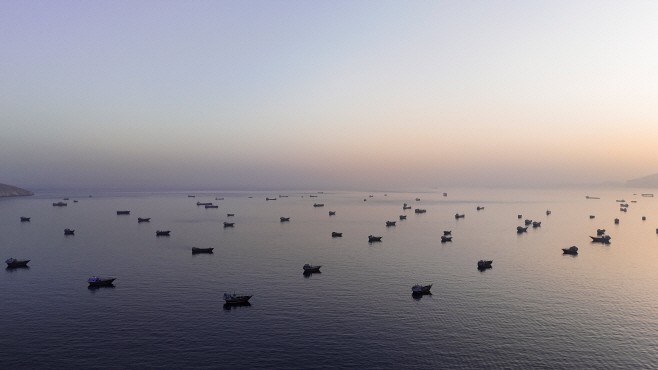 |
| Vessels anchor in the Strait of Hormuz off Musandam, Oman, on the 3rd (local time). / Photo via Reuters, Yonhap News |
Iran begins collecting tolls in the Strait of Hormuz; Pakistan's mediation channel mobilized
Iran continues to utilize the Strait of Hormuz as leverage in the negotiations. Iran's semi-official Fars News Agency reported that Iran has begun collecting a service fee averaging 1.5 million to 2 million dollars (2.34 billion to 3.12 trillion won) per vessel passing through Hormuz. Some payments are also being made via the dollar-based cryptocurrency Tether (USDT), spot goods, or barter trade. The New York Times reported that the cost of the war with Iran reached approximately 29 billion dollars (45.23 trillion won) as of May, and an Economist/YouGov poll showed that 68% of respondents and 55% of Trump supporters believed a deal should be reached as quickly as possible.
Pakistan continues to maintain its mediation channel. Pakistani Interior Minister Mohsin Naqvi met with Iranian Foreign Minister Abbas Araghchi in Tehran to deliver a letter from the Pakistani side to Iran's Supreme Leader. Lebanese Armed Forces Commander Joseph Aoun was also reported to have visited Pakistan at the invitation of Pakistan's Chief of Army Staff General Asim Munir.
Robert Einhorn, a former senior nonproliferation official at the U.S. State Department, told The New York Times, "Realistically, no negotiated outcome can guarantee that Iran will never acquire nuclear weapons," adding, "As long as Iran possesses the knowledge and resources, it can one day disregard its legal obligations and move toward nuclear weapons."
Ha Man-joo
Most Read
-
1
Celltrion’s Omlyclo gains ground in major European..

-
2
Trump demands rates fall below 1% as Fed hikes for..

-
3
Trump makes $1 trillion bet ahead of midterm elect..

-
4
Iran resumes ballistic missile production, assembl..

-
5
Samsung Electronics, Mistral AI to jointly develop..

-
6
Trump warns countries not helping U.S. must pay re..

-
7
Apple launches first foldable, 1 million won prici..

PEOPLE






HEADLINE NEWS
- Trump to roll out ‘unprecedented welcome’ for Xi with B-2 bombers, F-22 fighters
- S. Korea, U.S., and Japan form united front on Taiwan and economic coercion..
- Trump administration moves to impose sweeping sanctions on International Cr..
- Xi to make state visit to U.S. Sept. 23-25, dispelling rumors over his heal..

-
Address : In-Young Bldg., 34, Uisadang-daero 1-gil, Yeongdeungpo-gu, Seoul
Copyright by ASIATODAY CO., LTD. All rights resereved