



Japan-Philippines mark 70 years of diplomatic ties, accelerating quasi-alliance to counter China
Jul 24, 2026, 10:12 am


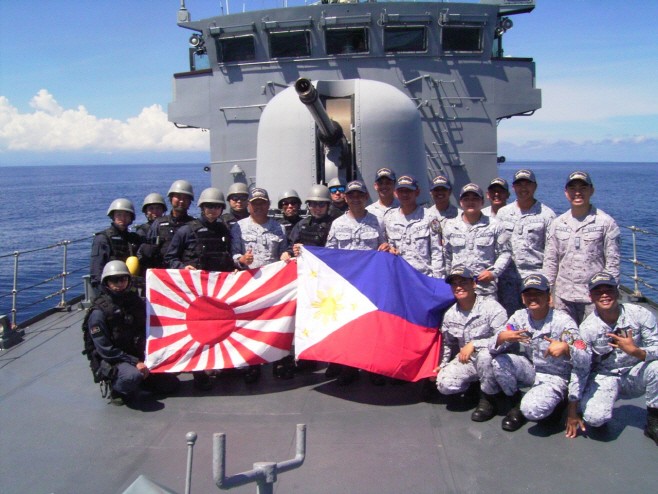 |
| Japan Maritime Self-Defense Force and Philippine Navy conduct joint exercise. / Official website of Japan Ministry of Defense |
Japan-Philippines relations are effectively being upgraded to a quasi-alliance on the occasion of the 70th anniversary of normalized diplomatic ties. Having normalized relations in 1956 through the San Francisco Peace Treaty and the reparations agreement with Japan, the two countries are accelerating alliance-level solidarity centered on security and economic security to mark the 2026 Japan-Philippines Friendship Year.
Japanese Prime Minister Sanae Takaichi held a summit with Philippine President Ferdinand Marcos Jr. during his state visit to Japan last May, issuing a joint statement that elevated bilateral relations to a comprehensive strategic partnership.
Prime Minister Takaichi publicly declared her commitment to strengthening bilateral ties continuously and multilaterally regardless of changes in the international environment, calling the Philippines one of Japan's closest like-minded nations.
Security cooperation has reached the level of an alliance. Japan has already built a quasi-alliance network through packages combining Reciprocal Access Agreements (RAA), Acquisition and Cross-Servicing Agreements (ACSA), and General Security of Military Information Agreements (GSOMIA) with Australia and the UK. The Philippines stands on the frontline, facing China directly in the South China Sea, and Japan's strategy aims to elevate the Philippines alongside Australia and the UK to quasi-ally status, simultaneously countering China's maritime expansion in the East and South China Seas.
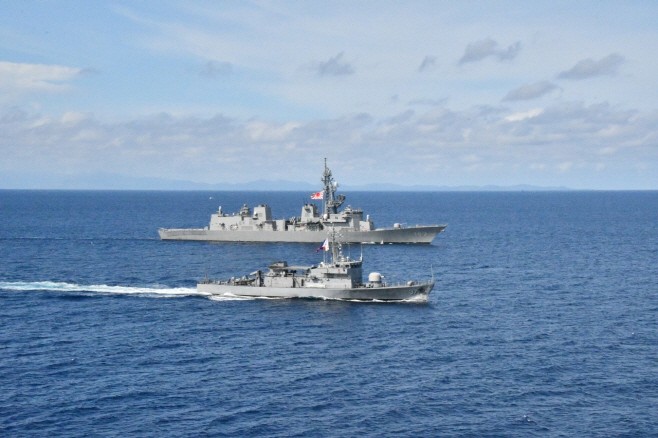 |
| Japan Maritime Self-Defense Force and Philippine Navy conduct a joint exercise. / Official website of Japan Ministry of Defense |
With the RAA signed in 2024, the Self-Defense Forces and the Philippine military can enter each other's countries without visas to conduct joint exercises, with military aircraft and vessels gaining free use of the other's bases and ports. In 2026, both sides agreed on an ACSA to mutually provide logistical support such as food and ammunition, establishing a military supply system for contingencies.
In addition, Japan and the Philippines agreed to initiate formal negotiations on GSOMIA to share military intelligence, laying the groundwork for a real-time information network among the U.S., Japan, and the Philippines to monitor Chinese naval and coast guard movements.
Ties are deepening in economic security as well. Prime Minister Takaichi and President Marcos discussed cooperation on critical minerals, energy, joint procurement during supply chain crises, and alternative transport routes, while agreeing to review upgrades to both the Japan-Philippines Economic Partnership Agreement (EPA) and the ASEAN-Japan Comprehensive Economic Partnership Agreement. Possessing strong supply potential in battery minerals like nickel and energy resources like LNG, the Philippines serves as a key partner for Japan seeking to diversify supply chains and reduce reliance on China.
The 70th anniversary of normalized diplomatic relations holds significance beyond mere symbolism. Leveraging trust built upon overcoming past conflicts over post-war reparations and aid, Japan is elevating the Philippines to a central pillar of its Free and Open Indo-Pacific (FOIP) strategy. Japan's decision to accord President Marcos top-tier red-carpet treatment matching that given to U.S. President Trump illustrates how a new alliance landscape designed to deter China's maritime expansion is reshaping Northeast and Southeast Asia into a single unified theater.
The implications for South Korea are equally substantial. As the trilateral U.S.-Japan-Philippines security and economic security network solidifies, Seoul's position and strategic choices will shift depending on how it aligns its own South-Korea-U.S.-Japan cooperation with its Southeast Asia strategy. The fact that the Japan-Philippines quasi-alliance stems from the 70th anniversary of diplomatic normalization highlights once again the complexity of East Asian diplomacy, where historical settlement intersects with security and economic realities.
Choi Young-jae
Most Read
-
1
Celltrion’s Omlyclo gains ground in major European..

-
2
Trump demands rates fall below 1% as Fed hikes for..

-
3
Trump makes $1 trillion bet ahead of midterm elect..

-
4
Iran resumes ballistic missile production, assembl..

-
5
Samsung Electronics, Mistral AI to jointly develop..

-
6
Trump warns countries not helping U.S. must pay re..

-
7
Apple launches first foldable, 1 million won prici..

PEOPLE






HEADLINE NEWS
- Trump to roll out ‘unprecedented welcome’ for Xi with B-2 bombers, F-22 fighters
- S. Korea, U.S., and Japan form united front on Taiwan and economic coercion..
- Trump administration moves to impose sweeping sanctions on International Cr..
- Xi to make state visit to U.S. Sept. 23-25, dispelling rumors over his heal..

-
Address : In-Young Bldg., 34, Uisadang-daero 1-gil, Yeongdeungpo-gu, Seoul
Copyright by ASIATODAY CO., LTD. All rights resereved