



Wang Yi emphasizes "opposition to external interference" to ASEAN
Jul 24, 2026, 10:02 am


Chinese Foreign Minister Wang Yi, who is also a member of the Communist Party of China Central Committee Political Bureau and Director of the Office of the Central Commission for Foreign Affairs, directly targeted Western nations during an address to ASEAN member countries, emphasizing, "We must oppose external interference and never allow the resurgence of militarism." Regarding the South China Sea issue, Wang reiterated China's claims while taking a critical stance against the Philippines.
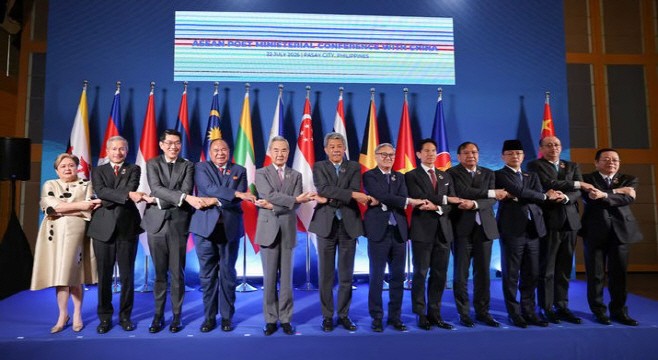 |
| Wang Yi, a member of the Political Bureau of the CPC Central Committee and Foreign Minister of China, poses for a group photo with representatives attending the China-ASEAN Foreign Ministers' Meeting in Manila, Philippines on July 22. / Xinhua News Agency |
According to the Ministry of Foreign Affairs of China on July 23, Wang, member of the Political Bureau and Foreign Minister, put forward four proposals during the China-ASEAN Foreign Ministers' Meeting held in Manila, Philippines the previous day: maintaining a peaceful regional environment for development, bolstering regional resilience for development, advancing innovative green development, and adhering to a people-centered approach.
Regarding a peaceful regional environment for development in particular, he urged, "We must firmly oppose unwarranted external interference and block the formation of exclusive cliques," adding, "We should refuse to stoke bloc confrontation and never allow a resurgence of militarism." This can be interpreted as emphasizing the need not only to oppose intervention by the U.S. and other Western nations in Southeast Asia, but also to curb Japan's shift toward the right.
On regional development, Wang also requested that food and energy security as well as supply chain stability be reinforced through the Regional Comprehensive Economic Partnership (RCEP).
Touching upon the South China Sea issue where friction between China and the Philippines has been mounting recently, he presented Beijing's stance in a manner targeting Manila, stating, "China and ASEAN nations possess the wisdom and capability to continue managing the South China Sea issue effectively." He went on to stress, "We must stop outside forces from inciting and abetting trouble," asserting, "We must oppose certain nations using the sea as a pretext to make trouble, while keeping the initiative to safeguard peace and stability in the South China Sea firmly in our own hands."
While he did not mention the Philippines by name regarding the South China Sea, given the circumstances, his remarks inevitably targeted Manila following recent maritime clashes with China.
The China-ASEAN Foreign Ministers' Meeting also adopted a joint statement on responding to shifting Middle East dynamics—as seen in the Iran conflict—and deepening energy cooperation.
On the sidelines of the meeting, Wang held separate bilateral talks with foreign ministers from India, Vietnam, Bangladesh, Brunei, Brazil, and Papua New Guinea, in addition to the Philippines. This could be seen as an active effort to assert China's presence as a regional power.
Hong Soon-do
Most Read
-
1
Celltrion’s Omlyclo gains ground in major European..

-
2
Trump demands rates fall below 1% as Fed hikes for..

-
3
Trump makes $1 trillion bet ahead of midterm elect..

-
4
Iran resumes ballistic missile production, assembl..

-
5
Samsung Electronics, Mistral AI to jointly develop..

-
6
Trump warns countries not helping U.S. must pay re..

-
7
Seoul faces triple squeeze over troop deployment t..

PEOPLE







-
Address : In-Young Bldg., 34, Uisadang-daero 1-gil, Yeongdeungpo-gu, Seoul
Copyright by ASIATODAY CO., LTD. All rights resereved