



Could U.S.-Iran peace deal set the stage for Hezbollah's revival?
Jun 18, 2026, 10:52 am


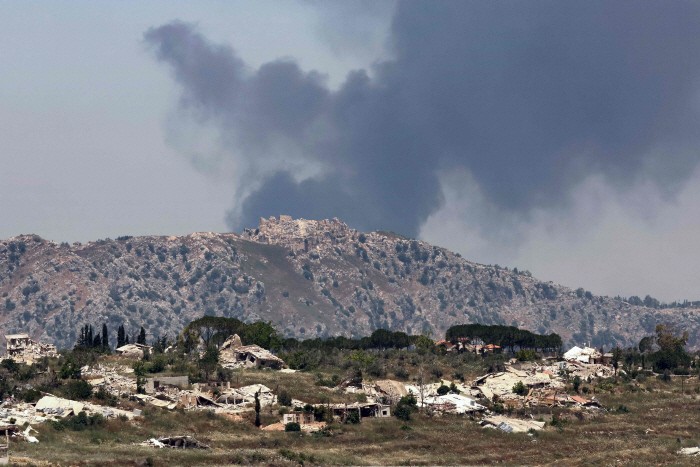 |
| Smoke rises behind Beaufort Castle in southern Lebanon on June 17 (local time). / Photo courtesy of AFP, Yonhap News Agency |
Observations are being raised that the peace deal between the United States and Iran could serve as a springboard for the military and political revival of the Lebanese militant group Hezbollah. Experts analyze that Iran will not abandon Hezbollah, a core strategic asset in the region, and that funds flowing into Iran following the agreement will trigger Hezbollah's recovery, Reuters reported on June 17 (local time).
According to the full text of the memorandum of understanding (MOU) on the peace deal released to the media by the U.S. administration on the day, under mutual agreement on relevant procedures, the United States commits to enabling the full use of frozen or restricted funds and assets of the Islamic Republic of Iran at the time the MOU is implemented.
Sources familiar with relations between Tehran and Hezbollah state that Iran plans to expand financial support to Hezbollah as soon as the frozen assets are released. This is expected to serve as a key driver for Hezbollah, which recently suffered massive losses from military clashes with Israel, to reorganize its organization and restore its infrastructure.
Mohanad Hage Ali, a senior fellow at the Malcolm H. Kerr Carnegie Middle East Center, diagnosed that the influx of Iranian funds would be a "game changer" for Hezbollah. He projected that once Hezbollah secures financial capacity, it will be able to rebuild its support base within Lebanon, which weakened during the conflict, and swiftly restore loosened political alliances. He also anticipated that Hezbollah would maintain its armament under the pretext of Israel's occupation of Lebanon, expecting that the issue of disarming Hezbollah will "take a back seat."
The fact that Iran strongly demanded a halt to fighting on the Lebanese front during the process of signing this MOU demonstrates the weight Hezbollah holds in Iran's foreign and security policy. Since its creation in 1982, Hezbollah has grown into a powerful proxy showcasing Iran's regional influence under the full support of the Islamic Revolutionary Guard Corps (IRGC).
Experts point out that Iran remitted approximately 1 billion dollars to Hezbollah last year alone despite harsh international sanctions, analyzing that Tehran will not easily abandon a strategic asset like Hezbollah.
Israel is demanding the complete disarmament of Hezbollah, but Hezbollah is refusing even the discussion itself, citing the presence of the Israeli military in Lebanon. Nicholas Blanford, a senior fellow at the Atlantic Council, pointed out that Israel's continued occupation of Lebanon is rather reinforcing Hezbollah's "rationale for resistance."
Lee Jung-eun
Most Read
-
1
Trump shares map on social media labeling Strait o..

-
2
Kia Sportage outperforms Mazda CX-5 in German auto..

-
3
Houthis launch successive attacks on Saudi airport..

-
4
U.S. deploys carrier, 10,000 more troops to Middle..

-
5
Trump rejects Iran's offer to open Strait of Hormu..

-
6
N. Korea conducts first swarm attack drill with dr..

-
7
U.S.-China summit falls short on substance as Trum..

PEOPLE






HEADLINE NEWS
- Seoul dismisses Ukraine's claim of 'S. Korean support for Russia' as "inaccurate and inappropriate"
- S. Korea, Japan race to develop nuclear-powered submarines
- Henri Kagan, Kenso Soai win Nobel Prize in Chemistry for uncovering how mol..
- Vance says Alaska LNG cooperation will move forward with Seoul's current or..

-
Address : In-Young Bldg., 34, Uisadang-daero 1-gil, Yeongdeungpo-gu, Seoul
Copyright by ASIATODAY CO., LTD. All rights resereved