



Trump scales back Korea-U.S. drills, sends carrier to Middle East, deepening Western Pacific security gap
Aug 19, 2026, 10:17 am


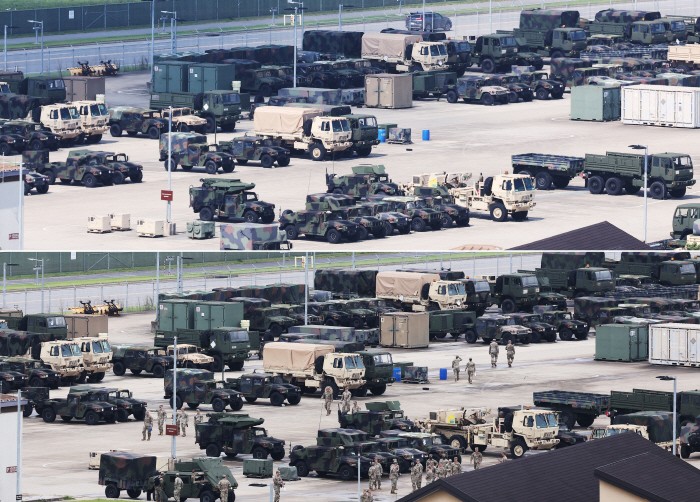 |
| Camp Humphreys in Pyeongtaek, Gyeonggi Province, appears quieter on the 18th, during the ongoing Korea-U.S. joint exercise "Ulchi Freedom Shield" (UFS), compared to the previous day (photo below). / Yonhap |
With the U.S. concentrating military resources on the war with Iran, the resulting gap in aircraft carrier presence in the Western Pacific has become a reality, and with the added order to significantly scale back Korea-U.S. joint military exercises, doubts over Washington's security commitments are growing among Indo-Pacific allies.
Major foreign outlets pointed out on the 18th (local time) that scaling back Korea-U.S. exercises could weaken deterrence against North Korea and combined readiness, and that with U.S. military assets also shifting toward the Middle East, allies' doubts over Washington's resolve to deter China are deepening as well.
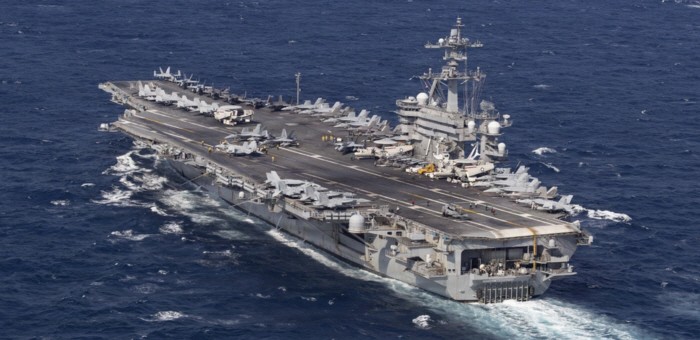 |
| The USS George Washington aircraft carrier sails through the western South China Sea, in a photo released by the U.S. Navy on the 8th (local time). / U.S. Navy website |
George Washington heads to Middle East to relieve Lincoln, leaving Western Pacific carrier gap
The U.S. Navy's George Washington Carrier Strike Group (CSG), previously forward-deployed in Japan, transited the Singapore and Malacca Straits on the 13th en route to the Middle East, with the Navy releasing photos and video of the voyage at the time. The George Washington will relieve the USS Abraham Lincoln, whose deployment was extended to support the Iran war and has now conducted operations at sea for nine months.
Concerns had emerged over crew mental health and supply issues aboard the Lincoln due to its extended mission. With the George Washington's departure, the Western Pacific is now left without a U.S. carrier present — a gap that also occurred in 2024, but which, according to U.S. military outlet The War Zone, had been rare for decades before that. The U.S. Navy operates 11 aircraft carriers in total.
Bryan Clark, a senior fellow at the Hudson Institute, told U.S. outlet Axios that maintaining two carriers continuously in the Middle East could create gaps of several months each year with no carrier in the Pacific. Mark Cancian, a senior adviser at the Center for Strategic and International Studies (CSIS), assessed that even without launching a full-scale invasion, China could use such gaps to expand its presence in the Pacific.
Clark noted that Taiwan, the Philippines, and Japan would be left watching China flex its military strength while no U.S. carrier is present, warning that if this becomes a recurring pattern, it could raise doubts about whether the U.S. would actually come to their aid in a real crisis. He said that if China can convince neighboring countries that "the U.S. won't actually come for them," then "it wouldn't even need to go to war."
The Wall Street Journal similarly assessed that with the George Washington's redeployment coinciding with the scaled-back Korea-U.S. exercises, China could use the moment to argue to regional countries that U.S. defense commitments cannot be relied upon.
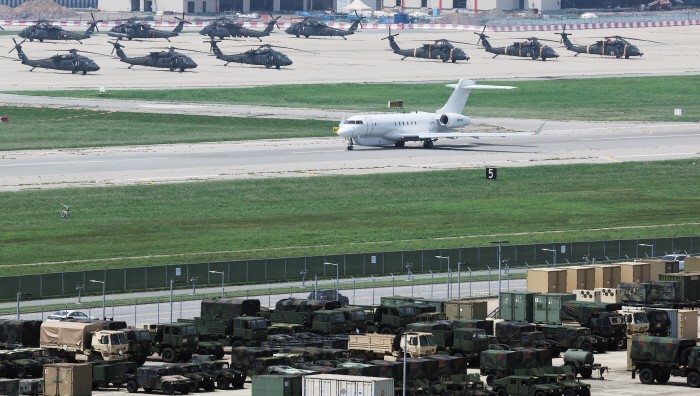 |
| An Athena-R reconnaissance aircraft prepares for takeoff at Camp Humphreys in Pyeongtaek, Gyeonggi Province, on the 18th, during the ongoing Korea-U.S. joint exercise "Ulchi Freedom Shield" (UFS). / Yonhap |
U.S. lawmakers, experts criticize UFS scale-back: "Undermines allied deterrence, credibility of U.S. security commitments"
Reactions within U.S. political circles to the scaled-back Korea-U.S. exercises were mixed. Rep. Young Kim, chair of the House Foreign Affairs Committee's Indo-Pacific subcommittee, wrote on X on the 17th that while the Korea-U.S. alliance and joint security exercises are essential to regional stability and deterring hostile forces, she remains deeply concerned about the South Korean government's treatment of U.S. companies and citizens.
Rep. Ami Bera, ranking Democrat on the same subcommittee, however, said in a statement that day that Secretary of State Marco Rubio had told him at a June hearing that America's security posture on the Korean Peninsula "remains unchanged," asking, "So what has changed?" He criticized President Trump for weakening deterrence posture over his personal relationship with North Korean leader Kim Jong-un, calling it "a betrayal of a democratic ally" that further erodes U.S. credibility across the Indo-Pacific.
Criticism also came from former officials who served under both Republican and Democratic administrations. Dan Fried, who served as assistant secretary of state for European affairs under the George W. Bush administration, told AP, "I can't see a single U.S. national interest served by this," saying it weakens South Korea and Japan, frightens Taiwan, unsettles NATO, and emboldens China and North Korea.
Charles Kupchan, a senior fellow at the Council on Foreign Relations (CFR), noted that allies are now in a position where, even as they hope the U.S. security umbrella continues, they must also consider "the possibility that the U.S. may not be there for them." Still, he assessed that America's forward bases and core alliance relationships themselves remain intact for now.
Zack Cooper, an Asia security expert at the American Enterprise Institute (AEI), told the Financial Times that while the Trump administration insists it is steadily strengthening deterrence in Asia, it is in fact sending key munitions and naval assets to the Middle East while also scaling back Korea-U.S. exercises.
The FT reported that with these moves coinciding with Chinese President Xi Jinping's upcoming visit to Washington, D.C. next month, allies including Japan and South Korea are closely watching America's resolve to deter China. The report noted that while the U.S. expanded the trilateral Korea-U.S.-Japan "Freedom Edge" exercise last year and strengthened military cooperation with the Philippines, its recent moves are sending conflicting signals.
In response, White House spokesperson Anna Kelly pushed back, according to Axios, saying President Trump has made America respected again and is correcting all diplomatic relationships to be based on reciprocity.
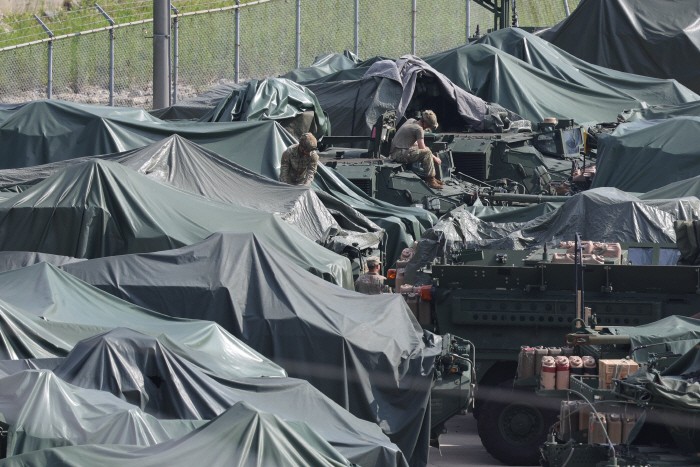 |
| Stryker armored vehicles are covered with waterproof tarps at a USFK base in Dongducheon, Gyeonggi Province, on the 18th, during the ongoing Korea-U.S. joint exercise "Ulchi Freedom Shield" (UFS). / Yonhap |
Philippines, Pentagon try to ease alliance concerns: "U.S. is not withdrawing from Asia"
Still, not all of America's Asian allies are concerned about weakened security commitments. According to Reuters, Philippine military spokesman Roy Vincent Trinidad said that despite the redeployment of U.S. assets like the George Washington to the Middle East, he doesn't expect joint military activity between the two countries to decline or slow down, calling the U.S.-Philippines defense commitment "ironclad." The Philippines has already approved new joint military activities with the U.S., including large-scale exercises and expert exchanges.
Elbridge Colby, Under Secretary of Defense for Policy, stressed in Manila last week that the U.S. is "not retreating" from Asia, saying Washington remains focused on maintaining a balance of power favorable to the U.S. in the Indo-Pacific.
The Financial Times noted that while the U.S. has expanded military cooperation with the Philippines and strengthened trilateral Korea-U.S.-Japan exercises, the combination of the George Washington's redeployment to the Middle East, the scaled-back Korea-U.S. exercises, and weapons supply delays tied to the Iran war has sent mixed signals to allies.
Reuters reported that the Trump administration has been pursuing efforts to "modernize" the Korea-U.S. alliance, aiming to enable U.S. Forces Korea to respond more flexibly to crises across the Indo-Pacific — including involving China and Taiwan — beyond just the Korean Peninsula. South Korea, while relying on U.S. defense commitments to deter North Korea, remains wary of being drawn directly into a potential Taiwan conflict.
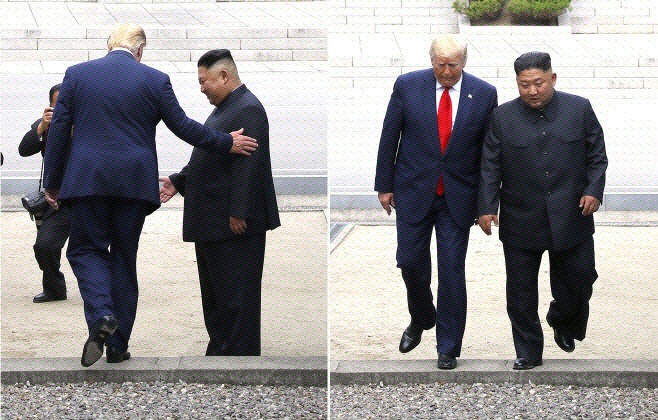 |
| U.S. President Donald Trump walks back from the North Korean side of the Demilitary Demarcation Line at Panmunjom with North Korean leader Kim Jong-un on the afternoon of June 30, 2019, after briefly stepping across the border into the North. / Yonhap |
WSJ, NYT criticize conciliatory approach toward North Korea, cite concerns over South Korean nuclear armament debate, denuclearization setbacks
Criticism has also grown over Trump's conciliatory approach toward North Korea. In an editorial, the WSJ criticized the scaled-back Korea-U.S. exercises as sending North Korea a message that U.S. deterrence and readiness are weakening. The WSJ projected that the decision could reinforce perceptions in Asia and Europe that the U.S. is an unreliable ally, and could also fuel South Korea's own domestic debate over independent nuclear armament. The WSJ assessed that this scale-back carries greater risk than in 2018, given that North Korea has since expanded its nuclear weapons and missile capabilities and gained battlefield experience through participation in Russia's invasion of Ukraine.
The New York Times analyzed the contrasting approaches Trump has taken toward Iran and North Korea, noting that as he finds himself stuck in the Iran war, he is once again turning his attention to his relationship with Kim Jong-un. Joel S. Wit, a distinguished fellow at the Stimson Center and former State Department North Korea official, warned that a U.S.-North Korea summit under current conditions could actually turn into a "disaster." Victor Cha, Korea chair at CSIS, assessed that the Iran war could reinforce North Korea's belief that pursuing nuclear weapons to avoid military attack was the right call.
President Trump's renewed remarks on South Korea's defense cost-sharing, raised immediately after the exercise scale-back, also stirred controversy. He claimed there are 39,000 U.S. troops stationed in South Korea and that he had gotten South Korea to pay $3 billion (about 4.2387 trillion won) annually during his first term, only for the Biden administration to eliminate that arrangement.
CNN pushed back, noting that according to Pentagon figures, U.S. troop levels in South Korea stood at 26,589 as of the end of March, that South Korea has shared defense costs since 1991, and that the cost-sharing amount agreed under the Trump administration in 2019 was actually under $1 billion (1.4129 trillion won). CNN pointed out that the Biden administration did not scrap the existing agreement but instead signed a new pact in 2021 raising South Korea's contribution by 13.9%, and signed another agreement in 2024 raising the 2026 contribution by 8.3% — identifying at least five inaccuracies in Trump's account.
CNN, AP fact-check Trump's claims and the UFS scale-back: errors on cost-sharing, concerns over weakened combined operations
AP assessed that "Ulchi Freedom Shield" (UFS) is a core alliance exercise that has, for decades, prepared South Korean and U.S. forces to conduct smooth joint operations in the event of a contingency. This year's UFS runs for 11 days, with about 18,000 South Korean troops participating. South Korea and the U.S. had originally planned 14 field training exercises, but it remains undecided which exercises and to what extent Trump's order for a significant scale-back will actually apply.
AP reported that experts are concerned that if exercise reductions become a recurring pattern amid regular command turnover, it could degrade the two militaries' ability to conduct combined operations in an actual crisis. Experts also noted that the scale-back could affect preparations for transferring wartime operational control to a combined command structure led by a South Korean general.
On the 16th, Trump ordered Defense Secretary Pete Hegseth to "significantly scale back" UFS, citing his relationship with Kim Jong-un and the cost of the exercise. He suggested the decision was also linked to a phone call with President Lee Jae-myung on the 17th, in which Trump said he asked for South Korea's support on operations related to Iran's denuclearization, only for President Lee to decline, saying, "No thanks!"
Ha Man-ju
Most Read
-
1
Trump shares map on social media labeling Strait o..

-
2
Kia Sportage outperforms Mazda CX-5 in German auto..

-
3
Houthis launch successive attacks on Saudi airport..

-
4
U.S. deploys carrier, 10,000 more troops to Middle..

-
5
Trump rejects Iran's offer to open Strait of Hormu..

-
6
N. Korea conducts first swarm attack drill with dr..

-
7
U.S.-China summit falls short on substance as Trum..

PEOPLE






HEADLINE NEWS
- Seoul dismisses Ukraine's claim of 'S. Korean support for Russia' as "inaccurate and inappropriate"
- S. Korea, Japan race to develop nuclear-powered submarines
- Henri Kagan, Kenso Soai win Nobel Prize in Chemistry for uncovering how mol..
- Vance says Alaska LNG cooperation will move forward with Seoul's current or..

-
Address : In-Young Bldg., 34, Uisadang-daero 1-gil, Yeongdeungpo-gu, Seoul
Copyright by ASIATODAY CO., LTD. All rights resereved