



Taiwan, unable to contain growth, to give all residents 450,000 won next year
Aug 19, 2026, 10:09 am


Taiwan, riding the AI industry boom and projected to post economic growth of around 11% this year, plans to give all residents a cash payout of 10,000 New Taiwan dollars (450,000 won) each next year. The move appears aimed at sharing the fruits of growth with the public, driven by a keen awareness of criticism that the benefits of the semiconductor boom's rapid economic expansion have flowed mainly to certain industries and investors. But put a bit more bluntly, it also seems fair to say this reflects Taiwan simply struggling to keep up with growth it cannot fully absorb.
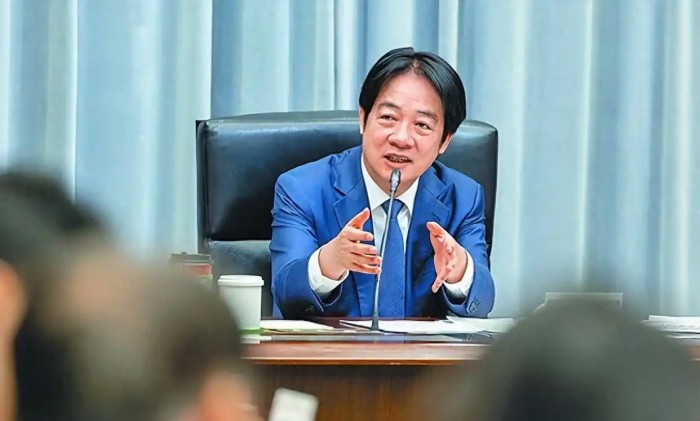 |
| Taiwan President Lai Ching-te announces plans to give all residents a payout of 450,000 won next year. / United Daily News (Taiwan) |
According to Beijing sources familiar with cross-strait affairs on the 18th, President Lai Ching-te announced the cash payout plan on Facebook the previous day, saying that all citizens should share in the dividends of AI. At a briefing on the 2027 central government budget proposal, he reiterated his thinking, stressing that the government isn't focused solely on the tech industry but will also look after every household working hard to make a living. In line with this, Taiwan's Executive Yuan is set to unveil the related next-year government budget proposal on the 20th.
Taiwan's economy has been growing rapidly, driven by surging global AI demand and massive investment in the semiconductor industry. GDP grew 12.9% year-on-year in the second quarter of this year alone. There's good reason the statistics agency, the Directorate-General of Budget, Accounting and Statistics, raised its forecast for this year's growth rate to 11.05% on the 14th — if that forecast holds, it would mark Taiwan's highest growth rate in 39 years, since 1987. Growth next year is also projected at 6%.
Taiwan's stock market has been no exception, benefiting substantially from the AI boom, having surged roughly 60% so far this year. Yet the breakneck growth in semiconductors and AI, along with wage gains, remains genuinely limited in reach. Given that a significant share of Taiwan's roughly 23 million people haven't felt the benefits of the chip and AI boom or the asset market rally, it's understandable that most residents are voicing complaints.
Taiwan's government also gave residents 10,000 New Taiwan dollars each last year, when economic growth hit 8.8%. This is likely why the main opposition Kuomintang has called for further cash handouts ahead of November's local elections — an approach widely seen as reflecting both livelihood concerns and political calculation ahead of the vote.
However, for the cash payout to actually happen, next year's budget must clear the high bar of passing the Legislative Yuan. Given that the ruling Democratic Progressive Party lacks a majority in a divided legislature, the deliberation process is expected to face significant friction. Still, if the budget passes, the payout is expected to be distributed in early next year.
Hong Soon-do
Most Read
-
1
Trump shares map on social media labeling Strait o..

-
2
Kia Sportage outperforms Mazda CX-5 in German auto..

-
3
Houthis launch successive attacks on Saudi airport..

-
4
U.S. deploys carrier, 10,000 more troops to Middle..

-
5
Trump rejects Iran's offer to open Strait of Hormu..

-
6
N. Korea conducts first swarm attack drill with dr..

-
7
U.S.-China summit falls short on substance as Trum..

PEOPLE






HEADLINE NEWS
- Seoul dismisses Ukraine's claim of 'S. Korean support for Russia' as "inaccurate and inappropriate"
- S. Korea, Japan race to develop nuclear-powered submarines
- Henri Kagan, Kenso Soai win Nobel Prize in Chemistry for uncovering how mol..
- Vance says Alaska LNG cooperation will move forward with Seoul's current or..

-
Address : In-Young Bldg., 34, Uisadang-daero 1-gil, Yeongdeungpo-gu, Seoul
Copyright by ASIATODAY CO., LTD. All rights resereved