



Pentagon denies interceptor missile stockpiles are depleted
Aug 07, 2026, 10:28 am


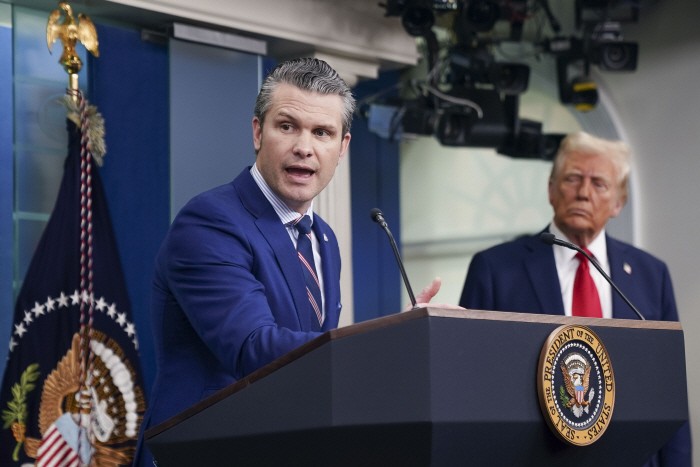 |
| U.S. Secretary of Defense Pete Hegseth (left) and U.S. President Donald Trump. / EPA-Yonhap |
U.S. President Donald Trump strongly reprimanded Defense Secretary Pete Hegseth over munitions shortages amid the prolonged war with Iran, the Washington Post reported on the 5th (local time), citing multiple sources. The Pentagon and White House have flatly denied reports of depleted interceptor missile stockpiles, calling them "fake news," but internal tension within the administration appears to be intensifying.
According to WP, Trump sharply criticized Hegseth at a Cabinet meeting he held at Camp David in Maryland on the 31st of last month. Trump reportedly said, "I thought this had already been resolved," pressing Hegseth over serious shortages of missiles and interceptors amid the prolonged war with Iran.
Earlier, CNN reported, citing multiple sources, that the U.S. military had used up about 80% of its Terminal High Altitude Area Defense (THAAD) interceptor stockpile and roughly half of its Patriot interceptor inventory since the war with Iran began. According to CNN, senior military commanders have continued warning that current munitions reserves have fallen to dangerous levels.
Multiple sources said the U.S. military expended 850 Tomahawk cruise missiles and more than 1,000 Patriot and THAAD interceptors in the first month of the war alone, and that stockpiles of the ATACMS tactical ballistic missile have been effectively depleted. As a result, Trump ordered what would have been "the largest attack since World War II" before canceling it, and has held off on further large-scale offensives.
According to the sources, when pressed by Trump, Hegseth reportedly deflected blame onto Deputy Defense Secretary Stephen Feinberg rather than taking responsibility himself, claiming that Feinberg had failed to properly brief the president, leading to his misunderstanding of the situation.
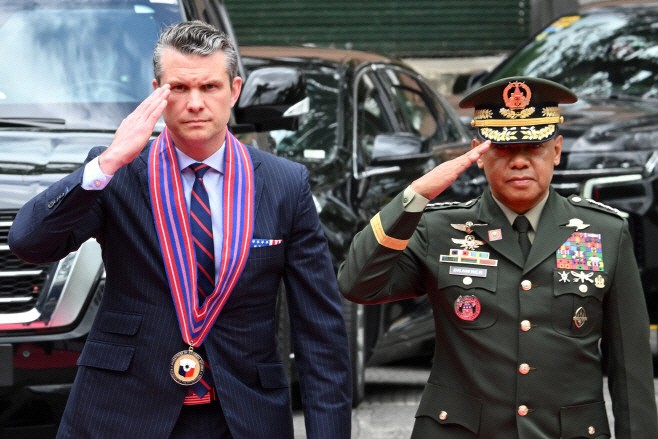 |
| U.S. Secretary of Defense Pete Hegseth (left) visits Manila, Philippines in March, greeted by Philippine Armed Forces Chief of Staff Romeo Brawner (right). / AFP-Yonhap |
The Pentagon and White House flatly denied any munitions shortage or internal conflict.
Pentagon spokesperson Sean Parnell said, "Our military still has abundant capability," adding, "We have everything needed to carry out the president's orders anywhere, anytime. The idea that stockpiles are depleted is not true."
White House spokesperson Karoline Leavitt said Trump's reported reprimand of the defense secretary "never happened." White House spokesperson Anna Kelly likewise stressed that the U.S. military has more than enough munitions and reserves to accomplish Trump's strategic objectives.
WP assessed that the tension between Trump and Hegseth has gone beyond a simple reprimand, spreading into a broader blame game within the Pentagon's leadership over the munitions shortage. It noted that Hegseth's apparent move to shift blame onto Deputy Secretary Feinberg reflects deeper distrust within the department over inventory management and reporting.
Hegseth, who had strongly advocated for the initial strikes on Iran, has enjoyed Trump's trust. While the successful operation to capture Venezuela's Maduro bolstered his standing, that trust has reportedly wavered amid the stalemate over reopening the Strait of Hormuz and the prolonged U.S.-Iran war.
Delays in the Pentagon's request for additional funding are also expected to hurt the war effort. The department requested $67 billion (about 89 trillion won) in supplemental funding in late July, but with congressional deliberations delayed, no short-term fix is in sight. Bradley Bowman, a senior director at the Foundation for Defense of Democracies, noted that replenishing stockpiles is a long-term challenge, since contracting and production can take years.
Ha Man-ju
Most Read
-
1
Celltrion’s Omlyclo gains ground in major European..

-
2
Trump demands rates fall below 1% as Fed hikes for..

-
3
Trump makes $1 trillion bet ahead of midterm elect..

-
4
Iran resumes ballistic missile production, assembl..

-
5
Samsung Electronics, Mistral AI to jointly develop..

-
6
Trump warns countries not helping U.S. must pay re..

-
7
Apple launches first foldable, 1 million won prici..

PEOPLE






HEADLINE NEWS
- Trump to roll out ‘unprecedented welcome’ for Xi with B-2 bombers, F-22 fighters
- S. Korea, U.S., and Japan form united front on Taiwan and economic coercion..
- Trump administration moves to impose sweeping sanctions on International Cr..
- Xi to make state visit to U.S. Sept. 23-25, dispelling rumors over his heal..

-
Address : In-Young Bldg., 34, Uisadang-daero 1-gil, Yeongdeungpo-gu, Seoul
Copyright by ASIATODAY CO., LTD. All rights resereved