



Takaichi leaves door open for sending JMSDF to Hormuz
Jun 18, 2026, 11:26 am


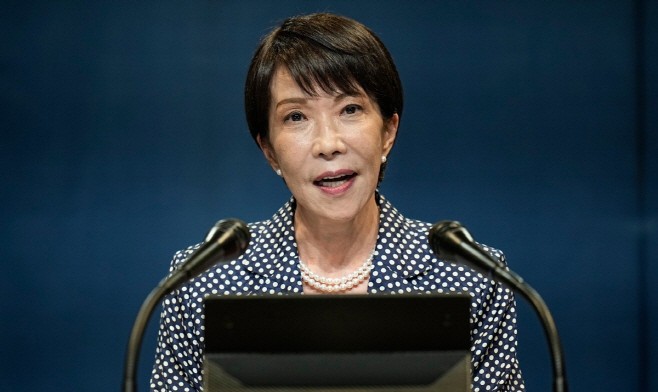 |
| Japanese Prime Minister Sanae Takaichi holds a press conference on June 17 (local time) after concluding the G7 summit. / Photo via AP, Yonhap |
Following the agreement between the United States and Iran to end hostilities, whether to deploy the Self-Defense Forces to the Strait of Hormuz—a vital maritime chokepoint for crude oil shipments—has emerged as a major point of contention within the Japanese government. Major Japanese media outlets reported on June 18 that Prime Minister Sanae Takaichi stated during a press conference following the conclusion of the G7 summit near Évian in eastern France on June 17, "Nothing has been decided at this point" regarding the deployment of the SDF to the Strait of Hormuz. However, Takaichi signaled that she would assess the local situation before making a final decision, adding, "We must closely examine the U.S.-Iran agreement and the actual situation on the ground."
The Strait of Hormuz is a crucial shipping lane through which Middle Eastern crude oil passes. As the U.S.-Iran conflict enters a phase of resolution following the cessation of hostilities agreement, the focus of Japan's response is shifting from deterrence diplomacy to securing navigation safety and post-war engagement. For Japan, which relies heavily on imported energy resources, instability in the Strait of Hormuz could directly impact logistics, energy prices, and the broader economy. Even if fighting stops, how the Japanese government will involve itself could rise to the top of the foreign policy and security agenda if issues like mine clearance and vessel safety persist.
The situation in the Middle East and securing the safety of maritime shipping lanes were also key topics on the G7 agenda. In particular, following the agreement to end hostilities, preventing a recurrence of military conflict and stably managing crude oil transport routes have emerged as common tasks for member nations. The Japanese government finds itself in a position where it must align its steps with allies and partners while seeking a response that does not breach its constitutional constraints.
Regarding the situation in the Middle East, Prime Minister Takaichi said, "We will build on all diplomatic efforts, including reconstruction support." Regarding securing the freedom of navigation in the Strait of Hormuz, she also emphasized, "We will review necessary responses, including diplomatic efforts, and resolutely carry out what we can."
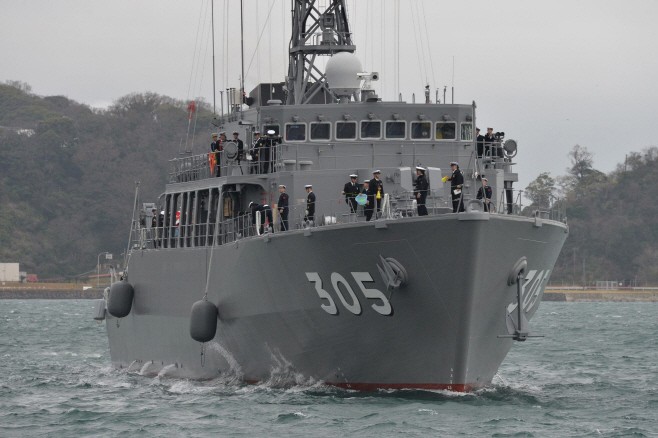 |
| The Japan Maritime Self-Defense Force minesweeper JS Hirado. / Photo courtesy of the Japan Maritime Self-Defense Force website |
In a joint statement demanding the unconditional reopening of the Strait of Hormuz, nations including the United Kingdom and France expressed their readiness to take on roles such as mine clearance. Japan has also signaled its intention to participate in this joint statement. Regarding this move, Prime Minister Takaichi explained, "The statement itself is also premised on being within the boundaries of the Constitution."
The core issue lies in how far the Self-Defense Forces can legally involve themselves. Article 9 of the Japanese Constitution prohibits the use of force, except for the exercise of the right to self-defense. For this reason, conducting mine clearance operations while hostilities are ongoing could spark controversy, as it might be interpreted as a use of force against the nation that deployed the mines.
Conversely, activities to clear "abandoned mines" left behind after a ceasefire agreement can be legally justified under the Self-Defense Forces Act. The Japanese government has a precedent for this: following the 1991 Gulf War ceasefire, it dispatched JMSDF minesweepers to the Persian Gulf to conduct mine clearance operations. That deployment is evaluated as one of the starting points for the debate surrounding the expansion of the SDF's post-war overseas activities.
While Prime Minister Takaichi's remarks do not represent an immediate decision to deploy the SDF, they are interpreted as leaving room for Japan to involve itself in the maritime security of the Strait of Hormuz, depending on the implementation of the U.S.-Iran agreement and the evolving situation on the ground. Whether Japan will confine itself to diplomatic support or go so far as to consider JMSDF operations during the restructuring of the Middle Eastern order in the post-conflict era is expected to be the focal point going forward.
Choi Yeong-jae
Most Read
-
1
Trump shares map on social media labeling Strait o..

-
2
Kia Sportage outperforms Mazda CX-5 in German auto..

-
3
Houthis launch successive attacks on Saudi airport..

-
4
U.S. deploys carrier, 10,000 more troops to Middle..

-
5
Trump rejects Iran's offer to open Strait of Hormu..

-
6
N. Korea conducts first swarm attack drill with dr..

-
7
U.S.-China summit falls short on substance as Trum..

PEOPLE






HEADLINE NEWS
- Seoul dismisses Ukraine's claim of 'S. Korean support for Russia' as "inaccurate and inappropriate"
- S. Korea, Japan race to develop nuclear-powered submarines
- Henri Kagan, Kenso Soai win Nobel Prize in Chemistry for uncovering how mol..
- Vance says Alaska LNG cooperation will move forward with Seoul's current or..

-
Address : In-Young Bldg., 34, Uisadang-daero 1-gil, Yeongdeungpo-gu, Seoul
Copyright by ASIATODAY CO., LTD. All rights resereved