



Iran to allow IAEA inspectors back for uranium disposal, Vance confirms
Jun 16, 2026, 10:39 am


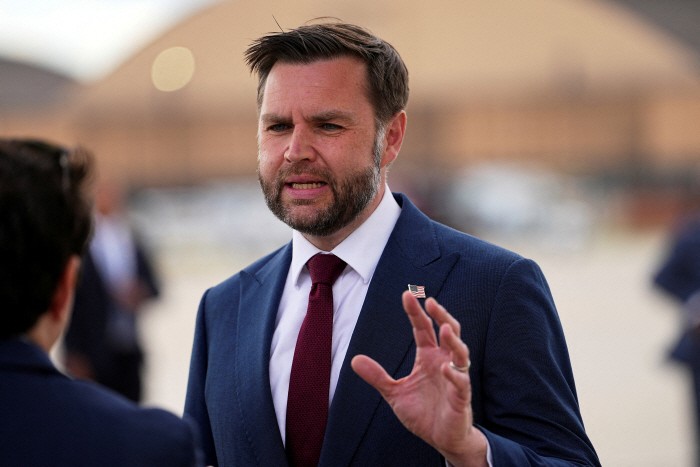 |
| U.S. Vice President JD Vance speaks with the media as he arrives at Joint Base Andrews in Maryland on May 28 (local time). / Photo courtesy of Reuters, Yonhap News Agency |
The United States and Iran have entered into a memorandum of understanding (MOU) to end their hostilities, with the U.S. administration confirming that the agreement will pave the way for the resumption of International Atomic Energy Agency (IAEA) nuclear inspections in Iran.
In an interview with NBC News on June 15 (local time), U.S. Vice President JD Vance emphasized that a cornerstone of the agreement involves the IAEA and the United States assisting Iran in dismantling its stockpiles of highly enriched nuclear material, a provision explicitly mandated in the memorandum.
The full text of the bilateral MOU is scheduled to be made public following an official signing ceremony in Switzerland on June 19. Addressing the delay in releasing the text, Vance clarified that the parties are currently fine-tuning technical implementation details rather than amending the core document itself. He also acknowledged the diplomatic contributions of Qatar and Pakistan in mediating the breakthrough.
Furthermore, the Vice President noted that nuclear inspections are highly anticipated to commence on June 19, adding that Iran would receive reciprocal benefits provided it remains in strict compliance with the terms.
The diplomatic breakthrough has sparked mixed domestic reactions in the United States. Former President Barack Obama previously expressed skepticism during an ABC News interview, questioning whether the deal brokered by the Trump administration would prove more advanced than the Joint Comprehensive Plan of Action (JCPOA) secured during his own tenure.
Vance countered that assessment, drawing a sharp distinction between the two approaches. He argued that while the JCPOA essentially offered financial concessions to halt an active nuclear program, the current arrangement follows a scenario where Iran's nuclear framework has been effectively dismantled, requiring a formal pledge that prevents its reconstitution.
Regarding the controversial transit fees proposed for the Strait of Hormuz, Vance confirmed that the agreement guarantees free, unhindered access through the vital waterway during the 60-day period designated for final contract negotiations. He downplayed Iran's stated plans to impose service fees on traversing commercial vessels, attributing the rhetoric to certain Iranian factions seeking to exaggerate their domestic gains.
Meanwhile, Iranian President Masoud Pezeshkian offered a more measured perspective via social media platform X, framing the MOU as a pivotal stepping stone toward halting the conflict and initiating structured dialogue, while reminding the public that negotiations toward a final accord remain ongoing.
Lee Jung-eun
Most Read
-
1
Trump shares map on social media labeling Strait o..

-
2
Kia Sportage outperforms Mazda CX-5 in German auto..

-
3
Houthis launch successive attacks on Saudi airport..

-
4
U.S. deploys carrier, 10,000 more troops to Middle..

-
5
Trump rejects Iran's offer to open Strait of Hormu..

-
6
N. Korea conducts first swarm attack drill with dr..

-
7
U.S.-China summit falls short on substance as Trum..

PEOPLE






HEADLINE NEWS
- Seoul dismisses Ukraine's claim of 'S. Korean support for Russia' as "inaccurate and inappropriate"
- S. Korea, Japan race to develop nuclear-powered submarines
- Henri Kagan, Kenso Soai win Nobel Prize in Chemistry for uncovering how mol..
- Vance says Alaska LNG cooperation will move forward with Seoul's current or..

-
Address : In-Young Bldg., 34, Uisadang-daero 1-gil, Yeongdeungpo-gu, Seoul
Copyright by ASIATODAY CO., LTD. All rights resereved