



[Exclusive] Harim absorbs HBC under prosecution probe, sparking row over escaping liability
Jun 18, 2026, 09:33 am


 |
 |
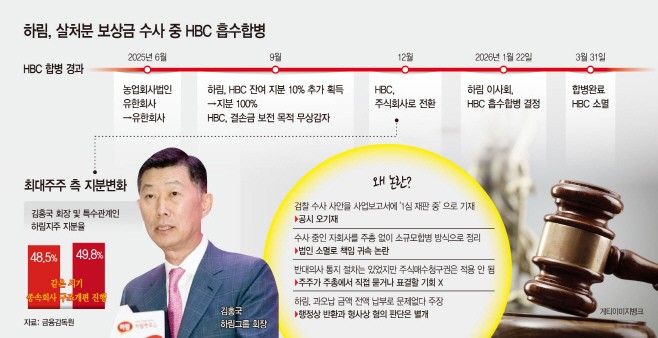
It has been revealed that Harim absorbed and dissolved its wholly-owned subsidiary, HBC, which was under investigation by the prosecution, prior to any indictment. HBC is a corporate entity that was being investigated over allegations of overreceiving culling compensations for Avian Influenza (AI). Although Harim publicly disclosed the purpose of the merger as "increasing management efficiency and maximizing synergy," questions are being raised over the background of clearing a deficit-ridden, 100% owned subsidiary through a merger while an investigation was still ongoing. Legal experts explain that while civil and administrative liabilities can carry over to Harim as the surviving entity, the status of a corporate entity subject to investigation under criminal procedures is difficult to be automatically transferred to Harim. As the merger was processed solely through a board of directors' resolution without a general meeting of shareholders, controversies surrounding the attribution of responsibility and the duty to explain to shareholders are intensifying.
According to the Electronic Disclosure System of the Financial Supervisory Service on June 17, Harim held a board meeting on January 22 this year and decided to absorb and merge HBC. Harim is the surviving company, HBC is the dissolved company, and the merger ratio is 1 to 0. Since Harim holds 100% of the issued shares of HBC, it was conducted as a splitless merger without issuing new shares. The date of the board resolution approving the merger was February 26, and the effective date of the merger was March 31.
HBC was a company in charge of breeding grandparent stock and parent stock in Harim's poultry production structure. Grandparent stock and parent stock refer to the parent and grandparent chicken stages that form the foundation of chick production. After being incorporated as a Harim subsidiary in 2014, HBC has sequentially absorbed breeding entities within the group, including Honglim in 2016 and BNP in 2023. The entity that had been consolidating the group's breeding sector was ultimately absorbed into the Harim main body.
The problem is that HBC was a corporate entity under prosecution investigation at the time of the merger. Under the contingent liabilities section of Harim's business report, a 'criminal lawsuit related to excessive compensation due to livestock species classification errors during culling' regarding HBC was recorded. This is a matter where allegations of species classification errors and overreceipt were raised in connection with government compensations paid when livestock are culled due to AI or other diseases.
Harim logged the pending institution for the matter as the 'Jeonju District Prosecutors' Office, Jeongeup Branch' and the progress status as 'first-instance trial underway.' Since a prosecutors' office is an investigative agency and a first-instance trial is a proceeding conducted in court after an indictment, these entries do not align with each other.
A Harim official explained, "It is still in the pre-indictment investigation stage, and 'first-instance trial underway' was a technical clerical error in the entry." If a company is aware of an error but fails to correct it, it could become subject to review by the Financial Supervisory Service.
Immediately prior to the merger, Harim secured all shares of HBC, went through financial settlements and organizational updates, and entered the merger process. In September last year, it acquired an additional 8.5% stake held by Harim Group Chairman Kim Hong-kuk and a 1.5% stake from Daesung Livestock Agricultural Association Corporation, adding to its existing 90% stake in HBC. The number of acquired shares was 118,008, and the acquisition amount was approximately 970 million won.
In June last year, HBC changed its corporate form from an agricultural corporation limited company to a general limited company, relinquishing its agricultural corporation status, and implemented a capital reduction without consideration in the second half of the year for the purpose of offsetting deficits. At the time, HBC was a deficit-ridden corporation with net assets of minus 472.03 million won. In December of the same year, it converted from a limited company to a joint-stock corporation, which aligns with the requirements of a small-scale merger conducted without a general meeting of shareholders.
A small-scale merger is a system designed to swiftly process transactions that do not significantly impact shareholders, allowing the procedure to be finalized solely with board approval without holding a general meeting of shareholders. However, given that HBC was a corporation with remaining prosecution investigation matters, questions are being raised over dissolving it without a general meeting of shareholders. Harim went through the procedure of notifying the intent to oppose the merger, but the appraisal rights of opposing shareholders do not apply to small-scale mergers. Ultimately, general shareholders had no opportunity to directly ask questions or vote regarding the merger of the subsidiary under investigation at a general meeting of shareholders.
A Harim official stated, "The overpaid amounts resulting from administrative errors have already been paid in full, and corrective measures have been completed," adding, "Since this is a splitless merger of a 100% owned subsidiary, there is no substantive risk to shareholders."
However, paying the overpaid amount in full does not automatically result in the termination of an investigation or the dismissal of charges, and even if administrative return measures were taken, the criminal liability assessment is a separate matter.
A legal expert noted, "The issue of liability following a merger must be viewed by separating civil and administrative burdens from the status under criminal procedures," adding, "As HBC was dissolved prior to indictment, how to view the subject of liability depending on future investigation results remains a point of contention."
In December last year, before HBC changed its organizational structure to a joint-stock corporation, the stake held by Chairman Kim Hong-kuk and his specially related parties in Harim Holdings rose from 48.5% to 49.8%. As the expansion of the largest shareholder side's stake and the restructuring of the subsidiary took place within the same month ahead of the year-end closing reference date, the controversy over Harim's accountability to explain to shareholders is expected to continue.
Kim So-ra
#Harim #HBC
Copyright by Asiatoday
Most Read
-
1
Celltrion nears additional contract with major U.S..

-
2
Putin proposes trilateral U.S.-China-Russia summit..

-
3
U.S. weighs dropping MOAB, world's most powerful n..

-
4
"Aren't those foreigners on welfare?": M..

-
5
Attention centers on APEC for possible Trump-Xi-Pu..

-
6
Saudi Arabia, Iran hold first diplomatic talks to..

-
7
China tightens grip on boosting domestic demand an..

PEOPLE







-
Address : In-Young Bldg., 34, Uisadang-daero 1-gil, Yeongdeungpo-gu, Seoul
Copyright by ASIATODAY CO., LTD. All rights resereved