



Trump mulls $300bn Iran rebuild fund with potential role for allies' companies
Jun 16, 2026, 02:54 pm


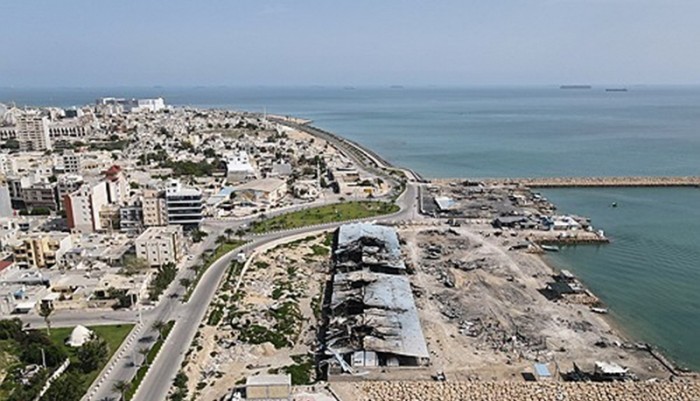 |
| Facilities at a fishing boat pier in a port on Qeshm Island, Iran, lie damaged on April 13 (local time) following multiple airstrikes executed during a joint U.S. and Israeli military operation. / Photo courtesy of AP, Yonhap News Agency |
The Financial Times (FT) reported on June 15 (local time) that the Donald Trump administration in the United States is prepared to establish a $300 billion (approximately 454 trillion KRW) investment fund for Iran, conditional upon Tehran agreeing to a final settlement that includes a nuclear accord.
A senior U.S. official conveyed that the administration has engaged in discussions regarding the potential relaxation of sanctions against Iran, alongside a $300 billion fund dedicated to national reconstruction. This financing will be linked to Iran's operational performance, including its compliance with a combat cessation memorandum of understanding (MoU) scheduled for formal signing in Switzerland on June 19.
A source briefed on the negotiations explained that the fund will be predicated on the final agreement framework outlined in the MoU, and will be formulated following a 60-day extension of the ceasefire, the reopening of the Strait of Hormuz, and subsequent nuclear negotiations. However, it is reported that the specific architecture or operational methodology of the fund has not yet been definitively established.
The source stated, "A significant number of enterprises from Europe, Asia—particularly South Korea and Japan—and the United States are demonstrating interest in investing in Iran," adding, "Once sanctions are eased, this fund will reach a substantial scale, and a massive influx of capital will occur."
U.S. Vice President JD Vance also remarked in an interview with CBS News on June 15 that "the $300 billion reconstruction fund is one example of the sort of capital [Iran] could have access to, so long as they faithfully honor their obligations under the agreement."
President Trump denied the reports regarding the fund initiative on the same day via his Truth Social platform. He wrote, "Iran has agreed never to possess nuclear weapons," while criticizing that "the story that the U.S. is paying Iran 300 billion Dollars is Fake News propagated by the Democrats."
It is understood that President Trump views this plan as politically sensitive, harboring concerns that it could be perceived as providing compensation to the Islamic regime.
In particular, he has consistently criticized the former Obama administration for extensively easing sanctions when it signed the Iran nuclear deal (JCPOA, or Joint Comprehensive Plan of Action) alongside other major powers in 2015, claiming that it dispatched "pallets full of cash" to Iran.
Figures opposing the current MoU criticize that the scale of financial assistance under discussion would significantly exceed the levels agreed upon during the Obama administration.
A senior official emphasized to reporters on June 15, "Sanctions relief is not tied specifically to any single particular conduct," adding, "It depends on them behaving appropriately across the board, and the matter we care most about above all is the nuclear program."
The United States and Iran have agreed to resolve the disposition of highly enriched uranium stockpiles in accordance with established protocols. According to a negotiation source, the baseline requirement involves the on-site dilution of all uranium under the supervision of the International Atomic Energy Agency (IAEA).
Iran is known to possess over 9,000 kilograms of enriched uranium; while the vast majority is low-enriched, approximately 440 kilograms are highly enriched, approaching a grade viable for nuclear weapon manufacturing. President Trump has previously referred to this material as "Nuclear Dust."
Kim Hyun-min
Most Read
-
1
Trump shares map on social media labeling Strait o..

-
2
Kia Sportage outperforms Mazda CX-5 in German auto..

-
3
Houthis launch successive attacks on Saudi airport..

-
4
U.S. deploys carrier, 10,000 more troops to Middle..

-
5
Trump rejects Iran's offer to open Strait of Hormu..

-
6
N. Korea conducts first swarm attack drill with dr..

-
7
U.S.-China summit falls short on substance as Trum..

PEOPLE






HEADLINE NEWS
- Seoul dismisses Ukraine's claim of 'S. Korean support for Russia' as "inaccurate and inappropriate"
- S. Korea, Japan race to develop nuclear-powered submarines
- Henri Kagan, Kenso Soai win Nobel Prize in Chemistry for uncovering how mol..
- Vance says Alaska LNG cooperation will move forward with Seoul's current or..

-
Address : In-Young Bldg., 34, Uisadang-daero 1-gil, Yeongdeungpo-gu, Seoul
Copyright by ASIATODAY CO., LTD. All rights resereved