



Japan, UK issue joint economic security declaration, aiming at China's rare earth curbs
Jun 15, 2026, 11:30 am


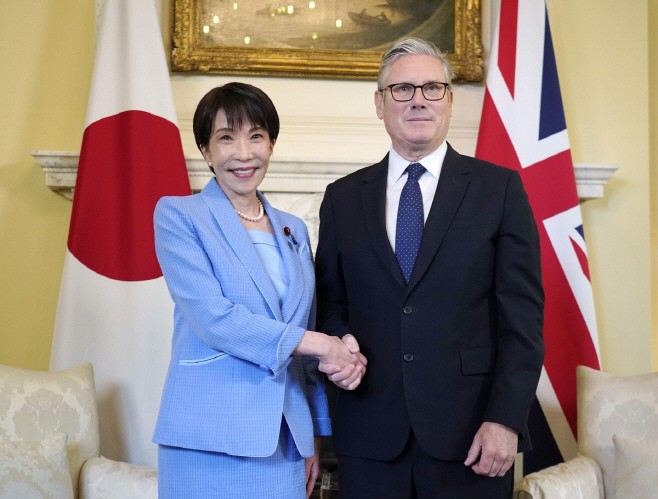 |
| Japanese Prime Minister Sanae Takaichi (left) and British Prime Minister Keir Starmer hold a bilateral meeting in London. / Yonhap News |
Japan, UK issue joint economic security declaration, taking aim at China's rare earth curbs
Japanese Prime Minister Sanae Takaichi and British Prime Minister Keir Starmer held a bilateral summit in London on June 14, issuing a joint declaration on economic security cooperation. Aimed at countering China's export controls on critical minerals like rare earths, the two nations agreed to collaborate on stabilizing and diversifying global supply chains. The ties between Japan and the United Kingdom are rapidly elevating to a de facto quasi-alliance encompassing security, economy, and advanced technologies.
According to an announcement by the Japanese Ministry of Foreign Affairs, Prime Minister Takaichi and Prime Minister Starmer held talks and a working luncheon lasting approximately two hours and 40 minutes at the Prime Minister's Official Residence in London. During the meeting, they unveiled the Joint Declaration on Japan-UK Economic Security Cooperation alongside the Japan-UK Frontier Technology Partnership. The two leaders held a restricted, small-group session for about 25 minutes at the start of the summit before attending a business roundtable alongside corporate leaders from both nations.
The joint declaration expressed "grave concern" over how economic coercion and arbitrary export restrictions—particularly those on critical minerals—destabilize global supply chains and undermine economic security and resilience. While the document did not explicitly name China, the phrasing is widely interpreted as a direct volley against Beijing, which has been tightening its grip on export controls for strategic materials such as rare earths and permanent magnets.
The two countries agreed to expand comprehensive cooperation across the entire lifecycle of the critical minerals sector, including mine development, smelting, processing, recycling, and stockpiling. They also committed to maintaining a working-level dialogue on battery materials, recycling, and joint projects in third countries. The instability of energy supply chains amid deteriorating geopolitical conditions in the Middle East was also high on the agenda. Both sides reaffirmed the importance of emergency response mechanisms like oil stockpiling, cooperation with the International Energy Agency, and maintaining the fluid flow of energy trade.
Advanced technology cooperation was introduced as another core pillar of the summit. The two nations launched the Frontier Technology Partnership to foster joint research and private-sector investment in fields including AI, semiconductors, quantum computing, space, cybersecurity, next-generation communications, and nuclear energy and fusion. The British government noted that this partnership is expected to unlock up to 18 billion pounds in economic impact, fueled by Japanese corporate investments in UK infrastructure, financial services, and offshore wind energy.
On the security front, the leaders reviewed the progress of the Global Combat Air Programme (GCAP)—a joint next-generation fighter jet development venture between Japan, the UK, and Italy. They pledged to support the signing of the next phase of contracts by the end of June and agreed to bolster cooperation in dual-use technologies, such as drones and AI, through a defense industry consultative framework. Prime Minister Takaichi noted that Japan and the UK share a unified strategic awareness that the security of the Indo-Pacific and the Euro-Atlantic regions is inherently indivisible.
This deepening alignment between Japan and the UK carries direct implications for South Korea. Seoul's flagship industries—semiconductors, secondary batteries, automobiles, and defense—are deeply intertwined with global supply chains for advanced technologies and critical minerals like rare earths, graphite, lithium, and nickel. If Japan and the UK move ahead to write the rules within frameworks like the G7, CPTPP, WTO reform, and critical mineral stockpiling, South Korea could find itself simultaneously acting as a beneficiary and a competitor in this shifting landscape.
In particular, quite apart from the trilateral security cooperation with the U.S. and Japan, South Korea faces the pressing task of broadening its economic security alliances with the UK, Australia, Canada, and the EU. If Japan preemptively secures institutional, technological, and investment networks with Europe in the collective effort to de-risk from China, South Korean enterprises risk being sidelined in resource procurement, standard-setting, and defense or AI cooperation. Conversely, if Seoul leverages its manufacturing prowess in batteries, semiconductors, shipbuilding, and defense to plug into this Japan-UK network, it could mitigate China risks while opening doors to the European defense market and advanced manufacturing supply chains.
Ultimately, this joint declaration is far more than a simple bilateral economic pact; it represents a major realignment of economic security, where China's weaponization of resources, Middle East energy volatility, post-Ukraine war European security, and the Indo-Pacific order are interlinked. For South Korea, it intensifies the pressure to move past the traditional dichotomy of treating security as military and economy as trade, forcing a more integrated architecture for supply chains, technology, and defense.
Choi Young-jae
Most Read
-
1
Trump shares map on social media labeling Strait o..

-
2
Kia Sportage outperforms Mazda CX-5 in German auto..

-
3
Houthis launch successive attacks on Saudi airport..

-
4
U.S. deploys carrier, 10,000 more troops to Middle..

-
5
Trump rejects Iran's offer to open Strait of Hormu..

-
6
N. Korea conducts first swarm attack drill with dr..

-
7
U.S.-China summit falls short on substance as Trum..

PEOPLE





HEADLINE NEWS
- Seoul dismisses Ukraine's claim of 'S. Korean support for Russia' as "inaccurate and inappropriate"
- S. Korea, Japan race to develop nuclear-powered submarines
- Henri Kagan, Kenso Soai win Nobel Prize in Chemistry for uncovering how mol..
- Vance says Alaska LNG cooperation will move forward with Seoul's current or..

-
Address : In-Young Bldg., 34, Uisadang-daero 1-gil, Yeongdeungpo-gu, Seoul
Copyright by ASIATODAY CO., LTD. All rights resereved