



U.S.-Iran deal: Hormuz reopens, nuclear disputes deferred
Jun 18, 2026, 09:15 am


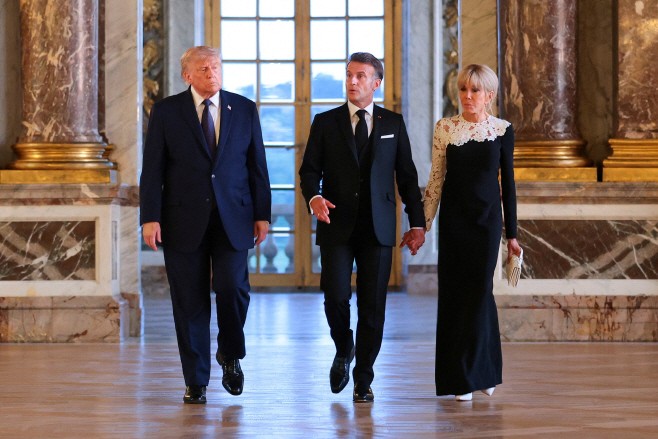 |
| U.S. President Donald Trump (left) is guided by French President Emmanuel Macron and First Lady Brigitte Macron prior to a dinner at the Palace of Versailles in France on June 17. / Photo courtesy of Reuters, Yonhap News Agency |
The U.S.-Iran memorandum of understanding (MOU) to end the conflict is structured to immediately reopen the Strait of Hormuz and activate sanctions exemptions for Iranian crude oil exports upon signing, while deferring the issues of the nuclear program, the timeline for terminating sanctions, and the creation of a $300 billion reconstruction fund to follow-up negotiations over the next 60 days.
Defending the agreement during a press conference closing the G7 summit in Évian-les-Bains, France, on June 17, U.S. President Donald Trump warned that if Iran fails to comply, "we will bomb them again."
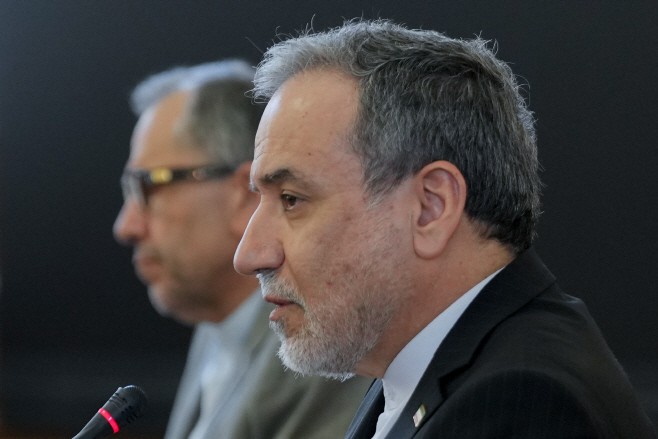 |
| Iranian Foreign Minister Abbas Araghchi speaks to foreign ambassadors and diplomatic representatives in Tehran, Iran, on June 16, explaining the U.S.-Iran memorandum of understanding (MOU) to end the conflict. / Photo courtesy of Iranian Foreign Ministry, AFP, Yonhap News Agency |
The U.S.-Iran MOU to end the conflict outlines that Iran will guarantee the safe passage of commercial vessels through the Strait of Hormuz—connecting the Persian Gulf to the Gulf of Oman—immediately upon signing. Iran will waive transit fees for 60 days, while the United States is required to completely lift its maritime blockade within 30 days.
Concurrently, the U.S. Department of the Treasury will issue sanctions exemptions for Iranian exports of crude oil, petroleum products, and derivatives, as well as associated financial, insurance, and shipping services, taking effect immediately upon the signing of the agreement.
The Strait of Hormuz, a vital artery through which approximately one-fifth of the world's oil supply flows, had been blockaded for several months following air strikes on Iran by the United States and Israel on February 28, triggers a sharp spike in global energy prices. Amid the breakthrough, Brent crude futures slipped below $80 per barrel this week.
President Trump remarked that a prolonged war "could have caused a global recession," adding, "The president I did not want to be was the late Herbert Hoover." Frequently referring to the MOU as the 'Trump Deal,' he praised the agreement as "a wall that blocks the path to nuclear weapons."
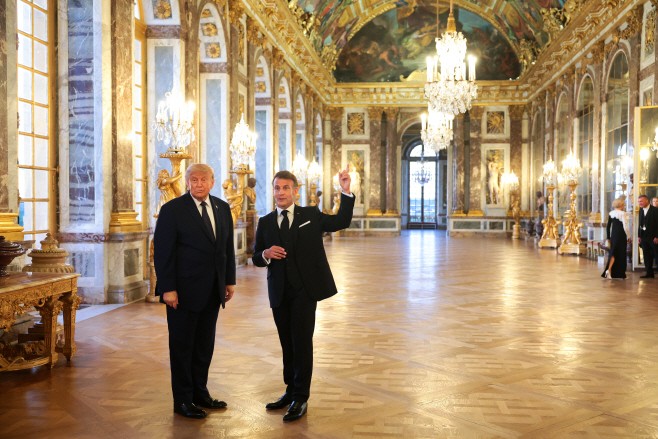 |
| U.S. President Donald Trump (left) is guided by French President Emmanuel Macron prior to a dinner at the Palace of Versailles in France on June 17. / Photo courtesy of AP, Yonhap News Agency |
Iran reaffirms pledge to forgo nuclear weapons; Enriched uranium disposal transferred to 60-day talks
Article 8 of the MOU stipulates that Iran reaffirms its commitment not to develop or acquire nuclear weapons, specifying that its enriched uranium stockpiles will be processed under the supervision of the International Atomic Energy Agency (IAEA) in a mutually agreed manner, with downblending on-site as the minimum baseline. Meanwhile, the right to enrichment, the level of nuclear inspections, and the future operation of nuclear facilities have been deferred to follow-up negotiations over the next 60 days.
Article 9 establishes that Iran will maintain the status quo of its current nuclear program until a final agreement is reached, while the United States agrees to refrain from imposing additional sanctions or deploying further military forces.
President Trump warned that "if they don't comply with the agreement, we will bomb them again until they comply."
He further praised the agreement as ensuring a "99% chance that Iran will never have nuclear weapons," while repeatedly criticizing the 2015 nuclear deal (JCPOA, Joint Comprehensive Plan of Action) reached under then-President Barack Obama, stating that "the Obama Deal was a path to nuclear weapons."
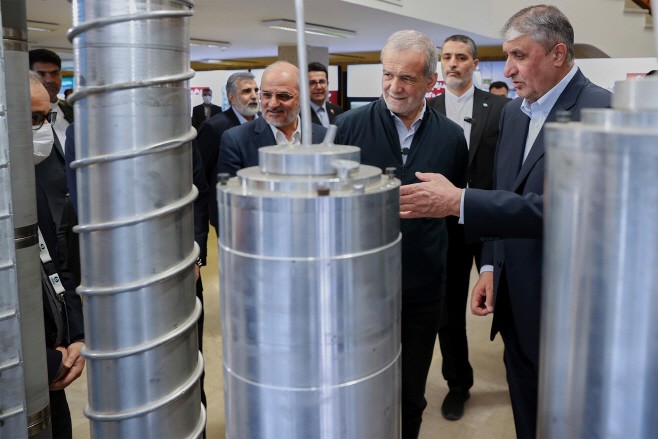 |
| Iranian President Masoud Pezeshkian (second from right) visits an exhibition showcasing Iran's nuclear achievements in Tehran, Iran, on April 9, 2025, while listening to an explanation from Mohammad Eslami, head of the Atomic Energy Organization of Iran. / Photo courtesy of Iranian Presidential Office, AP, Yonhap News Agency |
Iran reconstruction plan valued at $300 billion pursued
Article 6 of the MOU stipulates that the United States, in cooperation with regional partners, will establish a plan worth at least $300 billion for Iran's reconstruction and economic development. Under this provision, Washington will grant the necessary licenses, exemptions, and approvals for the associated financial transactions, with the specific implementation methods to be finalized during the negotiations over the next 60 days. Meanwhile, Article 11 allows Iran's frozen and restricted assets to be fully accessible upon the implementation of the MOU, though the concrete procedures for lifting the restrictions are to be agreed upon during the upcoming talks.
President Trump remarked that "the frozen assets of Iran do not belong to us; they are their money," adding that "at some point, we have to return them." He emphasized that "if we do not return them, no one will invest in the U.S. dollar." Regarding the reconstruction fund, he clarified that "the United States will not pay any money," noting that other nations could invest if Iran behaves correctly.
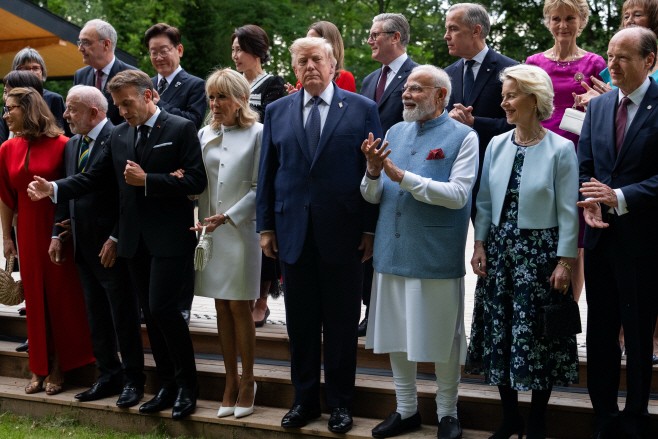 |
| South Korean President Lee Jae-myung and First Lady Kim Hye-kyung, alongside U.S. President Donald Trump, French President Emmanuel Macron, and First Lady Brigitte Macron, pose for a commemorative photo during the Group of Seven (G7) summit held in Évian-les-Bains, France, on June 16. / Photo courtesy of AP, Yonhap News Agency |
G7 welcomes MOU; US republicans push back, Israeli operations in Lebanon remain a wild card
The G7 leaders welcomed the agreement in a joint statement, emphasizing that "the negotiations must address regional Iranian threats and the non-acquisition of nuclear weapons."
While expressing support for the agreement, French President Emmanuel Macron voiced concerns regarding the potential resumption of clashes along the Lebanon front or Iran's possible attempts to impose transit fees in the Strait of Hormuz. Despite Article 1 of the MOU stipulating the cessation of military operations across all fronts, including Lebanon, Israel continues to assert its right to conduct operations against Hezbollah.
Backlash within the U.S. Republican Party was severe. Senator Bill Cassidy of Louisiana criticized the deal on social media, stating, "Before the war, the strait was open and Iran was crushed by sanctions. Now, 13 Americans are dead and the sanctions are lifted. This is the worst diplomatic blunder in decades." Former Vice President Mike Pence also pointed out that "there is nothing in this MOU that verifiably dismantles their nuclear weapons program."
President Trump expressed his gratitude to Chinese President Xi Jinping and Russian President Vladimir Putin for remaining neutral during the conflict, noting, "I asked President Xi not to provide shoulder-fired surface-to-air missiles to Iran, and as a result, he largely complied."
The official signing of the MOU is scheduled to be conducted by U.S. Vice President J.D. Vance and Iranian Parliament Speaker Mohammad Baqer Qalibaf on June 19 in Bürgenstock, Switzerland.
David Schenker, director of the Arab Politics Program at the Washington Institute for Near East Policy and former Assistant Secretary of State for Near Eastern Affairs during the first Trump administration, told AP, "This type of negotiation requires relentless focus, attention to detail, and the involvement of numerous technical experts." He further criticized, "Once Trump loses interest, he moves on, and so does the administration. They don't seem to understand the Iranian strategy."
Ha Man-joo
Most Read
-
1
Trump shares map on social media labeling Strait o..

-
2
Kia Sportage outperforms Mazda CX-5 in German auto..

-
3
Houthis launch successive attacks on Saudi airport..

-
4
U.S. deploys carrier, 10,000 more troops to Middle..

-
5
Trump rejects Iran's offer to open Strait of Hormu..

-
6
N. Korea conducts first swarm attack drill with dr..

-
7
U.S.-China summit falls short on substance as Trum..

PEOPLE






HEADLINE NEWS
- Seoul dismisses Ukraine's claim of 'S. Korean support for Russia' as "inaccurate and inappropriate"
- S. Korea, Japan race to develop nuclear-powered submarines
- Henri Kagan, Kenso Soai win Nobel Prize in Chemistry for uncovering how mol..
- Vance says Alaska LNG cooperation will move forward with Seoul's current or..

-
Address : In-Young Bldg., 34, Uisadang-daero 1-gil, Yeongdeungpo-gu, Seoul
Copyright by ASIATODAY CO., LTD. All rights resereved