



G7's global dominance is over, Chinese state media claims
Jun 21, 2026, 09:51 am


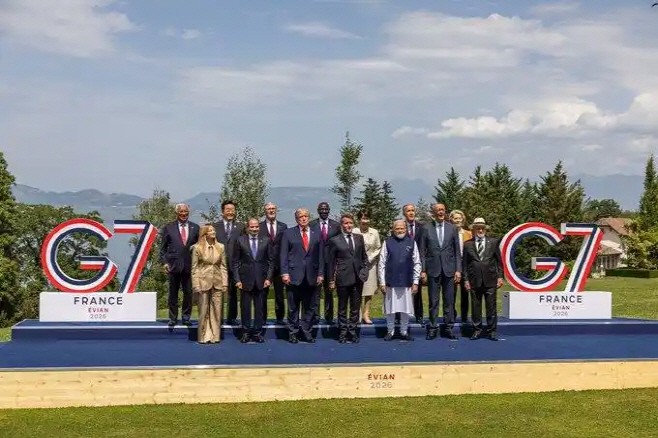 |
| The recent G7 Summit held in Evian, France, came under intense fire from Chinese state media. / Internet portal site Sina |
A Chinese state media outlet has claimed that the era when the U.S. and Europe-centered Group of Seven (G7) determines the global order is over, emphasizing that a 'more inclusive and representative body' will shape future global governance. China Daily, well-known as a state-run English-language media outlet, asserted in a commentary published on the 19th under the headline 'The era of G7 dominating the world is gone' that "over the past two decades, the G7's agenda has shifted from efforts to solve global issues to internal security concerns, geopolitical rivalries, trade disputes, and strategic competition."
The newspaper went on to argue that "development, poverty alleviation, and global public goods have been pushed to the periphery, while coordinating differences among allies has increasingly become the core task," further criticizing that "to make matters worse, this gathering appears incapable of resolving even those internal issues."
It also evaluated that "the U.S., which has long been regarded as the central axis of the G7, is facing trade disputes with Europe. It has even begun to question long-standing security commitments. Moreover, as it openly challenges its partners on various issues ranging from defense spending to industrial policy, the G7's ability to produce global outcomes is inevitably weakening."
Citing data from the International Monetary Fund (IMF), the daily pointed out that the economic scale of G7 nations accounted for 60% of global gross domestic product (GDP) in 2005, but has recently dropped to around 40%.
In addition, it stressed that "G7 members still rank among the most advanced nations in the world. However, the era when a small group of developed countries largely determined the direction of the international system through closed-door meetings has clearly passed," adding that "the world of 2026 is more multipolar, more interconnected, and more diverse." This can be interpreted as an argument that China refuses to recognize the G7's monopolistic leadership over the 'world order,' given that the G7's share of the global economy has shrunk over the past two decades while China's economic power has expanded. In fact, China's share of global GDP increased from about 7% in 2005 to around 18% last year.
This claim by the Chinese state media came right after the G7 set a goal at its recent summit in France to jointly respond to attempts to weaponize critical minerals such as rare earths. At the time, the G7 did not explicitly mention 'China.' However, it was interpreted as a move targeting China, which has recently exerted influence by restricting rare earth exports. The Chinese Ministry of Foreign Affairs also criticized the G7 for 'undermining the international trade order.'
Recently, China has been putting forward slogans such as 'an equal and orderly multipolar world' and 'a universally beneficial and inclusive economic globalization.' It is positioning itself as a new central axis against the U.S.-centered world order. China Daily's latest claim can be seen as an effort to actively support the legitimacy of Beijing's such moves.
Hong Soon-do
Most Read
-
1
Celltrion’s Omlyclo gains ground in major European..

-
2
Trump demands rates fall below 1% as Fed hikes for..

-
3
Trump makes $1 trillion bet ahead of midterm elect..

-
4
Iran resumes ballistic missile production, assembl..

-
5
Samsung Electronics, Mistral AI to jointly develop..

-
6
Trump warns countries not helping U.S. must pay re..

-
7
Seoul faces triple squeeze over troop deployment t..

PEOPLE







-
Address : In-Young Bldg., 34, Uisadang-daero 1-gil, Yeongdeungpo-gu, Seoul
Copyright by ASIATODAY CO., LTD. All rights resereved